Get Full Government Meeting Transcripts, Videos, & Alerts Forever!
Get email alerts on the Artificial Intelligence Governance topic
No spam. Unsubscribe anytime.
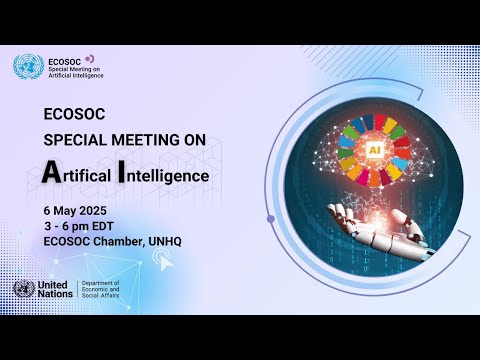
UN ECOSOC meeting urges global, inclusive AI governance and investment in capacity building
Summary
At a special ECOSOC meeting, UN officials, member states, private-sector and civil-society speakers called for coordinated global governance, new scientific review mechanisms, and large investments in capacity, compute and data to prevent an AI-driven inequality gap.
New York — Representatives at a United Nations Economic and Social Council special meeting on artificial intelligence called on member states, the private sector and international organizations on Thursday to coordinate governance, boost funding for capacity building, and ensure AI benefits reach the global majority.
The meeting brought together ECOSOC leadership, UN agency officials, national delegations and private-sector representatives to discuss how AI can advance the Sustainable Development Goals while limiting harms. "How can we make sure that artificial intelligence can be a force for good?" asked ECOSOC President Bob Rae in opening remarks, framing the session around inclusion and risk management.
Speakers repeatedly urged shared scientific and policy resources. Under‑Secretary Amandeep Singh Gill noted that "member states have agreed to establish an independent international scientific panel on AI" and to convene a global dialogue on AI governance, and said the Secretariat would prepare financing options to present to the General Assembly at its 79th session. Delegations and panelists described those three pathways as evidence building, regulatory interoperability and financing for capacity-building.
Why it matters: delegates said decisions made now will shape who captures AI's economic gains and who is left behind. Multiple delegations and experts cited wide gaps in infrastructure and compute: Gill pointed out that "all of Africa put together has less than a thousand GPUs," while one UN statement contrasted that with one private firm holding more than 250,000 GPUs. Participants warned those disparities risk cementing an "AI divide" that would widen existing global inequalities.
Panelists and member states proposed a mix of approaches. Civil‑society and academic speakers emphasized human‑rights and inclusion as central governance criteria. Dr. Rachel Adams, CEO of the Global Center on AI Governance, said rights‑based frameworks and country‑level assessments are essential and described the Global Index on Responsible AI as a tool for measuring progress. Private‑sector representatives including Chris Sharrock of Microsoft described investments in regional data centers and skilling programs and called for multistakeholder cooperation and interoperable data governance to sustain private investment.
Delegations from a wide range of regions endorsed the proposed UN processes. The European Union delegation highlighted the EU AI Act as an example of a risk‑based approach to regulation and said it supports the scientific panel and global dialogue. Several developing countries — including Kenya, South Africa, India, members of the African Union and smaller states — stressed the need for financing, talent development and affordable compute, and recommended South‑South cooperation and regional hubs.
Speakers gave concrete examples of AI use for development, and of risks requiring safeguards. Amandeep Singh Gill cited a mobile ultrasound system tested in Benin that diagnosed tuberculosis with 93% sensitivity as an example of life‑saving potential. Representatives from Malawi and Brazil described digital public infrastructure and registries that reduced fraud and supported environmental programs. At the same time, delegates and panelists warned about harms such as bias, disinformation and gender‑based abuse amplified by generative AI.
No formal votes were taken. Instead, the meeting focused on advancing implementation of commitments already referenced in UN processes: the Global Digital Compact and member‑state decisions endorsing a scientific panel, a global dialogue on governance and a Secretariat report on financing options. Several agencies and organizations announced or reiterated plans for capacity work: the UN Development Programme noted a forthcoming human development report on AI, the World Food Programme described an AI strategy for humanitarian response, and the ILO highlighted its observatory on AI and the world of work.
Speakers emphasized implementation details that will determine whether the initiatives benefit the global majority: investments in reliable connectivity and energy, lower‑cost or shared compute models, representative and high‑quality datasets, and locally led skills and research programs. Professor Jerry John Punyo of Kwame Nkrumah University of Science and Technology said national and regional strategies must be matched with recurring budget allocations for infrastructure, data and talent.
The meeting concluded with calls to maintain multistakeholder momentum across UN agencies and regions. Delegates signaled attention to upcoming forums and indicated support for turning the Global Digital Compact's concepts into operational programs. The ECOSOC president closed by underscoring cooperation across the UN system as central to meeting the challenge.
Ending: Participants said next steps include operationalizing the scientific panel modalities, launching the Global Dialogue on AI Governance, and delivering the Secretary‑General's report on voluntary funding options; those deliverables will provide the basis for technical work and financing conversations in the months ahead.