Get Full Government Meeting Transcripts, Videos, & Alerts Forever!
Get email alerts on the Zoning Variances Livestock topic
No spam. Unsubscribe anytime.
Cochise County Board of Adjustment approves two variances allowing reduced horse-corral setbacks and smaller lots with conditions
Summary
The Cochise County Board of Adjustment approved two applicant-initiated variances — BAR25-03 for a property near Benson and BAR25-04 for a property in Miracle Valley — allowing reduced setbacks for horse corrals and, in one case, a reduced minimum lot area. Both approvals include conditions requiring regular cleaning and a two-horse maximum.
The Cochise County Board of Adjustment approved two separate variances on Monday permitting reduced setbacks for horse corrals and placing conditions on animal care.
The board approved docket BAR25-03, an applicant-initiated variance for property at 1421 North Cemetery Road (Joseph Valentine, applicant), reducing the required 50-foot setback for a corral and corral shade structure along the south and west property lines (the staff recommendation reduced the south setback to 0 feet and the west setback to about 5 feet). The board also approved docket BAR25-04, for property at 10193 South Rainbow Ranch Road (Rhonda Jo Wilson, applicant), reducing the minimum lot area required to keep horses from 36,000 square feet to 23,522 square feet and allowing reduced corral setbacks along multiple property lines with a 7.5-foot setback for a shade structure along the east and west lines. Staff recommended both approvals with conditions including regular cleaning to limit odors and flies and a limit of no more than two horses on each property.
Why it matters: The two dockets highlight tensions common in rural Cochise County between long-established residential and hobby-livestock uses and county setback rules adopted in 1975. The board's decisions allow current owners to keep horses where they have been located on lots that are difficult to conform to setback rules while adding animal-welfare and nuisance-control conditions that staff said would reduce impacts to neighbors.
Staff presentation and public comment
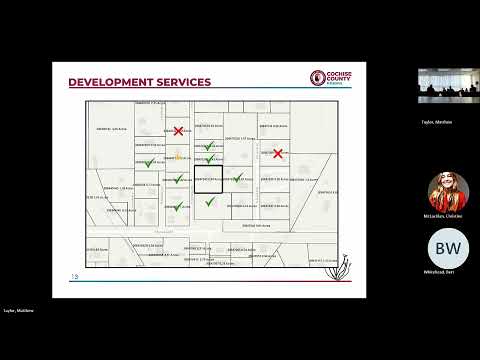
Matt Sherman, county planner, presented both staff reports and described the legal standard for a variance (the board must consider eight factors including hardship and whether the condition is self-created). For BAR25-03 Sherman said the R-18–zoned parcel at 1421 North Cemetery Road is roughly 1 acre, the corral area is approximately 2,400 square feet and the shade structure about 120 square feet, and that staff mailed 20 notices to nearby owners and received seven responses in favor and two in opposition. Sherman also said the closest residence to the corral is at least 60 feet away and that a stockade fence separates that house from the corral.
Applicant Joseph Valentine told the board the corral location has been in use for about 12 years and that nearby neighbors have not complained about odors or other problems. "The horse has been there in that location for 12 years, and never had a problem," Valentine said.
Neighbor Bridal Barnes opposed BAR25-03 in public comment, saying she had been told by the applicant that the dispute was with a different neighbor and that she did not know the corral was within the Cemetery Road setback. Barnes said some supporters changed their minds after receiving notices and that the variance "is totally against the zoning law." Barnes objected that allowing a zero-foot road setback could harm future buyers and neighbors.
For BAR25-04, Sherman described the lot as originally platted in 1968 (Miracle Valley Unit No. 3) with three street frontages that make a 50-foot setback for corrals difficult to meet. He said the corral area on the property totals about 9,600 square feet, that staff mailed 20 notices and received two opposing responses, and that the nearest residence to the BAR25-04 corral is more than 100 feet away.
Applicant Rhonda Jo Wilson described moving to the property three years ago and said she had believed the parcel was marketed as horse property. Wilson described several incidents she said involved a nonneighbor who had confronted her; she said she bought the house to be her "forever home" and asked the board for time to keep two elderly horses in place for the remainder of their lives. "This is my forever home," Wilson said. "I had no idea [about the setback]." Members of her neighborhood submitted support or told staff they had no problem with her keeping the horses.
Board action and conditions
In both dockets the board approved staff's recommendations. For BAR25-03 the board approved reducing the minimum required horse-corral setback from 50 feet to 0 feet along the south property line and to 5 feet along the west property line, and the shade-structure setback to 5 feet, subject to conditions recommended by staff including regular cleaning to control flies and odors and a limit of no more than two horses on the property.
For BAR25-04 the board approved reducing the minimum required site area to keep livestock from 36,000 square feet to 23,522 square feet, reducing horse-corral setbacks from 50 feet to 0 feet along the east, west and south property lines, and allowing a 7.5-foot setback for a corral shade structure along the east and west lines. That approval also carries the staff-recommended conditions that corrals be cleaned regularly to prevent odors and flies and that no more than two horses be kept on the property.
Votes at a glance
- Approval of minutes (prior meeting): voice vote; "Aye," motion carried. - Docket BAR25-03 (1421 N. Cemetery Road, Valentine): motion to approve with staff conditions — voice vote; "Aye," motion carried. - Docket BAR25-04 (10193 S. Rainbow Ranch Rd., Wilson): motion to approve with staff conditions — voice vote; "Aye," motion carried.
What the approvals do not do
The board’s approvals do not change the county’s definitions or zoning code text; they are site-specific variances that the board said should "remain in harmony with the zoning regulations." Sherman reminded the board that any approved variance cannot authorize use or activities that violate state or federal law and that property owners must still comply with other applicable local and state requirements. The board also left enforcement and follow-up to county staff; applicants were told they would coordinate with county planner Taylor for implementation and any required next steps.
Context and next steps
Both variances reflect a recurring issue for Cochise County: older, platted lots and long-standing animal-keeping practices that predate current setback rules. Staff said the lot configurations in these two cases constrained where corrals could be sited. The board attached operational conditions to both approvals aimed at reducing nuisance risks and protecting animal welfare.
Applicants were instructed to coordinate with county staff about the conditions. The board closed the public hearings and the meeting proceeded to other items.