Get Full Government Meeting Transcripts, Videos, & Alerts Forever!
Get email alerts on the Open Meeting Law topic
No spam. Unsubscribe anytime.
Lyon County trains advisory boards on Nevada open-meeting rules, serial communications and public-comment procedures
Summary
County staff led a training for citizen advisory boards covering Nevada's open-meeting statute, limits on private communications among members, agenda and posting requirements, public comment procedures, minutes and recordings, and how to cure or avoid violations.
Lyon County held a training session for citizen advisory boards that reviewed Nevada's open-meeting law and how advisory panels should run meetings to avoid violations. Staff emphasized that deliberations and decisions must occur in public and warned members against serial communications, unclear agendas and ad hoc actions outside noticed meetings.
"Just remember that the go-to all the time is that your decision is made openly and your deliberations are done openly," said Steve, a staff member leading the training, summarizing the session's central directive.
The training laid out why the rules matter: compliance protects public trust and prevents civil or criminal penalties. Staff reviewed key topics members encounter regularly, including what counts as a meeting, how quorums work and when advisory committees themselves are subject to the law.
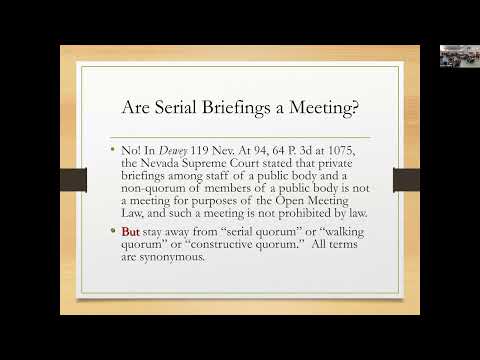
County staff explained that a quorum generally is a majority of board members (for example, three on a five-member board) and that two kinds of meetings frequently cause trouble: (1) informal "serial" communications where members exchange views by e-mail, social media or sequential conversations and (2) holding deliberative discussions about agenda subjects outside a properly noticed meeting. Staff cited the so-called Seminole matter and related attorney general guidance as examples in which private communications led to findings of violation.
Staff reinforced that a narrow exception exists for attorney-client communications but said most advisory-board interactions are not covered by that exception. They warned members that an innocuous "reply all" to an applicant's e-mail that includes multiple board members can produce a prohibited deliberation.
The training covered agenda and posting requirements in detail. County staff said agendas must state the date, time, place, contact, and a clear and complete description of each item so the public can understand what will be discussed. The county posts agendas to its website and the state public meeting portal and maintains a principal office posting; older practices that required multiple physical posting sites are no longer mandatory. Staff requested that advisory boards send draft agendas to county clerks five days before the posting deadline (eight working days before the meeting) so the county can review wording and post on time.
Public-participation rules were reviewed at length. Lyon County's advisory boards provide two public-comment periods (one at the start, one at the end of the meeting) and staff recommended allowing public comment on individual agenda items before votes. Time limits (commonly three to five minutes) are lawful, staff said, but chairs may allow speakers to finish at their discretion. Board members were told they may ask clarifying questions but should avoid engaging in a substantive back-and-forth with members of the public during comment in ways that constitute deliberation on matters not on the agenda.
On minutes and records, staff said one copy of the meeting packet and supporting materials must be available at the meeting for public inspection; recordings are retained for three years and minutes for five years. Minutes should contain date, time, location, attendance (including remote participants), substance of matters discussed, motions and votes, and, where requested, public remarks or attachments. If a board cannot approve minutes within the statutory timeframe, staff advised sending draft minutes to the county to post as drafts and later updating them when approved.
The presenters described how violations should be cured when discovered: raise the issue at the next meeting, reopen the item, allow public comment and take action openly rather than ignoring a problem. Staff noted past enforcement actions, including a Washington County School District matter where board members were fined after removing a superintendent outside a public meeting, and said attorney general opinions and prior case guidance are available online.
Staff also reviewed practical meeting management tips: cancel a meeting if no quorum is present (recommended practice, not strictly required), avoid copying all board members when circulating agenda drafts, keep social gatherings from becoming deliberative, and document postings. They advised that meetings held by teleconference or Zoom must provide two-way communication and that a 2021 change to state practice expressly allows remote participation but still requires a physical meeting location in some cases for elected bodies.
County staff urged advisory-board members to consult the county manager's office, the district attorney's office or the Nevada attorney general's open-meeting handbook for questions and to request help if they face possible violations.
Lyon County staff and clerks said they would continue to review agendas and support advisory boards with posting, record retention and procedural questions.