Get Full Government Meeting Transcripts, Videos, & Alerts Forever!
Get email alerts on the Stadium Funding topic
No spam. Unsubscribe anytime.
Senate committee hears plan to tap electronic pull-tab growth for US Bank Stadium capital needs; A1 amendment adopted, bill laid over
Summary
US Bank Stadium’s long-term capital needs, a request for $30 million toward a second phase of a permanent secured perimeter and a proposal to dedicate growth in electronic pull-tab revenue to stadium capital were the focus of a May 6 hearing before the Minnesota Senate Taxes Committee.
US Bank Stadium’s long-term capital needs, a request for $30 million toward a second phase of a permanent secured perimeter and a proposal to dedicate growth in electronic pull-tab revenue to stadium capital were the focus of a May 6 hearing before the Minnesota Senate Taxes Committee.
Mike Pekic, chair of the Minnesota Sports Facilities Authority, told the committee the authority oversees the state-owned stadium and is requesting short-term and long-term funding to “protect the state's asset and invest in safety enhancements.” He said a facility condition assessment completed in 2023 identifies roughly $300 million in preventative maintenance, repairs and capital projects over the next 10 years and that Phase 2 of the permanent secured perimeter is currently estimated at nearly $85 million.
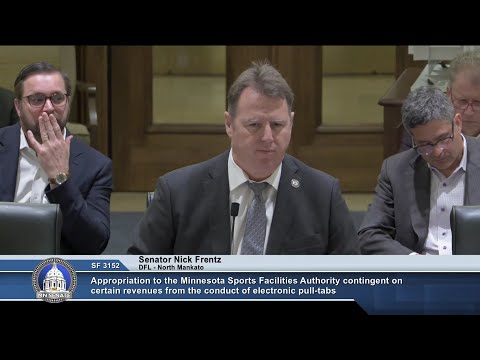
Senate File 3152, sponsored in committee by Senator France, proposes to direct any growth in combined net tax receipts attributed to electronic pull-tab (e-pull tab) revenue above a fiscal 2023 base year to the Minnesota Sports Facilities Authority for stadium capital up to a maximum of $20 million per fiscal year (the bill would adjust the maximum for inflation beginning in fiscal 2026). The bill also seeks $30 million in the current session for hardening the stadium perimeter, including additional anti-climb fencing, crash-rated barriers and bollards near the West side legacy gate, Medtronic Plaza and the Downtown East Plaza.
Why it matters: US Bank Stadium is a state-owned asset operated under the Minnesota Sports Facilities Authority (MSFA). Supporters told the committee the venue produces substantial economic activity — testimony cited more than 9 million visitors since opening, nearly 1,900 events, and major concerts — and argued a stable, predictable capital funding mechanism would avoid repeatedly returning to the Legislature for one-off capital requests.
Key testimony and details - Mike Pekic (chair, Minnesota Sports Facilities Authority) summarized the MSFA’s statutory duty to keep the stadium “in a first-class manner,” reviewed operating partners and funding streams (state, city of Minneapolis, Minnesota Vikings, ASM Global) and outlined the Phase 2 secured perimeter project and the broader 10-year capital forecast. - Brady Spencer (senior principal, Populous) described the 2022–23 facility condition assessment process — a visual inspection of architectural, structural, mechanical and audiovisual systems — and told the committee the stadium is in “very good condition” but will face normal and predictable life-cycle replacements that should be planned and budgeted for now. - Andrew Miller (chief operating officer, Minnesota Vikings) and Lester Bagley (executive vice president, Minnesota Vikings) said the Vikings contributed substantial up‑front capital to build the stadium and continue to pay significant operating and capital costs; they supported the bill’s pay‑as‑you‑go approach to protect the stadium’s long‑term condition without raising taxes. - Labor and business witnesses — including Dan McConnell (president, Minnesota Building and Construction Trades Council), Wade Lunenburg (political director, Unite Here Local 17), Adam Dunnick (president & CEO, Minneapolis Downtown Council) and Mike Logan (interim president & CEO, Minneapolis Regional Chamber) — urged support, saying stable funding preserves jobs, operations and downtown economic activity.
Funding mechanics discussed - The bill (as described in committee) would require the commissioner of revenue, in consultation with Minnesota Management and Budget, to calculate the increment in combined net tax receipts attributable to electronic pull tabs compared with fiscal 2023 and, if positive, appropriate that increment (up to the inflation‑adjusted $20 million cap) annually to the MSFA for capital. - The formula in the bill apportions the combined net receipts to electronic pull tabs by multiplying total combined net receipts by the ratio of net receipts from e-pull tabs to total lawful gambling net receipts. - Committee members asked technical questions about the revenue estimate; committee staff noted the estimate shows dormancy in some years (projected zeros in FY28–29 in the document provided) because forecasts for those years fall below the bill’s threshold. Madeline Herr (legislative coordinator, Minnesota Department of Revenue) said she would follow up with the committee after consulting tax research staff.
Policy and stakeholder concerns - Several senators and witnesses emphasized the need to coordinate with charitable gambling organizations. Testimony acknowledged that 2023 changes to e-pull-tab law reduced some charities’ revenues and several senators said they want any funding change to protect or consider charitable gaming groups. - Senators also discussed city contributions and the mix of state, city, and private funding for the stadium. Senator Dibble and others said the city of Minneapolis has existing sales-tax streams that have been redirected to the stadium in the past and suggested continued conversations with the city about an appropriate funding mix.
Votes and committee action - The committee adopted an A1 amendment on Senator France’s behalf; Senator Dibble moved the amendment on the floor and the chair said, “the motion prevails and the amendment is adopted.” (The transcript records a voice vote; no roll-call tally was recorded in committee.) - Senate File 3152 as amended was laid over for further consideration; the chair announced the bill is "laid over" and that the committee will take additional testimony and consider the larger Senate tax bill later in the week.
Discussion vs. decision - Discussion only: Most testimony and committee questioning were informational (facility assessment results, long‑term capital forecast, and technical explanation of the proposed revenue allocation). Several senators asked for further information from the Department of Revenue and noted outstanding conversations with charitable gambling groups and the city of Minneapolis. - Direction/assignment: Department of Revenue agreed to provide further explanation of the revenue estimate to the committee. - Formal action: adoption of the A1 amendment; the bill was laid over (no final passage or committee recommendation recorded).
Ending note: Senator France closed by urging a long-term funding approach, saying, “If we're not gonna fund the stadium's ongoing needs this way, what do you wanna do?” The committee laid Senate File 3152, as amended, over for later action and signaled follow-up on revenue and stakeholder concerns.
Votes at a glance: - A1 amendment to Senate File 3152 — moved by Senator Dibble; voice vote recorded; outcome: adopted. - Senate File 3152 (as amended) — laid over for further consideration (no committee vote to advance taken at the hearing).