Get Full Government Meeting Transcripts, Videos, & Alerts Forever!
House passes human services finance bill after tense debate over nursing-home board and county cost-sharing
Summary
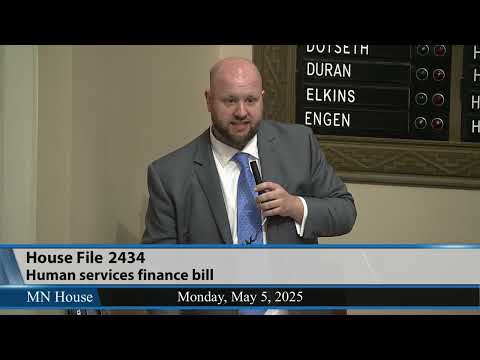
The Minnesota House passed House File 2434, a human services finance bill, after a lengthy floor debate and multiple roll-call amendments. The bill, described on the floor as the committee’s budget package for human services, was approved 109–25 on third reading.
The Minnesota House passed House File 2434, a human services finance bill, after a lengthy floor debate and multiple roll-call amendments. The bill, described on the floor as the committee’s budget package for human services, was approved 109–25 on third reading.
Lawmakers said the bill was written to meet a committee target of $1.3 billion in reductions over four years while protecting and prioritizing funding for nursing homes, behavioral health, homelessness programs and program integrity. "This is the Human Services finance bill, our budget bill for the year," Representative Schumacher said on the floor as he outlined the measure.
The bill bundles multiple policy areas: an aging-services article that updates nursing-home case-mix rules to a federally required patient-driven payment system and applies a statewide bed surcharge; disability-service reforms that tighten documentation and narrow the kinds of rate-exception payments that qualify and require a county share for certain exceptions; behavioral-health provisions that create a state-managed certification for recovery residences and increase substance-use-disorder rates; program-integrity and background-study expansions; and direct-care and treatment (DCT) investments including $5 million for health record systems and $1.2 million for demolition of the Miller building at the Anoka Metro Regional Treatment Center.
Key provisions and figures mentioned on the floor include a $1.3 billion committee reduction target, an estimated $400 million annual line for early intensive developmental and behavioral intervention (EIDBI) services, a proposed county share of one-third for some rate exceptions, a 24-month commissioner authority to impose a moratorium on new provisional EIDBI licenses, an ongoing $5 million DCT health-record fund, and reinstatement of TEFRA parental fees for families above 675 percent of the federal poverty guidelines (a cited example: roughly $217,000 annual income for…
Already have an account? Log in
Subscribe to keep reading
Unlock the rest of this article — and every article on Citizen Portal.
- Unlimited articles
- AI-powered breakdowns of topics, speakers, decisions, and budgets
- Instant alerts when your location has a new meeting
- Follow topics and more locations
- 1,000 AI Insights / month, plus AI Chat