Get Full Government Meeting Transcripts, Videos, & Alerts Forever!
Get email alerts on the Human Services Budget topic
No spam. Unsubscribe anytime.
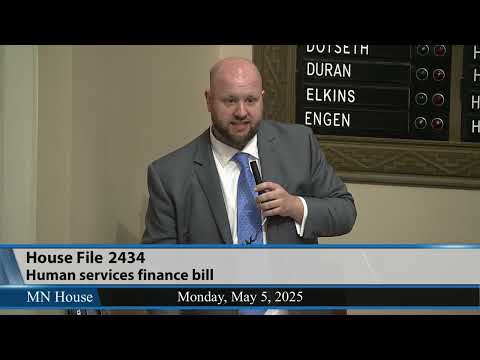
House passes human services finance bill after tense debate over nursing-home board and county cost-sharing
Summary
The Minnesota House passed House File 2434, a human services finance bill, after a lengthy floor debate and multiple roll-call amendments. The bill, described on the floor as the committee’s budget package for human services, was approved 109–25 on third reading.
The Minnesota House passed House File 2434, a human services finance bill, after a lengthy floor debate and multiple roll-call amendments. The bill, described on the floor as the committee’s budget package for human services, was approved 109–25 on third reading.
Lawmakers said the bill was written to meet a committee target of $1.3 billion in reductions over four years while protecting and prioritizing funding for nursing homes, behavioral health, homelessness programs and program integrity. "This is the Human Services finance bill, our budget bill for the year," Representative Schumacher said on the floor as he outlined the measure.
The bill bundles multiple policy areas: an aging-services article that updates nursing-home case-mix rules to a federally required patient-driven payment system and applies a statewide bed surcharge; disability-service reforms that tighten documentation and narrow the kinds of rate-exception payments that qualify and require a county share for certain exceptions; behavioral-health provisions that create a state-managed certification for recovery residences and increase substance-use-disorder rates; program-integrity and background-study expansions; and direct-care and treatment (DCT) investments including $5 million for health record systems and $1.2 million for demolition of the Miller building at the Anoka Metro Regional Treatment Center.
Key provisions and figures mentioned on the floor include a $1.3 billion committee reduction target, an estimated $400 million annual line for early intensive developmental and behavioral intervention (EIDBI) services, a proposed county share of one-third for some rate exceptions, a 24-month commissioner authority to impose a moratorium on new provisional EIDBI licenses, an ongoing $5 million DCT health-record fund, and reinstatement of TEFRA parental fees for families above 675 percent of the federal poverty guidelines (a cited example: roughly $217,000 annual income for a family of four).
Contentious floor debate centered on powers and structure of the nursing home workforce standards board and on proposals that members said would shift costs to counties. Representative Zalesnikar offered an amendment (a7) to require two-thirds support within each of the board’s three membership categories before the standards board could adopt policy; proponents argued it would guarantee cross-stakeholder buy-in, while opponents said it would create a de facto veto and stall the board’s work. The amendment was decided by roll call and failed on a 67–67 tie.
A separate amendment (a17) that would have required legislative approval of workforce-board decisions tied to costs also failed on a 67–67 tie. Multiple members warned that changes limiting the board’s authority could produce unintended consequences for nursing-home operations; others argued the board currently can act without sufficient input from operators or counties.
Counties and rate exceptions: Several members raised concerns that changes to the disability waiver system and the proposed county share for some rate exceptions would increase local property taxes and obligations for county governments. Representative Gilman’s amendment (a13) would have reduced a planned county operating adjustment intended to offset some county costs; the motion was decided by roll call and did not prevail (67–67). Supporters of county relief warned the shift could produce double-digit levy increases in some counties; supporters of the bill’s approach said the state must rein in rapidly growing rate-exception spending and add accountability and documentation for exceptions.
Other amendments and floor actions: The House adopted several amendments on voice votes that sponsors described as technical fixes or targeted program clarifications, including a technical cleanup amendment (a9) and an amendment (a14) that clarified how state senior-nutrition dollars may be used to permit more local flexibility in partnerships and spending (sponsor: Representative Perriman). An amendment (a15) extending the expenditure period for an unspent appropriation to support “supported decision making” was adopted. Representative Nadeau withdrew an amendment (a16) to add $500,000 for building capacity for a collaborative psychiatric care model after negotiations with committee chairs. Representative Curran’s amendment (a11) addressing MNChoices assessment backlog language was adopted. Attempts to remove funding for the triennial Wilder Foundation homeless study and redirect $900,000 into housing support (a12) failed on a 67–67 tie; sponsors argued Wilder’s balance meant the study could be privately funded, while opponents said the Wilder study is the state’s long-standing public data source on homelessness.
A separate tax-contingent amendment (a18) proposing a millionaire surtax to replace possible federal Medicaid cuts was introduced and subsequently withdrawn by its sponsor. Several other amendment motions were withdrawn by sponsors after discussion.
Floor discussion emphasized competing priorities and difficult trade-offs. Supporters of the House package said the bill advances nursing-home funding, increases substance-use-disorder rates, invests in DCT capacity and strengthens program integrity while meeting the committee’s budget target. Critics said the plan cuts or shifts costs in ways that will affect people with disabilities, counties and local taxpayers and warned the state has added new agencies and staff in recent years while now reducing services for vulnerable Minnesotans.
The bill passed on third reading by a recorded vote of 109 yays to 25 nays and now moves to conference with the Senate.
Votes at a glance (selected floor actions): - Motion: Adopt HF2434 as amended — Final passage (budget_adoption). Tally: 109 yes, 25 no. Outcome: approved. - Amendment A9 (technical cleanup) — Mover: Representative Schumacher; Second: Representative Grossman; Outcome: adopted (voice vote). - Amendment A14 (senior nutrition flexibility) — Mover: Representative Perriman; Second: Grossman; Outcome: adopted (voice vote). - Amendment A15 (extend supported decision-making appropriation) — Mover: Representative Nadeau; Second: Grossman; Outcome: adopted (voice vote). - Amendment A16 (collaborative care $500,000) — Mover: Representative Nadeau; Outcome: withdrawn by sponsor. - Amendment A11 (MNChoices assessment backlog language) — Mover: Representative Curran; Second: Grossman; Outcome: adopted (voice vote). - Amendment A7 (two-thirds-in-category rule for nursing home standards board) — Mover: Representative Zalesnikar; Second: Grossman; Tally: 67 yes, 67 no; Outcome: failed. - Amendment A17 (require legislative approval for certain workforce-board cost/policy changes) — Mover: Representative Baker; Second: Grossman; Tally: 67 yes, 67 no; Outcome: failed. - Amendment A13 (reduce county share shift / restore operating adjustment) — Mover: Representative Gilman; Second: Grossman; Tally: 67 yes, 67 no; Outcome: failed. - Amendment A12 (remove Wilder study funding and move $900,000 to housing support) — Mover: Representative Franzen; Second: Grossman; Tally: 67 yes, 67 no; Outcome: failed. - Amendment A19 — Mover: Representative Franzen; Outcome: withdrawn. - Amendment A18 (contingent millionaire surtax to backfill federal Medicaid cuts) — Mover: Representative Gomez; Outcome: withdrawn by sponsor.
What to watch next: HF2434 proceeds to conference committee with the Senate. Conference negotiations are likely to address the county rate-exception share, nursing-home implementation details tied to the workforce standards board, homelessness and housing funding choices, and any opportunities to reverse or soften the bill’s larger cuts or shifts.
Quotes used in this story are taken from floor remarks recorded in the House transcript and are attributed to speakers as identified in the transcript.