Get Full Government Meeting Transcripts, Videos, & Alerts Forever!
Get email alerts on the Traffic Safety Enforcement topic
No spam. Unsubscribe anytime.
Carlsbad police: no fatal collisions in Q1; enforcement, hit‑and‑run solvability and e‑bike rules highlighted
Summary
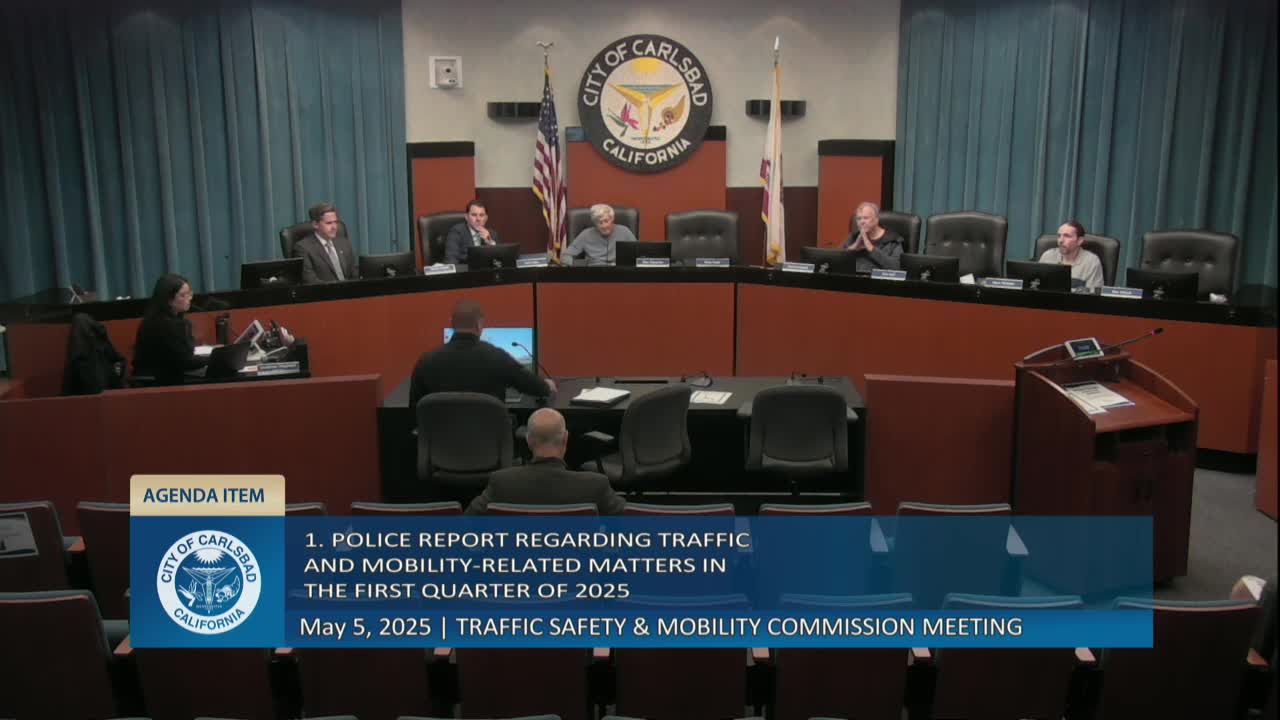
Lieutenant Jason Arnotti of the Carlsbad Police Department presented the department’s first‑quarter traffic report, reporting zero fatal collisions and outlining enforcement activity, collision trends and upcoming initiatives.
Lieutenant Jason Arnotti of the Carlsbad Police Department presented the department’s first‑quarter traffic safety and mobility report to the Traffic Safety and Mobility Commission, reporting no fatal collisions and outlining enforcement activity, collision breakdowns and upcoming enforcement programs.
The report, covering the first quarter of 2025, showed zero fatal collisions, four major injury collisions, 79 minor‑injury collisions and 87 non‑injury collisions; officers also handled about 120 additional traffic‑related incidents for which no formal collision report was taken. Arnotti said parking citations increased “noticeably” this quarter, attributing the rise to improved staffing and restoration of an automated license‑plate‑reader system.
Why it matters: the data guide the police department’s deployment and enforcement strategy. Arnotti said collisions concentrate along major arterials and intersections and that speeding, unsafe turns and right‑of‑way violations remain the most common primary factors. He described enforcement efforts this quarter that included a DUI saturation patrol funded by the Office of Traffic Safety, distracted‑driving details and bicycle safety outreach with the Carlsbad Unified School District.
Key details from the presentation: officers made 21 officer‑initiated DUI arrests this quarter (a decline Arnotti linked to temporary staffing changes); the department conducted 2,523 traffic stops; provided three bicycle and e‑bike safety presentations (one with the Carlsbad Unified School District attended by more than 100 students and parents); and issued “over a hundred” citations for speeding, cell‑phone use and related violations. The department reported a 41% resolution rate on hit‑and‑run investigations, which Arnotti said is well above the national average and attributable in part to license‑plate‑reader use.
Arnotti cautioned that some categories are underreported or limited by data systems: non‑injury collisions are not always required to be formally reported and are not entered into the department’s Crossroads collision database, which constrains spatial analysis. He also explained how the primary collision factor is recorded: investigators select one primary factor on the collision report based on the totality of circumstances, such as skid‑mark measurements and witness statements.
On policy and forthcoming initiatives, Arnotti said the department is preparing for a “Click It or Ticket” seat‑belt campaign, expanded DUI enforcement operations and a community bicycle safety event. He also said staff are coordinating with the transportation department on Assembly Bill 43 and stand ready to assist the commission on an item described in the presentation as “Assembly Bill 2,234,” which the department characterized as an item restricting e‑bike use by children age 12 (the department said only San Diego County municipalities are part of a pilot referenced earlier). Arnotti said the department used Office of Traffic Safety grant funds this quarter to send four officers to advanced DUI training.
Questions from commissioners focused on how primary collision factors are assigned, whether collision types have been correlated with roadway widths and why DUI counts varied quarter to quarter; Arnotti said primary factors are assigned by investigating officers and that narrower roadways have not yet been correlated to broadside collisions in the presented analysis but that staff could pursue such a geographic analysis with transportation staff.
The presentation included caveats about small sample sizes in some modal breakdowns (for example e‑bike or pedestrian collisions) and recommended measuring trends across multiple reporting periods rather than from isolated quarter‑to‑quarter changes.
Ending: Commissioners did not take action on the report; they asked staff to clarify certain statistics in future reports, including further breakdowns of primary collision factors and possible correlations between collision types and roadway geometries.