Get Full Government Meeting Transcripts, Videos, & Alerts Forever!
Get email alerts on the Capital Improvement Plan topic
No spam. Unsubscribe anytime.
Eagan unveils $166 million CIP, flags North Water Treatment Plant rehab and utility rate increases
Summary
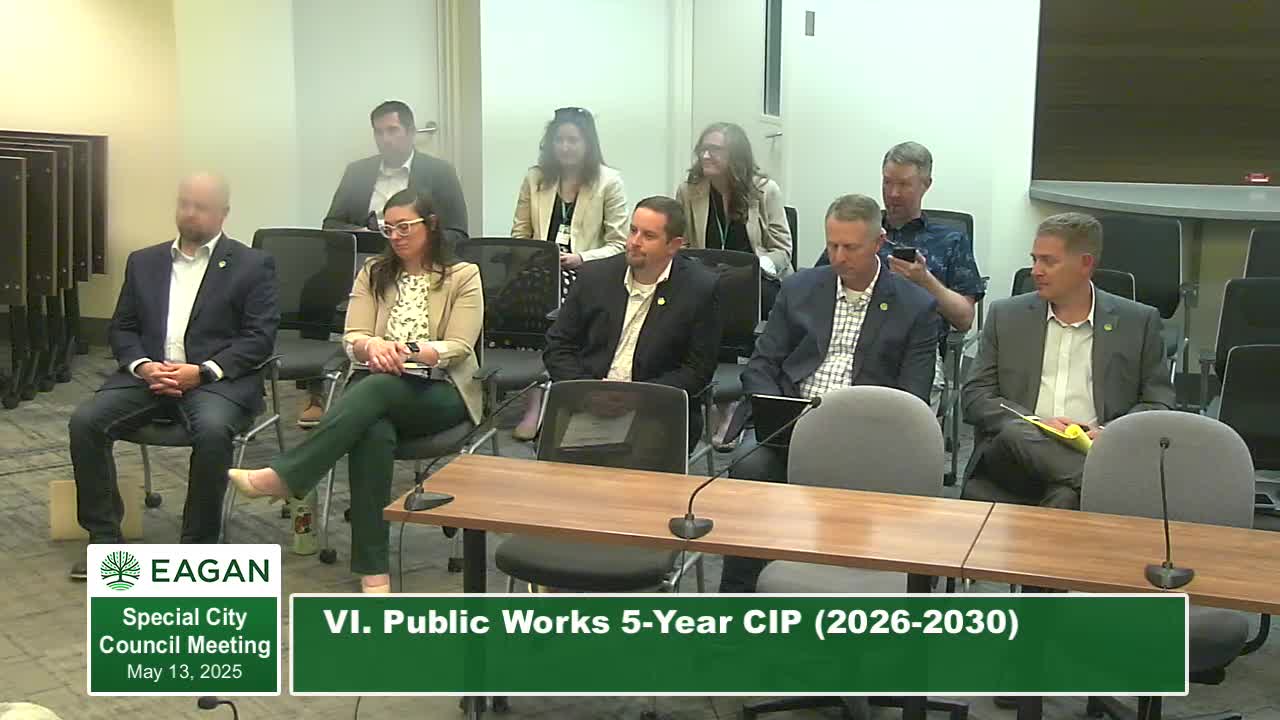
City public works staff presented a $166 million, fully funded capital improvement plan for 2026'2030 at a May 13 workshop, highlighting water treatment-plant rehabilitation, sewer trunk maintenance, trail projects tied to Dakota County, and proposed utility-rate increases and annual bonding.
City public works staff presented a multi-year capital improvement plan (CIP) at the May 13 special council meeting that covers 2026 through 2030, totals about $166 million in project costs, and includes roughly $100 million of city-funded expenditures with the balance financed by county, state, federal or private partners.
Major items and funding tools: Staff highlighted several major projects and funding approaches in the CIP presentation. Notable items included: a planned North Water Treatment Plant filter rehabilitation (staff estimated roughly $3.2 million for the filter replacement and associated work); sanitary and trunk-sewer lining and repairs (Fish Lake area trunk work and lining of larger-diameter pipes); upgrades related to the Greenway and Argenta Trail (many trail costs will be paid by Dakota County); Yankee Reservoir rehabilitation; and several arterial and local street investments. The presentation also noted developer-built Opperman Drive will be included in the CIP as an asset even though initial construction costs are paid by the developer.
Staff described financing tools the city intends to use across the CIP: annual bonding for capital projects, continued utility-rate adjustments and use of available fund balances. Staff said they were proposing a utility-rate increase of 9.25% for the next year as part of the plan to maintain utility fund balances and meet infrastructure needs. Bonding would be used each year to spread costs to future beneficiaries and help preserve fund balances.
Why it matters: The CIP frames multiyear capital needs and how the city will pay for them, with significant utility and street investments that will affect rates, bonding and the major street fund. Staff noted that construction costs are modeled with a 4% annual inflation factor and that staff has started showing design and property-acquisition expenditures in the year they are expected to occur (often a year before construction) to improve fiscal transparency.
School, safety and grant programs: Staff reported a $100,000 federal planning grant to prepare a Safe Streets and Roads for All action plan; the plan will identify safety needs across city, county and state roads and later support grant applications for construction funding. Staff also described a joint study with Independent School District 196 (the district and city would split a $130,000 study cost, with the district covering certain site-specific school recommendations) to evaluate traffic safety at most district schools and coordinate improvements with school and city capital projects.
Next steps: Staff will present the CIP for formal council action at a future meeting (staff indicated June 3 as the next substantive council date for related pavement-management and assessment policy decisions). The city will continue to refine project timing, coordinate with Dakota County and the school district where appropriate, and bring specific project approvals and financing plans back to the council.