Get Full Government Meeting Transcripts, Videos, & Alerts Forever!
Get email alerts on the Pavement Management topic
No spam. Unsubscribe anytime.
Eagan staff to pursue 80-year pavement life cycle; council backs moving toward 100 years and exploring curb-and-gutter assessments
Summary
City staff presented an analysis to the Eagan City Council on May 13 proposing an 80-year pavement life-cycle (with an objective to move toward 100 years) and a change in the city's special-assessment policy to include curb-and-gutter costs.
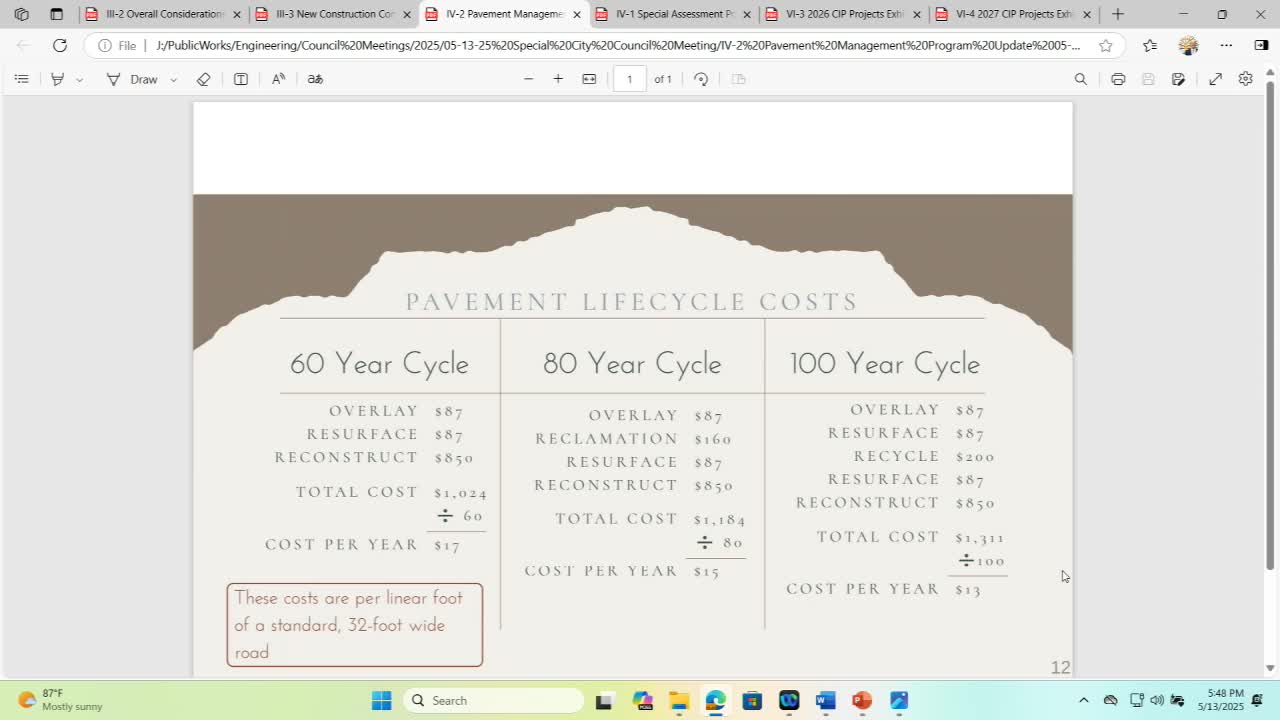
City staff told the Eagan City Council on May 13 that changing pavement management assumptions could reduce annualized street costs and that the council should consider two related policy changes: adopting a longer pavement life cycle (staff recommended 80 years, with an objective to move toward 100 years) and revising the special-assessment policy to include concrete curb-and-gutter costs in assessable project costs.
Staff explained that Eagan currently uses a 60-year pavement life-cycle assumption for streets (with routine overlays and maintenance at roughly 20-year intervals to achieve that lifecycle) and that modeling showed spreading pavement costs over 80 or 100 years reduces annualized cost by shifting the type and timing of interventions (for example, reclaiming/fully removing bituminous surfacing at intermediate points rather than repeated small overlays). Staff emphasized the need to coordinate any change with underground utility life cycles and with streets that are already partway through an existing life cycle.
Public works staff proposed that the council direct staff to prepare a formal change in the pavement management program to an 80-year life-cycle and to plan opportunistically to achieve a 100-year target where feasible. Staff said a formal council action on the pavement-management schedule could come at the June 3 meeting.
Assessment policy: Staff also reported that Eagan historically has not included curb-and-gutter replacement in project assessable costs while many peer cities do. Staff presented a historical estimate showing that if curb-and-gutter costs had been included on projects from 2019'24, the city would have collected, on average, about $620,000 additional assessment revenue per year. Under current practice, residential assessments cover 50% of asphalt costs for overlay projects; the proposed change would add concrete curb-and-gutter into the assessable base and continue to apply the council's percentage assessments (staff described spreading curb-and-gutter cost across a project rather than charging homeowners only for the portion replaced).
Why it matters: Extending a pavement life-cycle and broadening assessable costs are two levers staff identified to address projected declines in the major street fund while the city faces more street maintenance needs. Council members asked for apples-to-apples comparisons over the same multi-decade horizon; staff responded that, when modeled over a long common period (for example, 240 years), an 80-year cycle reduces lifecycle costs relative to repeated 60-year cycles and that a 100-year approach yields still larger long-term savings, though the near-term transition and timing of interventions vary by street segment.
Council reaction and next steps: Council members generally signaled support for pursuing an 80-year pavement life-cycle with a goal of moving toward 100 years where practical. Staff said it would return to the June 3 council meeting with a formal pavement-management-program revision and additional implementation details. Separately, staff said it will bring policy language to the council to amend the special assessment policy to include curb-and-gutter costs for future projects; the change would increase assessments for affected projects and would be considered by the council before implementation. The meeting record shows no final ordinance or resolution was adopted on May 13; both measures were presented as staff recommendations and next-step directions.