Get Full Government Meeting Transcripts, Videos, & Alerts Forever!
Get email alerts on the County Budgets topic
No spam. Unsubscribe anytime.
Alachua County constitutionals present continuation budgets; sheriff seeks pay and staffing increases
Summary
Constitutional officers presented FY25–26 continuation budgets at an Alachua County special budget meeting May 6, 2025. Most requested only routine funding; notable exceptions included the public defender’s IT increase and the sheriff’s multi-year pay and staffing plan.
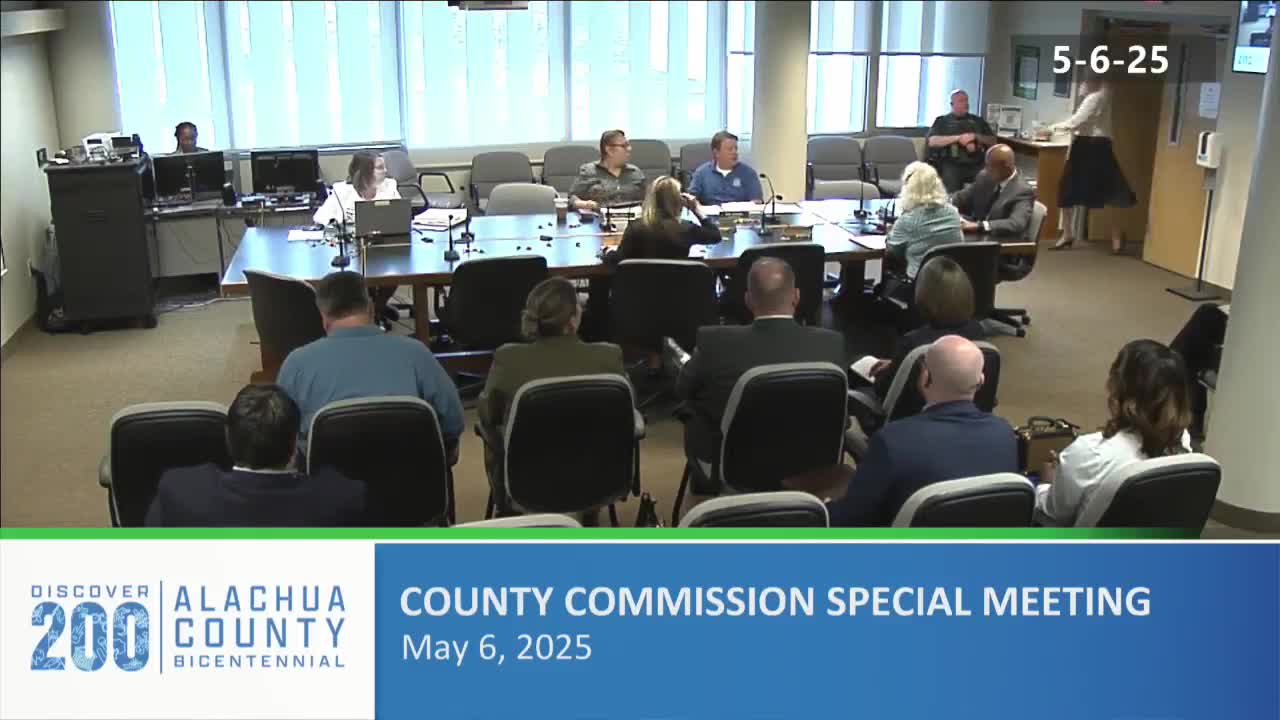
Court Administrator Michael Reeves and other constitutional officers presented their FY25–26 continuation budgets at an Alachua County Board of County Commissioners special budget meeting on May 6, 2025, focusing mainly on maintaining current services while flagging several upcoming cost pressures.
The meeting opened with routine approval of the agenda. Most offices said they were submitting continuation budgets but flagged specific increases they expect next year or asked the board to consider targeted additions now.
The public defender’s office told commissioners it is seeking an increase to cover sharply higher vendor fees for its case-management software (CIP) and to acquire video‑analysis software (Axon) that staff said would speed review of body‑worn- and surveillance-video evidence. The office said the CIP contract price is rising substantially (the transcript records an increase of about 88%), and the request includes roughly $38,000 that would be billed to other counties in the circuit. The office described the request as an investment expected to stabilize costs over a multi‑year contract and to reduce other budget pressures such as transcript costs and personnel time.
Rebecca Schimpach, introduced as the new executive director in the State Attorney’s Office, said that office is currently a continuation budget but is absorbing similar vendor cost pressures and has deployed a comparable electronic evidence tool using replacement‑fund resources. She told the board the next budget cycle may require a formal request to cover those software costs.
Tax Collector staff reported a net reduction in their overall budget as loan payments for the newly constructed Northwest Service Center will end in August, freeing nearly $1 million annually to return to taxing authorities. The office said its operating expenses will fall by more than $500,000 in the coming year and that it supports the manager’s 4% pay adjustment and a projected 2% health‑insurance increase. The tax collector also discussed kiosk rollouts in two Publix locations: current use is about 300 transactions per month with a target of about 1,000 monthly; the vendor needs roughly 800 monthly transactions for the kiosks to be viable (vendor fee cited at $3,600/month); a merchant convenience fee was reported as $4.50 per kiosk transaction.
The property appraiser’s office asked for a 4% budget increase driven in part by a plan to open a satellite office in Newberry and requested two entry‑level positions to staff that office. The appraiser said the request responds to new home growth on the county’s western side.
The supervisor of elections reported that a vendor that hosted county websites for multiple supervisors of elections has announced it will stop that service before year‑end, which will create an unbudgeted cost the office is trying to absorb for now. The office also requested budget funds to buy deployable check‑in stations for polling places and additional pallet racking to store legally required paper records.
Clerk of Court leadership asked the board to match the county’s proposed 4% cost‑of‑living adjustment for county‑funded clerk positions and explained adjustments to accounting lines to reduce transfers among clerk staff when paying employee insurance and retirement costs.
Property‑level detail and collaboration items drew commissioner comments: several commissioners praised cross‑office cooperation on probate and estate‑planning outreach and asked constitutional officers to engage with the county’s Forward Focus initiative for the eastern part of the county.
Sheriff Scott presented the largest set of staffing and pay proposals. The sheriff said the budget includes a 4.52% increase for non‑ranking deputy sheriff starting pay (the transcript reports a rise "from 55, thousand $14 to $57.05") and set a multi‑year target of a $60,000 starting salary in FY 2026–27 and $62,000 in FY 2027–28. The sheriff requested roughly 6.5 FTEs (the transcript described multiple additions and conversions): two additional mental‑health co‑responder deputies (bringing the unit to four dedicated mental‑health correspondents), one community service deputy, one crime analyst (to increase analytical capacity), a digital evidence specialist, a building maintenance specialist, conversion of a part‑time audio‑production specialist to full time, a part‑time fleet administrative specialist and other support positions. The sheriff’s office also described rising vendor and contract costs for medical/health services in the jail, an expected rise in Florida Retirement System employer rates, and a requested technology initiative described as a “real‑time crime center” to integrate data, video and analytics for faster operational response.
No formal budget items were voted on at the meeting. Commissioners asked questions about staffing, collaboration among jurisdictions on speed‑camera enforcement, the central receiving facility for mental‑health care and the sheriff’s evidence‑storage needs. Staff said space for an evidence‑storage expansion is identified and that initial moves would be funded within the current budget while final outfitting and capital costs are planned with county staff.
The meeting concluded after each constitutional office presented; commissioners and staff praised cross‑office cooperation and customer service in several front‑facing offices.
Votes at a glance: The meeting recorded a single formal motion — approval of the meeting agenda — which was adopted by voice vote. No roll‑call or named vote tally for subsequent budget presentations was taken and no appropriation votes occurred during this session.