Get Full Government Meeting Transcripts, Videos, & Alerts Forever!
Get email alerts on the Transportation Infrastructure topic
No spam. Unsubscribe anytime.
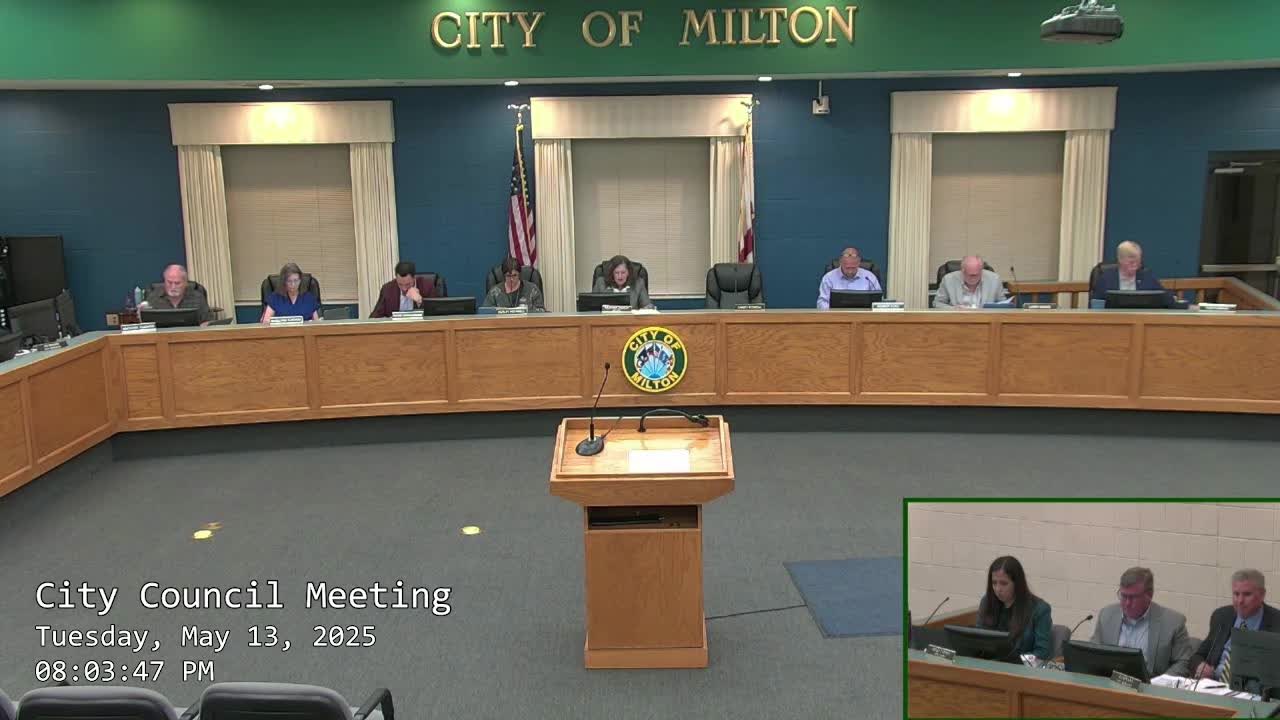
Milton council backs request to add US‑90 corridor to Florida strategic intermodal system, 5‑2
Summary
The Milton City Council voted 5‑2 on May 13 to ask state transportation officials to add a segment of U.S. 90 and connecting roads to Florida's Strategic Intermodal System, a move the mayor said is intended to make the corridor eligible for higher‑priority funding for widening and a bridge project that serves NAS Whiting Field.
The Milton City Council voted 5‑2 on May 13 to ask state transportation officials to designate a segment of U.S. 90 and connecting roads as part of Florida's Strategic Intermodal System (SIS) to seek higher priority for funding to widen the road and address capacity and safety problems that affect access to Naval Air Station Whiting Field.
Mayor Heather Lindsay said the resolution was "simply a means to an end of escalating our importance so that we can access funding that is currently not available to us." The mayor told the council the request would allow Milton to seek higher priority for right‑of‑way and construction funding that staff and regional partners say are not currently programmed.
Why it matters: The corridor covered by the resolution runs from State Road 87 north of Interstate 10, west on U.S. 90 to State Road 89 (Dogwood) and north on Dogwood to NAS Whiting Field. Council and staff said the corridor currently operates at a failing level of service as measured by FDOT and the Florida‑Alabama Transportation Planning Organization, and that right‑of‑way funding for bridge widening and four‑laning has not been programmed. City officials said moving the corridor into the SIS could increase the chances of getting funding sooner than waiting on the non‑SIS project priority list.
Discussion and public comment centered on process and design. Several residents urged the council not to act without seeing design drawings or fuller public review; others said the city should pursue any path that speeds up improvements. Vernon Compton, a Milton resident who helped organize a local design charrette, said the charrette produced a four‑lane concept that "protects our historic character," and urged the council to insist FDOT honor that approach. Howard Steele, another resident, objected to what he described as a last‑minute push and said he wanted more evidence that the Department of Defense requires the route for Whiting Field access.
Council members split on whether to proceed immediately. Councilman Powers moved the resolution and Councilman McKee seconded. Powers, McKee, Councilwoman Fretwell, Councilwoman Farrow and Councilman Cusack voted yes. Councilman Hawthorne and Councilman Leake voted no. The city attorney read the resolution into the record as "Resolution 25‑09, resolution of city council, the city of Milton to request designation as part of the strategic intermodal system" in support of the military mission at NAS Whiting Field.
Design status and historic site questions: City staff told the council FDOT's project development and environment (PD&E) work is roughly 30% complete and that the current 30% design routes a bridge replacement through the Fisher Hamilton Building, a locally important historic property that residents and the charrette study recommended protecting. The charrette proposed a separate pedestrian and bicycle bridge and a narrower four‑lane roadway to limit impacts to the historic building, but staff said funding to move the Fisher Hamilton Building no longer exists. That gap—plus unresolved right‑of‑way funding—were cited by both supporters and opponents as reasons to either proceed with the SIS request or wait for more information.
Next steps: Mayor Lindsay said she would use the council's vote as part of her remarks at a Transportation Planning Organization (TPO) meeting the following day and that staff will continue to pursue design and funding options. Several council members and members of the public asked staff to circulate the charrette results and the 30% FDOT design documents to council and the public for review; staff agreed to distribute those materials by email.
Votes at a glance (formal actions recorded May 13): - Resolution 25‑09 (request SIS designation for the US‑90/Dogwood/State Road 87 corridor) — motion by Councilman Powers, second Councilman McKee; outcome: approved, 5 yes (Powers, McKee, Fretwell, Farrow, Cusack), 2 no (Hawthorne, Leake). - Other formal items on the agenda that evening (approved or acted on earlier in the meeting) included unanimous approval of the city's annual audit acceptance (motion: Councilman Cusack; second Councilman McKee); approval of several ordinances on second reading (fence standards; council compensation) and a right‑of‑way maintenance agreement with FDOT; adoption of a resolution authorizing a banking signatory arrangement and a related investment move (approved with staff directed to keep looking at options); approval of GrayRobinson for city legal services pending negotiation of travel/fees; and defeat of a proposed UDC change to allow Nigerian dwarf goats in residential districts (vote 3‑4). Staff will provide a compiled list of the night's formal actions and relevant ordinance/resolution numbers.
The council's vote advances the city's request for SIS consideration but does not itself change roadway design or require FDOT to build any specific project. If the state agrees the corridor meets statutory criteria, the designation would move Milton onto a list that FDOT and the TPO use to prioritize limited state and federal funds; final design decisions, including treatment of the Fisher Hamilton Building and pedestrian accommodations, remain subject to FDOT studies, community input and funding availability.
Councilmembers and residents who want more design detail were directed to review materials that staff said would be circulated to council by email; the mayor said the next formal opportunity for regional priority setting would be at TPO meetings later in the year.