Get Full Government Meeting Transcripts, Videos, & Alerts Forever!
Get email alerts on the Metro Districts topic
No spam. Unsubscribe anytime.
Planning commission recommends Pine Ridge metro district service plan to BOCC; mill levy and debt limits explained
Summary
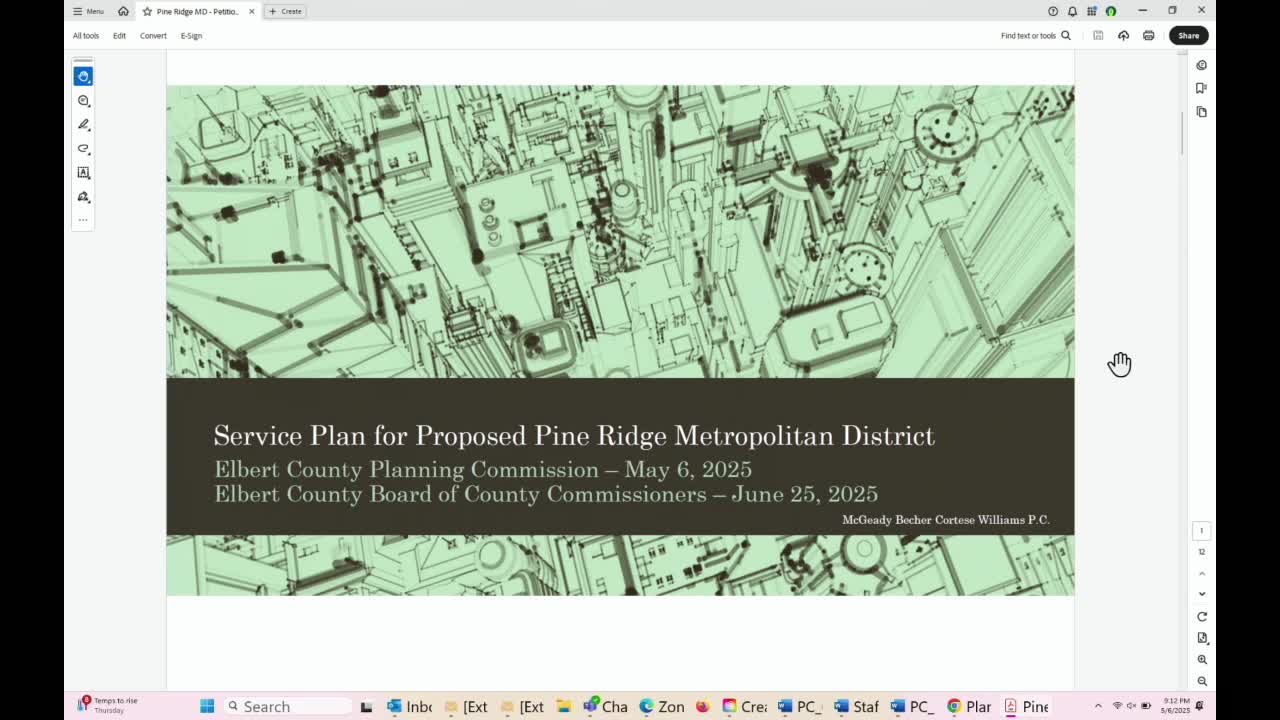
The Elbert County Planning Commission voted to recommend that the Board of County Commissioners consider the Pine Ridge metropolitan district service plan, a Title 32 district proposed to finance streets, water and sewer for a new ~186‑lot community.
The Elbert County Planning Commission on May 6 voted to recommend that the Board of County Commissioners consider the Pine Ridge metropolitan district service plan, which proposes centralized water, sanitary sewer, streets and limited park infrastructure for a new residential community south of Highway 86 and east of Legacy Ridge.
Attorney Suzanne Meintzer, representing the petitioner, described the purpose of a Title 32 metro district and summarized statutory changes that have tightened transparency and reporting requirements in recent years. She said the service plan conforms to Title 32 requirements that must be met before the Board of County Commissioners and the district formation court will act.
Meintzer said the proposed district would serve roughly 420 acres and about 186 residential lots (presentations referenced approximately 180–186 units in different places in the record), with infrastructure cost estimates of about $45 million. The service plan proposes a maximum operating and debt mill levy of 65 mills (presented to the commission as a statutory cap that reflects Gallagher adjustments to assessed valuation) and a maximum debt limit of $70,000,000 to provide flexibility for inflation and interest-rate fluctuations. Meintzer explained that the mill‑levy cap is a statutory control point and that projected tax burdens vary with assessed values; she illustrated that a 65‑mill cap applied under current assessment rules produces tax revenue roughly comparable to a prior-era 50‑mill benchmark because of changes in assessment rates and the $50,000 exemption.
Developer Jim Marshall described how metro districts are typically used in the county to finance water, sewer and internal streets, and stated the district will not perform covenant enforcement; he said funding will come from a combination of developer and builder advances plus debt issued by the metro district, noting that in practice the district will issue less debt initially than the total cost of improvements and that refunds of bonds typically follow build‑out and improved assessed valuation. The petitioner said they anticipate one or two builders for the project and that house price points are expected to be in a higher tier for the local market.
County legal and finance reviewers told the commission they had reviewed the service plan and that outside financial and legal review did not flag statutory noncompliance. Commissioners asked for clarification about how soon homeowners would be eligible to serve on the district board; the applicant said eligible electors may serve once they own taxable property in the district and noted historically it can take time for homeowners to step into board roles.
After discussion the planning commission voted to recommend the service plan to the Board of County Commissioners. Roll‑call votes recorded in the meeting minutes show six commissioners in favor and one opposed; Commissioner Nicole Hunt recorded the no vote and said she wanted stronger commitments about early homeowner participation and clearer statements tying operational notifications (for example a change from bulk-water to a water-line connection) to county notification requirements. The recommendation will be forwarded to the Board of County Commissioners, after which court proceedings and an election are required to form the district if the BOCC approves the service plan.