Get Full Government Meeting Transcripts, Videos, & Alerts Forever!
Get email alerts on the Police Reform topic
No spam. Unsubscribe anytime.
SFPD reports 96.7% compliance with DOJ collaborative reform; nine recommendations remain
Summary
Chief Bill Scott and department leaders told the Board of Supervisors the San Francisco Police Department achieved substantial compliance on federal collaborative reform recommendations (263 of 272 items, or 96.7%), highlighted reductions in uses of force, and outlined nine outstanding recommendations tied to performance dashboards and appraisal
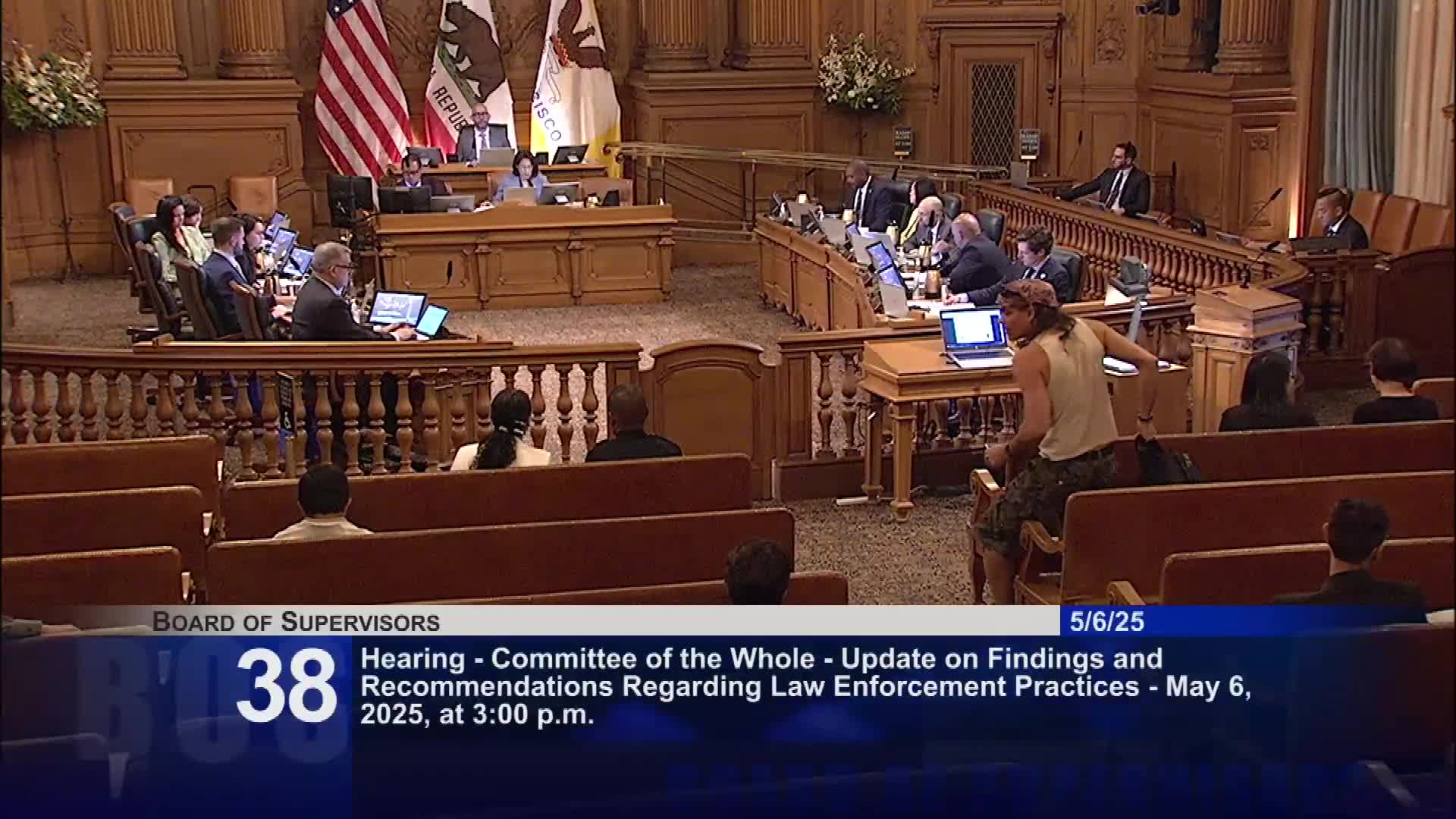
The San Francisco Police Department is in “substantial compliance” with the collaborative reform initiative overseen after the department’s 2016–2019 federal review, Chief Bill Scott told the Board of Supervisors on May 6.
Scott said the department met 263 of 272 recommendations (96.7 percent) and cited four key accomplishments: a measurable reduction in uses of force, fewer officer-involved shootings compared with the earlier review period, sustained executive leadership focused on reform, and concurrent reductions in major categories of crime. “Our city stands today as one of the only major cities in the nation to have both successfully completed a federally outlined collaborative reform initiative and simultaneously reduced crime across all major categories,” Scott said, quoting the department’s final report.
The update to the board framed the remaining work as technology and management steps linked to a departmentwide rollout of new performance appraisals and a management dashboard slated for early 2026. Executive Director Catherine McGuire (Strategic Management Bureau) said nine outstanding recommendations relate to appraisals and dashboards; the department planned a pilot in coming months and an internal working group to beta-test systems that will allow supervisors to monitor trends, disparities, and performance issues more promptly.
Supervisors pressed department leaders on bias and training. Supervisor Shamann Walton asked what the department is doing about racial disparities in traffic stops; the chief said that revised policies and the forthcoming management dashboard will help supervisors identify patterns early and take corrective steps. Scott said use-of-force incidents declined across racial groups with the steepest drop involving Black or African American subjects and that a suite of policy changes and training updates have been enacted since 2018.
Board members asked how implicit bias training is implemented and whether it is ongoing beyond the academy. Director McGuire described modules in the basic academy and recurring advanced officer training; the department also uses interactive online vignettes and academic partnerships to refine curriculum and measure effectiveness.
Public comment included calls for stronger independent oversight and concerns about surveillance tools. Some members of the public criticized the department’s historical data categorization and urged transparency and civilian review. Others urged faster action on unsolved homicides and better outreach to families.
Ending: The board agreed to continue the hearing to October 7, 2025, to review progress on the nine outstanding recommendations and the department’s pilot rollout of performance management technologies.