Get Full Government Meeting Transcripts, Videos, & Alerts Forever!
Get email alerts on the Mental Health Crisis Response topic
No spam. Unsubscribe anytime.
Erie officials outline expanded crisis response: reinstated crisis car, co-responder program and new negotiation vehicle grant
Summary
City officials and police described the reinstated crisis car unit, a co-responder program with crisis clinicians, officer wellness efforts and a state grant to replace a 30-year-old crisis negotiation vehicle.
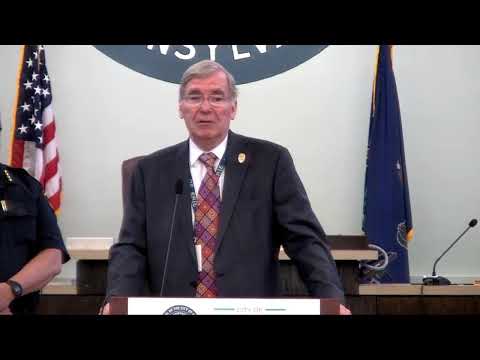
Mayor Schember said the City of Erie has expanded its crisis-response capacity after a two-year reinstatement of a specialized police crisis car and related programs, and officials described new training, staffing and funding that city leaders say aim to improve mental-health responses and officer wellness.
The mayor said the city allocated $12,000,000 in American Rescue Plan (ARP) funds to reinstate the crisis car and the juvenile unit and to add four officers to the Neighborhood Action Team (NAT). He said the Erie Police Department (EPD) responded to 59,399 calls for service in 2023, up from about 45,000 in 2020, and that assists-to-other-agency calls rose from 2,353 in 2018 to 3,099 in 2023.
Lieutenant Jamie Russo, who was assigned to reinstate and supervise the crisis car, said the mobile unit launched May 1, 2023, and now consists of nine officers who each had at least two years' prior EPD experience and received 40 hours of specialized training in de-escalation, negotiation, suicide prevention and handling substance-use and behavioral-health crises. "Mental health is just as important as physical health," Russo said, describing continuity of care, relationships and familiarity with individuals as core goals of the unit.
Sergeant Belotti described operational coverage and duties. "The crisis car or crisis intervention unit is a specialized unit of the patrol division that responds to calls with people who are experiencing mental health and family crisis issues," Belotti said. He said the unit is staffed for all three shifts to provide 24-hour coverage and works closely with local agencies including the Erie County Office of Children and Youth, the Mental Health Association and crisis services via a co-responder program.
Officials provided activity data for early 2024 to illustrate caseload and service mix. Lieutenant Russo said that in February 2024 the crisis unit responded to 3,468 calls, including 467 mental-health outreaches, 518 welfare checks, 425 involuntary commitments and 1,604 non-crisis calls. He and other presenters said the unit is intended to divert people from more restrictive responses such as emergency hospitalization or incarceration when appropriate.
Representatives of the co-responder program — crisis clinicians embedded with the police response — described the partnership and early results. A Safe Harbor/Crisis Services representative said the co-responder program began April 22 (year not specified in the remarks) and that clinicians have joined officers on 442 calls. The clinician described goals of least-restrictive referrals, reducing hospital transports and diversion from the criminal-justice system where treatment is a better fit.
Sergeant Tom Caboto reviewed officer-focused programs developed alongside the crisis response. Caboto described the department's Critical Incident Stress Management (CISM) team, available 24/7 to meet with officers after critical incidents, and a peer-support program, Erie Police Blue Assist, trained through the Fraternal Order of Police Power and Peers curriculum. "Mental health wellness is extremely important to Erie Police Department and its officers," Caboto said.
On funding and equipment, Sergeant Caboto and other speakers thanked state representatives for securing a state grant to replace a 30-year-old crisis negotiation vehicle. Caboto said Representative Mirsky and Representative Harkins helped the city obtain a state grant of $127,500 to purchase a new crisis communications vehicle. Later in the program, Representative Mirsky presented a check described as $127,000 on behalf of the Commonwealth; both figures were reported during the event.
Speakers also described training partnerships and resources: virtual-reality scenario training at Mercyhurst University’s Municipal Police Training Academy, coordination with UPMC, Lecom Health and Millcreek Community Hospital, and ongoing instruction from Safe Harbor. Officials said the department will continue follow-up outreach to people served, distribute information packets with community resources and provide harm-reduction materials such as naloxone and test strips as part of post-contact support.
The press conference concluded with the check presentation and photos. Speakers asked that the public observe Mental Health Awareness Month and highlighted the combined goal of improving community outcomes while supporting officer wellbeing.