Get Full Government Meeting Transcripts, Videos, & Alerts Forever!
Get email alerts on the Charter Schools topic
No spam. Unsubscribe anytime.
State panel advances Harbor School charter application to Virginia Board of Education
Summary
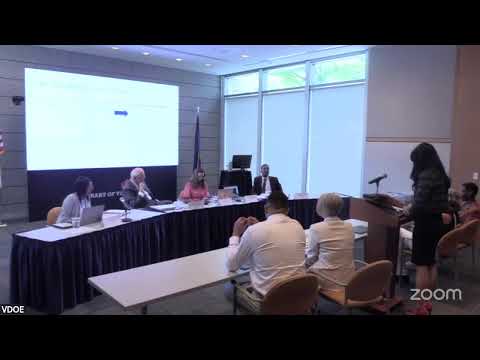
The Public Charter School Standing Committee of the Virginia Department of Education voted on May 8 to find that the Harbor School’s application met the board’s approval criteria and to advance the application to the Virginia Board of Education for its May 22 business session.
The Public Charter School Standing Committee of the Virginia Department of Education voted on May 8 to find that the Harbor School’s application met the Board of Education’s approval criteria on feasibility, curriculum, financial soundness and other objective measures and to advance the application to the Virginia Board of Education for its May 22 business session.
The vote follows a presentation from the applicant and an extensive question-and-answer session about the Harbor School’s competency-based middle school model, student assessment and remediation plans, staffing and facilities, and its plans to prioritize outreach to low-income and hard-to-reach families. Sarah Craig, lead community founder of the Harbor School, said the model grew from “over 4 years of investment, contributions from over a 175 people, and over 4,200 hours of design, implementation and reflection.”
Why it matters: If the state board recommends approval and the local school board votes in favor, the Harbor School would become a public charter middle school in Richmond that the applicants say is targeted to students who have historically struggled in traditional models. The local school division (Richmond Public Schools) is the final authorizer under Virginia law.
What the application proposes The Harbor School proposes a competency-based, learner-centered middle school model for grades 6–8 built around small cohorts and multi-adult teams. According to the application and presentation, students would start in an “onboarding” phase, move through stacked competencies at a flexible pace, and be organized in cohorts of 8–12 learners with one learning coach. Three cohorts form an anchor group of roughly 24 students; three anchor groups form a pod (about 108 students). The school plans a certified teacher learner-to-coach ratio of about 12:1 and an effective in-school developmental ratio of about 8:1 when specialists are included.
Enrollment and finances The Harbor School plans to open with a small initial cohort (the team gave an initial enrollment target of 48 students) and grow to 324 students over several years to reach a financially sustainable model. The founders said start-up and early-year costs will rely heavily on community fundraising; they estimated community donations would cover roughly two-thirds of combined year‑0 and year‑1 costs, with donations representing about one-third of first-year income. The team said it could support up to $12 million in debt service for a renovated Richmond Public Schools facility if required.
Assessment, remediation and equity measures Committee members pressed the team on assessment and students who enter far behind grade level. The Harbor School team said the model emphasizes front-loaded onboarding assessments, individualized learning pathways, frequent trimester conferences, and targeted direct instruction (for example, phonics programs) to accelerate learning. The applicants acknowledged all students must take state SOLs but said they want interim measures and clearer ways to document and celebrate growth for students who are multiple years behind.
On student selection, the application proposes a dual-lottery mechanism intended to reserve seats for students from low‑income backgrounds; the founders said the intent is to ensure the school enrolls the populations it aims to serve and to reduce access barriers, not to artificially manipulate performance data.
Staffing, collective bargaining and professional development The Harbor School plans an initial mix of experienced teachers, learner-centered practitioners recruited nationally, and staff from youth-development backgrounds. The founders said they will negotiate terms consistent with Richmond Public Schools’ collective bargaining obligations where relevant, and they expect to offer stipends and targeted incentive pay for specific additional responsibilities or credentials, subject to negotiation. Professional development would draw on the Learner-Centered Collaborative and other local providers, with an emphasis on coaching, trauma-informed practice and staff wellness.
Committee discussion and vote Department staff explained the committee would vote on four criterion (feasibility, curriculum, financial soundness and other objective criteria) and then on the overall application, as required by the department’s evaluation rubric and the public charter school statute. After discussion, the standing committee voted by voice on each criterion and on the overall application; committee members indicated “aye” for each motion and the committee chair stated each motion passed. The committee also agreed to prepare written feedback and an addendum with clarifications for the record before the Board of Education meeting.
Next steps The standing committee’s action advances the Harbor School application to the Virginia Board of Education, which will determine whether to recommend the application to Richmond Public Schools, the local authorizer. Department staff said the committee’s written and oral feedback will be compiled in a report and that the applicant may address committee suggestions before it goes before the state board. If the Board of Education recommends approval, the final decision rests with the Richmond Public Schools board.
Quotes “This is precisely why Virginia has a public charter school law and why today is so important,” Superintendent Gullickson said during remarks introducing the application review. Sarah Craig, the applicant’s lead community founder, described the project as rooted in local experience and said the school’s “competency-based model” grew out of pilots, tutoring and community design work.
Staff and speakers Department staff and the Harbor School team answered detailed questions from members of the standing committee about assessment, remediation, staffing, facility plans, family engagement and discipline practices; committee members requested clarifications that will be captured in the committee’s written feedback to the Board of Education.