Get Full Government Meeting Transcripts, Videos, & Alerts Forever!
Get email alerts on the District Attorney Budget topic
No spam. Unsubscribe anytime.
Supervisors hear San Francisco district attorney's plea to protect prosecutors as caseloads and state mandates rise
Summary
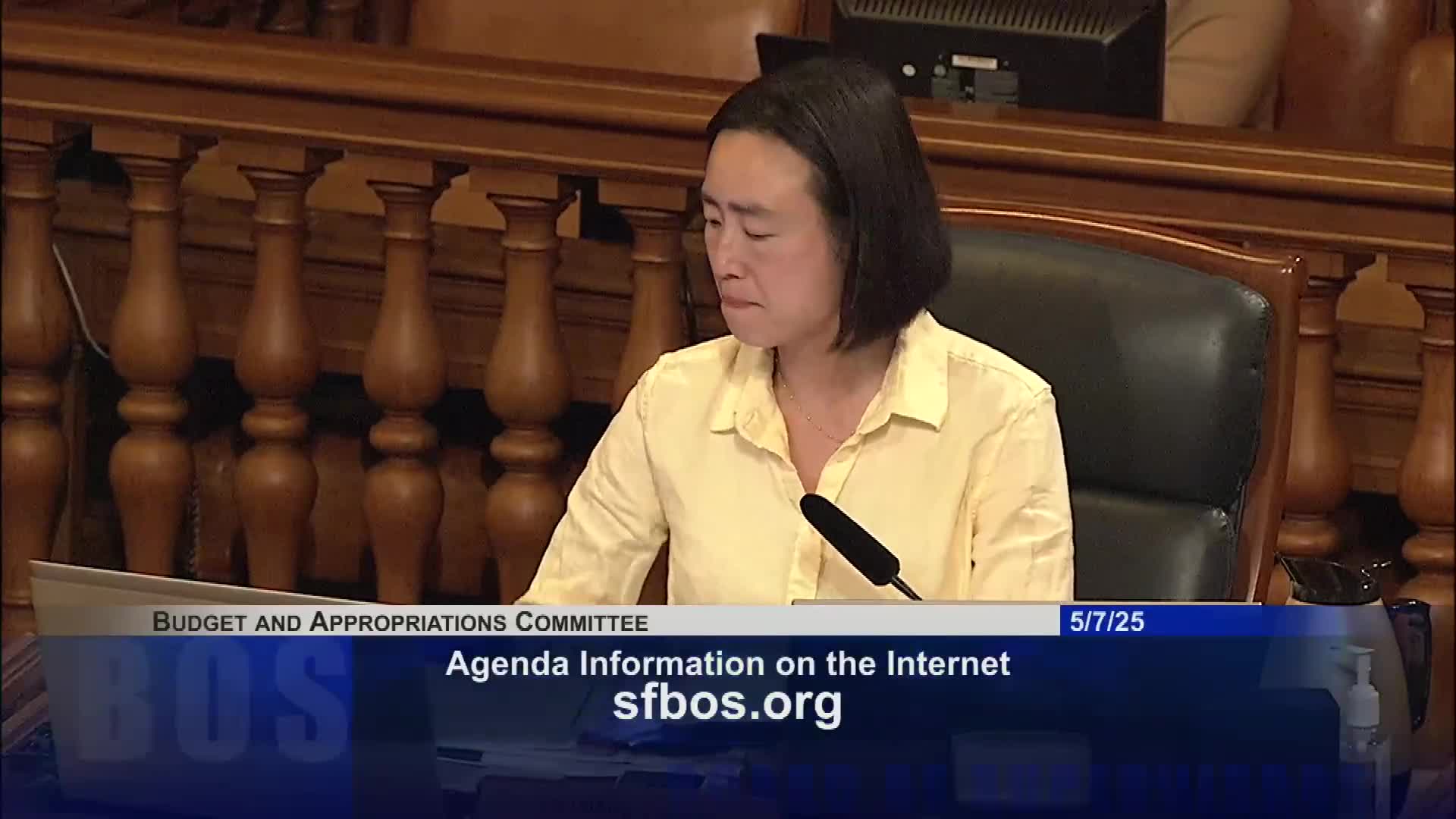
City Hall — San Francisco District Attorney Brooke Jenkins told the Board of Supervisors' Budget and Appropriations Committee on May 7 that her office is operating near capacity and faces rising caseloads, unfunded state mandates and a potential $5.4 million cut that she said would force the office to reduce prosecutions.
City Hall — San Francisco District Attorney Brooke Jenkins told the Board of Supervisors' Budget and Appropriations Committee on May 7 that her office is operating near capacity and faces rising caseloads, unfunded state mandates and a potential $5.4 million cut that she said would force the office to reduce prosecutions.
The hearing, convened by Supervisor Connie Chan and led by Vice Chair Supervisor Matt Dorsey, examined staffing levels, recruitment and retention challenges, the district attorney’s capacity to implement last year’s Proposition 36, and other resource gaps in the DA’s office. Jenkins and the public defender testified and more than three dozen members of the public, business groups and advocacy organizations offered testimony during the public-comment period.
Jenkins said the office is carrying roughly 7,100 pending cases and that staffing and nonpersonnel shortfalls have increased the time it takes to resolve cases. “These cases have become increasingly lingering in our system for much longer periods of time,” Jenkins said, and reported median lengths to disposition of about 591 days for felonies and 574 days for misdemeanors.
Why it matters: The DA’s office prosecutes crimes that affect victims, the city’s commerce and neighborhood safety; reductions in staff or litigation resources, Jenkins warned, would force the office to decide which categories of cases it can no longer pursue and would reduce the office’s ability to prepare cases for trial or respond to court-mandated motions.
What the DA presented
Jenkins outlined the office’s proposed budgets for fiscal years 2025–26 and 2026–27 and the drivers of recent increases. The office’s proposed budget for 2025–26 was presented as about $96.5 million and the following year about $99 million; the general fund supplies roughly 91% of the department’s revenue, she said.
Staffing and vacancies: Jenkins said the office has 324 budgeted positions, 317 of them filled and 19 vacancies. She reported 147 budgeted attorney positions, 141 of which were filled, and said some attorney vacancies are being held open until new hires complete bar exams. Jenkins said victim advocate and investigator positions are also underfilled (44 budgeted victim advocates with 39 filled; 39 investigator positions with 34 filled).
Caseloads and workloads: Jenkins gave unit-level caseload averages she said illustrate pressure on attorneys: misdemeanor lawyers (12 in the unit) average roughly 186 cases each; preliminary-hearing attorneys average about 104 cases each; the general felony trial unit (13 lawyers) averages about 70 cases each; the homicide unit averages about 17 cases per lawyer. Jenkins said her office served 9,966 victims in 2024 and that victim advocates carry large caseloads.
Unfunded mandates and nonpersonnel shortfalls: Jenkins detailed several areas the office says are underfunded or newly required by state law: staff and software for so-called “race-blind charging” and for responding to motions under the state Racial Justice Act; a continuing cost-share for the Be the Jury program that pays low-income jurors; cutbacks in VOCA victim-services funding; and ongoing litigation and technology costs (including annual maintenance for the office’s e-prosecutor case-management system, records management and legal research subscriptions). Jenkins described a combined set of underfunded nonpersonnel items totaling several hundred thousand dollars annually and cited an additional $135,000 cost tied to union dues that the city negotiated to cover for attorneys but did not fund to the DA’s office.
Potential cuts and consequences: Jenkins said a mayoral target reduction delivered to departments — $5.4 million for the DA’s office — would equate to about 25 prosecutor positions. “A reduction of 25 lawyers would create unmanageable caseloads,” she told the committee. Jenkins said that would likely require suspending routine misdemeanor prosecutions and would overwhelm remaining specialty units; she warned it would “risk their licenses” if attorneys cannot meet discovery and ethical obligations.
Public defender and courtroom context
San Francisco’s public defender also testified. The public defender, introduced in the hearing as Manu Raju, described vertical representation at the defender’s office and said defense attorneys face heavy caseloads as well: he said his office’s average felony caseload is about 65 cases per attorney and misdemeanors about 145. He warned that underfunding defense services also harms the justice system and the fairness of outcomes.
Supervisors’ questions and exchanges
Supervisors asked about court backlogs, the effect of COVID-era closures on pending cases, whether Proposition 36 was driving filings, and recruitment strategies. Jenkins told the committee that a portion of the pending-case growth stems from higher arrest and presentation rates (she cited a rise in felony presentations and an increase in retail-theft and narcotics cases), and that the recent slowdown in some court operations during COVID contributed but does not explain the full increase.
She told the committee the office has tried to limit the reach of Proposition 36 by using “washout” periods when assessing prior convictions, and that San Francisco has not seen the same spike in charging other counties have experienced since implementation. Jenkins also emphasized retention challenges: she said the DA’s office pays lower salaries than most Bay Area counties, which makes lateral recruitment difficult.
Public comment: broad agreement and targeted concerns
About four dozen speakers addressed the committee. Business groups including the San Francisco Chamber of Commerce, the Hotel Council of San Francisco and the Union Square Alliance urged the committee to maintain or increase funding for the DA’s office to support prosecutions of retail theft and related quality-of-life crimes. Several community organizations and residents credited the DA’s office with recent improvements in public safety.
Opposing viewpoints appeared as well. Representatives of the ACLU of Northern California and other advocacy groups urged caution about expanding prosecutorial budgets, arguing the city should prioritize treatment, diversion and community services and raised concerns about equity, immigration consequences and the DA’s office’s policies. Some speakers also raised concerns about ICE referrals and other federal collaborations and urged that city funds not be used in ways that produce adverse immigration outcomes; those claims were raised during public comment and not the focus of the DA’s presentation.
Formal actions and committee disposition
Before the hearing, the committee moved to excuse Board President Rafael Mandelman; Supervisors Shamann Walton and Matt Dorsey moved and seconded that excusal and the committee approved the request. At the end of the hearing the committee voted to file the item. The roll calls were recorded on the transcript and the clerk recorded the motions as passed.
What the hearing did not decide
No final budget decisions were made in the hearing. Supervisors said they would continue to weigh the DA’s requests alongside competing departmental needs as the city works to close an estimated multi-hundred-million-dollar shortfall this fiscal cycle. Several supervisors said they wanted further budget hearings with both the DA and the public defender to consider systemwide impacts.
Taper/next steps
Committee members said the presentation underscored that “public safety” involves multiple connected offices — police, public defenders, the DA, probation and community services — and that funding choices will affect the entire system. The committee will consider the DA’s requested supplemental items in the coming budget deliberations and will hold additional hearings on related public-safety budget proposals.
Ending note: The committee filed the hearing record at the conclusion of the meeting; no budget allocations were made at this session.