Get Full Government Meeting Transcripts, Videos, & Alerts Forever!
Get email alerts on the Public Drug Use topic
No spam. Unsubscribe anytime.
Committee holds wide‑ranging hearing on a Zurich‑style "four pillars" strategy for public drug use and overdose prevention
Summary
A full hearing considered the Budget and Legislative Analyst’s report on Zurich’s 4‑pillars approach (prevention, harm reduction, treatment, enforcement), testimony from doctors and city departments, and the costs and legal questions around supervised consumption sites; the committee filed the hearing record for follow‑up.
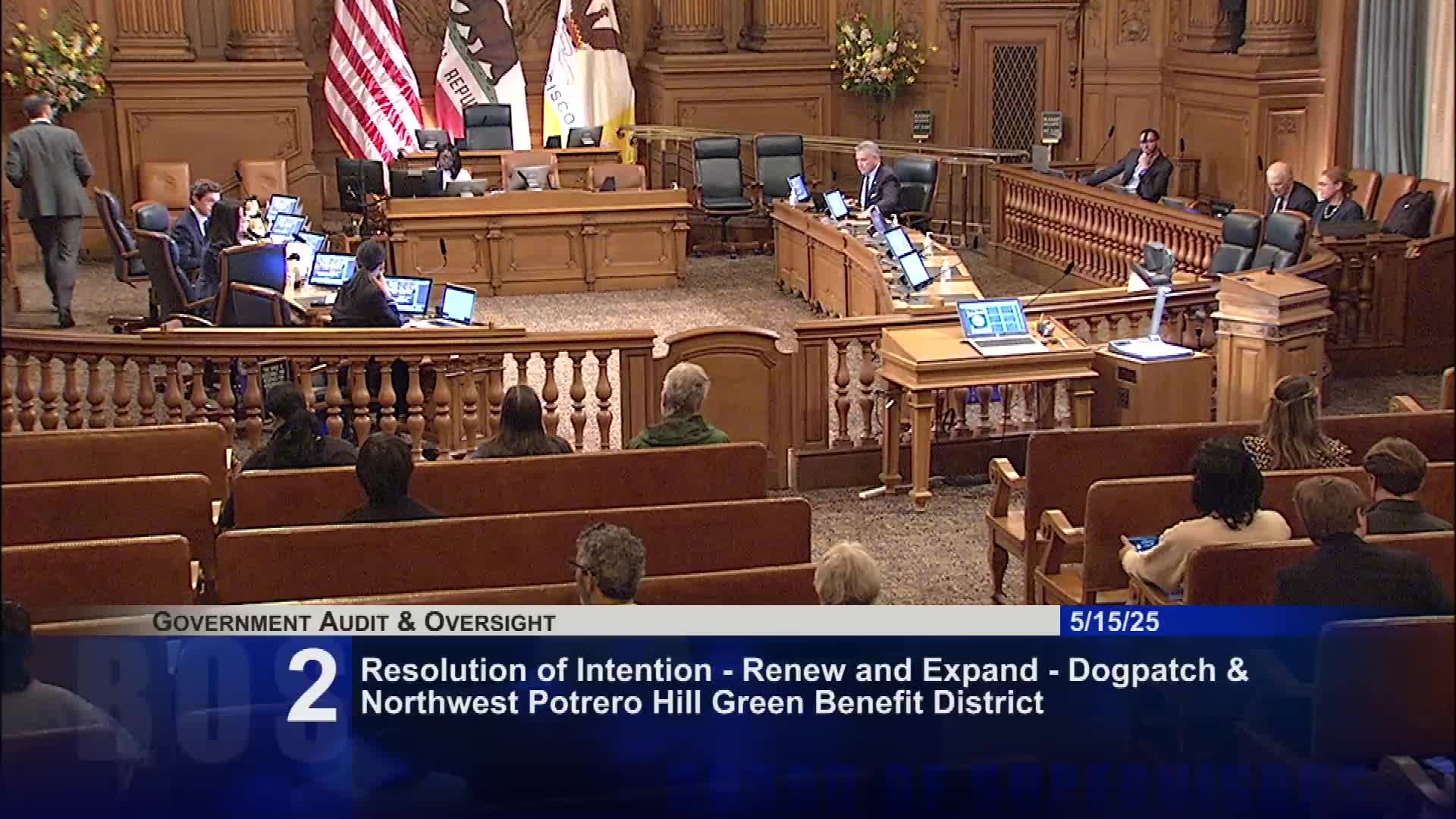
The Government Audit and Oversight Committee convened a multi‑hour hearing May 15 to examine a comprehensive “four pillars” strategy — prevention, harm reduction, treatment and enforcement — for addressing open‑air drug markets, public drug use and overdose deaths in San Francisco.
Chair Jackie Fielder opened the hearing and cited rising overdose fatalities citywide; Supervisor Matt Dorsey and other cosponsors framed the hearing as a search for pragmatic, evidence‑based approaches. The Budget and Legislative Analyst (BLA) summarized a November report that compared Zurich’s multi‑agency program and performed a cost‑benefit analysis of supervised consumption (safe consumption) sites if one were opened in San Francisco. BLA analyst Fred Brusseau and colleague Terry Feeley presented slides and summarized findings.
Key points from the BLA and medical witnesses: - Zurich’s “four pillars” model combined prevention, harm reduction (including supervised consumption sites), treatment and law enforcement in a coordinated, pragmatic program; Zurich has three supervised consumption sites and officials there said the approach reduced visible open‑air drug use in parks that were formerly sites of heavy public use. - The BLA modeled a single safe consumption facility for San Francisco and estimated baseline benefits of about $3.5 million against costs just above that figure; a larger facility produced higher net benefits in the model. The BLA estimated a conservative 15–27 fatal overdoses potentially prevented in a year by a safe consumption site and noted these calculations excluded a monetized value of lives saved (the report supplied an illustrative value of about $1.2 million per life in the model). - The federal Anti‑Drug Abuse Act (the “crack‑house” statute, 1986) poses unresolved legal risk for supervised consumption sites; a Third Circuit federal appeals decision upheld a challenge in Philadelphia and other legal outcomes remain unsettled nationally. - Medical experts (Dr. Ayesha Appa, UCSF addiction medicine; Dr. Dan Ciccaroni, UCSF) emphasized addiction as a chronic disease, the need for long‑term engagement and trust building, low‑barrier medication for opioid use disorder (MOUD) such as methadone and buprenorphine, and the role of harm reduction and supervised consumption in engagement and linking people to care.
City department leaders described current and planned local actions. San Francisco Department of Public Health Director Dr. Grant Tsai (introducing DPH remarks) said the city is strengthening coordinated responses, expanding treatment capacity and accelerating low‑barrier entry to care (including RESTORE, a program pairing interim housing with rapid initiation of MOUD). Mary Ellen Carroll, Department of Emergency Management, described neighborhood street teams integrating DEM, DPH, HSH, SFFD and SFPD partners for daily huddles, shared priority lists and the All Street Teams Integrated Dataset (ASTRID). Commander Derek Liu summarized DMACC (Drug Market Agency Coordination Center) law enforcement tactics and outcomes and presented seizure statistics: DMACC reported about 66,708 grams of fentanyl seized in 2024 (the presentation translated that amount to an illustrative 33,400,000 lethal doses using a standard 2 mg per lethal dose metric for modeling purposes).
Supervisors, analysts and clinicians debated the tradeoffs between enforcement and harm reduction, the legal hurdles for supervised consumption sites, the need for scaled treatment beds and shelter linkage, and the importance of reliable, longitudinal data to measure outcomes (treatment starts, persistence in care, overdose trends, neighborhood quality metrics). Multiple members of the public testified for a balanced four‑pillars approach; others urged prioritizing enforcement or raised neighborhood impact concerns.
At the hearing’s close the committee voted to file the hearing (a formal committee action to place the hearing record on file) with a recorded 3‑aye vote.