Get Full Government Meeting Transcripts, Videos, & Alerts Forever!
Get email alerts on the Law And Justice topic
No spam. Unsubscribe anytime.
Clark County council reviews jail funding model, weighs levy, sales-tax and grant options
Summary
Councilors and staff discussed revenue scenarios for a jail capital project and broader law-and-justice spending, reviewed a financial model, considered state grant opportunities and planned public outreach ahead of any ballot measure.
Clark County Council members on April 23 reviewed a financial model for potential revenue options to pay for a proposed jail capital project and broader law-and-justice spending, and directed staff to continue outreach and coordination with the City of Vancouver before deciding whether to place measures on the ballot.
County staff presented an interactive model showing how different revenue choices — including a councilmanic 1% property tax option, a proposed legislative 3% option that was later reported as likely removed, and a levy lid-lift — would affect annual revenues and the impact on a median homeowner. "I've created a model that helps calculate depending on which options are taken," Mark Gassway said, noting the model can show one-time or multiyear levy lid-lift scenarios and household impacts given a median home value used in the model.
The model produced a scenario that staff described as generating about $130,000,000 under a levy lid-lift option. Staff said the interactive spreadsheet also shows the effect of annual increases and compounding if multiple years of a capped percentage were taken, and can output household impacts using an assumed median home value of $540,000. The transcript did not specify exact per-household figures for every scenario; where precise per-household impacts were not spoken or were unclear in the meeting record, staff said they would provide clarified figures to council.
Jordan Bogie, the county's policy analyst, updated council on recent legislative activity that bears on the county's choices. "It does appear at this point based on my understanding, that they have removed the change to up to 3%," Bogie said, referring to language that would have allowed cities and counties to raise the property-tax limit to 3 percent. He and other staff also described House Bill 2015 as moving through the Legislature; that bill would create a grant program for law-enforcement hiring and allow qualified counties to impose a separate 0.1% public-safety sales tax through 2028 if they meet eligibility requirements. Bogie said the most recent budget language he had seen included $20 million for that grant program, not the $100 million the governor originally proposed.
Staff emphasized that grant funding would be subject to appropriations and that any hires funded by grants could create ongoing costs the county would need to sustain in future years. "That's another key component," a staff member said, noting that initial grant funding for hiring typically is not ongoing and that counties must plan for sustaining positions after grant dollars expire.
On outreach, Amber, a county staff member working on communications, said staff plan a grassroots-first approach followed by a paid campaign once a vendor is selected. "We're gonna look at doing an open house every month for the summer to talk through the jail proposal," she said, adding staff plan to take presentations into neighborhoods and partner with existing community circuits and neighborhood associations to reach residents who do not attend council meetings.
Council members discussed timing and coordination with the City of Vancouver. Kathleen, a county staff member, reported that the City of Vancouver confirmed it will not place a measure on the August ballot, which prompted staff to recommend there is no rush to place a county measure in August and that the next steps be informed by final legislative outcomes and ongoing city–county coordination. "They're open to discussions and collaborating and partnering on how we can fund both the law and justice impacts as well as the jail capital project," Kathleen said.
Councilors emphasized a need to clarify both revenue and spending components before committing to a ballot measure. Councilor Little asked whether property tax and sales tax options are regressive; Bogie pointed councilors to state-level analyses showing Washington relies heavily on sales and property taxes and is relatively regressive compared with other states. Councilors also raised the technical question of whether half-percentage points are allowable under state law if that becomes an option; staff said that depends on how any legislative language is written and would require legal review.
Councilors and staff agreed to continue refining the fiscal model and return with more detailed spending plans and eligibility criteria for state grants. Staff said they will produce clarified numbers from the model, further legal analysis of ballot and levy options once legislative language is finalized, and a public-engagement plan that starts with grassroots open houses and scales up with an outside communications vendor if council elects to proceed to ballot.
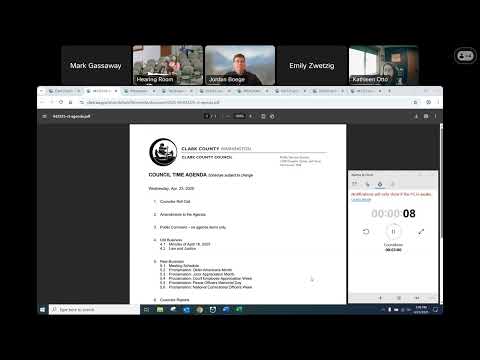
Votes and formal actions taken during the meeting were limited and procedural. The council approved an amendment to the meeting agenda to remove items 9.2 and 9.3 from the executive session and to add agenda item 8.2 (a draft letter supporting Pacific Coastal Salmon Recovery Fund appropriations), and later approved the minutes from the prior meeting with the corrections noted on the record.
The council later convened into executive session under state law for pending litigation and collective bargaining; the chair announced the session would be extended and the body later reconvened and adjourned with "no after action."