Get Full Government Meeting Transcripts, Videos, & Alerts Forever!
Get email alerts on the School Budget topic
No spam. Unsubscribe anytime.
Avon Grove budget: administrators propose 3% tax increase, project $5.8M fund-balance use and outline multi-year fiscal risks
Summary
Business administrators presented the proposed 2025–26 general-fund budget with a 3% millage increase, a total revenue/expenditure plan of $120.7 million and a planned use of $5.8 million of fund balance. Trustees debated lowering the increase and asked for longer-term projections that show fund-balance erosion if cost trends persist.
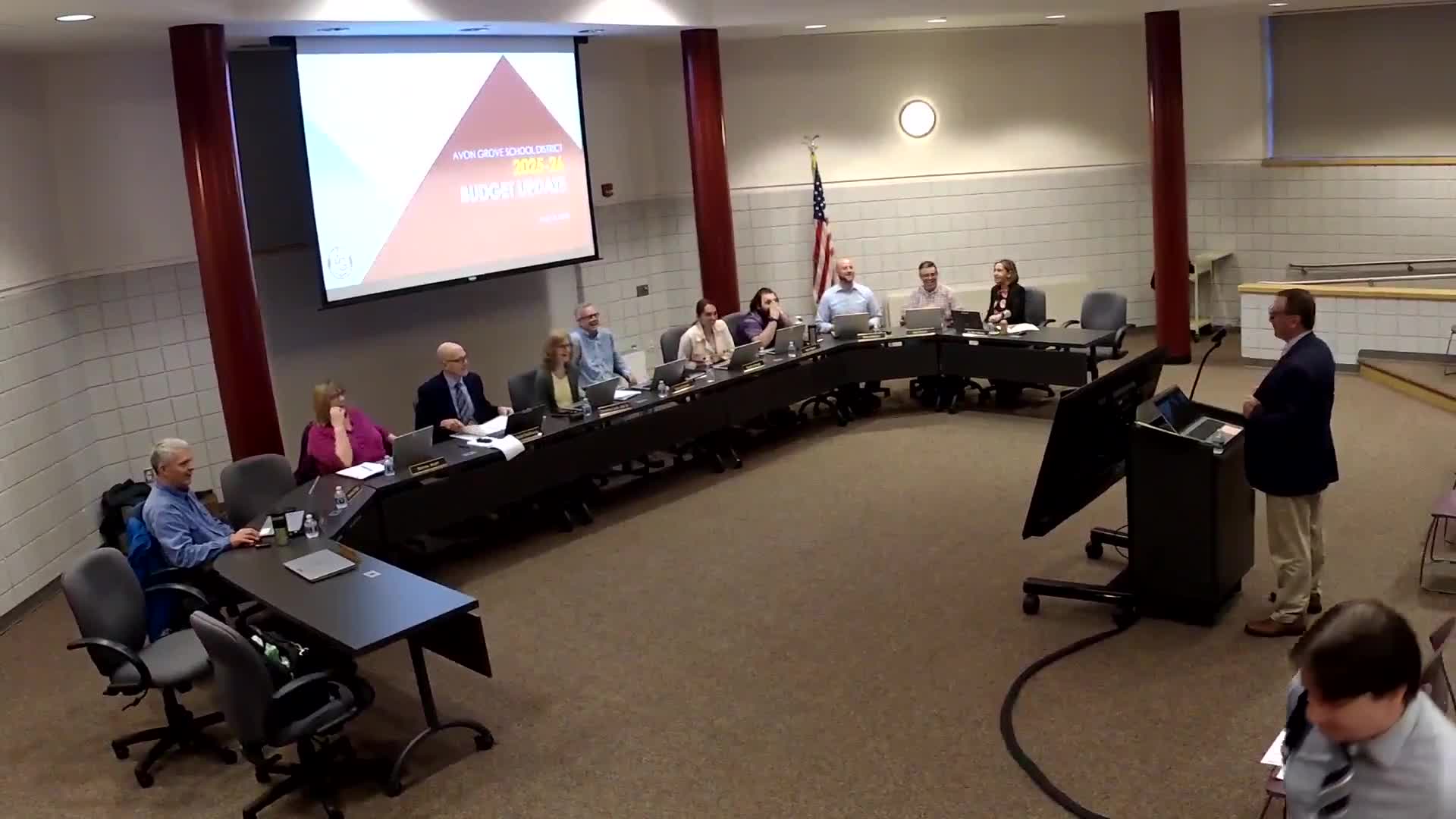
Avon Grove School District officials presented the final budget proposal for fiscal 2025–26 on Tuesday, including a proposed 3% property-tax increase, an operating budget of $120.7 million and a planned draw of $5.8 million from general-fund reserves.
Business officials said the budget assumes local revenues of about $70.7 million, state revenues of about $42.8 million and federal revenues of about $1.2 million, for total revenues and other financing sources of $120.7 million. The administration proposed a general-fund budget that matches planned expenditures of $120.7 million, yielding an estimated year-end general-fund balance of roughly $29.3 million if projections hold.
Mr. Carsley (business administrator) and Eric (finance staff) walked trustees through five-year projections showing that a steady 3% annual tax increase coupled with conservative estimates for salary (4% growth) and benefit (7% growth) costs would significantly reduce district reserves over time. Under the administration’s central projection—recognizing roughly one-third of proposed state funding in year one—the district’s total fund balance could decline from about $44.7 million at the end of 2023–24 to approximately $7.1 million by 2029–30 if the board adopted only the 3% increases and other assumptions were realized.
Trustees asked whether the board could reduce the proposed 3% increase. Board member Rick Dumont said, “I would be more supportive of a 2.5% increase than I would [of] 3%,” citing county-level tax pressures on residents. Administrators responded that a lower increase would reduce immediate taxpayer impact but would accelerate projected long-term reserve erosion and could require steeper increases later or program reductions.
The presentation included budget drivers and recent historical variances: investment income spiked in recent years and boosted local revenues (the presentation noted interest income near $3.0 million in the most recent year), charter-tuition and transportation costs fluctuate with vendor availability and supply pressures, and state reimbursements for retirement and PlanCon projects affect cash flow. Administrators said they expect the district’s 2024–25 year-end financials to be more favorable than initially budgeted and that auditors’ results will be shared when available.
Board members also questioned a single capital purchase on the proposed list: a district police vehicle priced at about $65,000. Trustees asked staff to explain the operational and safety rationale; staff described faster emergency response, secure radio access to county dispatch and the ability to carry specialized equipment as reasons for the purchase.
Several trustees urged caution and recommended continued review. Some said they were comfortable with the administration’s long-term projections and supported the 3% framework; others pushed to use more fund balance now to soften the tax increase. Administrators said they would continue to refine year-end projections and present additional detail at upcoming meetings before a final June vote.