Get Full Government Meeting Transcripts, Videos, & Alerts Forever!
Get email alerts on the Mtss Intervention Grading Homework topic
No spam. Unsubscribe anytime.
Fairport CSD reports early MTSS gains; grading and homework pilots continue
Summary
District leaders described multi-year MTSS work and action-research pilots on grading, homework and interventions. Teachers reported a homework-quiz and learning-recovery model in math, districtwide IXL use in some schools showed large growth percentiles, and leaders proposed additional cohorts and summer programming.
Fairport Central School District presented mid-year MTSS (Multi-Tiered System of Supports) results and described teacher-led pilots on grading, homework and intervention practices during a board workshop.
District staff said the MTSS program is producing measurable movement of students toward grade-level benchmarks and described several classroom- and building-level pilots intended to improve learning, assessment and motivation. Presenters explained cohort-based action research on grading-for-learning, standards unpacking and homework guidelines, plus expanded intervention tools and summer offerings.
Kevin Henshin and other district leaders summarized the grading-for-learning cohort. The district worked with the Crescendo Group and Joe Feldman to support a 19‑person action-research cohort that tested a range of practices this year, including redo/retake policies, new approaches to zeros and decisions about how to record participation and group work. Participants gave the experience generally positive ratings and some cohort members plan to continue in year two; staff acknowledged questions remain about how alternative grading scales translate for college admissions and how to scale practices across the district.
JJ, identified in the presentation as a math educator and lead at Minerva DeLand, described his classroom pilots on homework and learning recovery. He told the board he stopped checking daily homework and instead gives a weekly homework quiz drawn directly from assigned problems, and that he follows low quiz/test scores with a structured learning-recovery activity in Delta Math that can replace a failing score with a baseline passing number once the student completes required practice. JJ said the model both provided a clearer link between homework practice and assessment and created opportunities for students to catch up before subsequent units. "I'm not gonna check your homework every day," JJ said. "Instead, we're gonna do a homework quiz every week." He reported positive student feedback and said the recovery approach reduced the number of students who fell behind on later units.
The district also reported specific intervention staffing and caseload figures. Presenters said the district provides reading intervention to 357 students across 72 groups (K–8) and math intervention to 161 students; staffing cited included 15 reading specialists, nine math specialists and two full‑time TOSAs this year, with three TOSAs planned next year. Staff described approaches to scheduling intervention when elementary intervention blocks conflict (for example, some second–fifth graders require 40‑minute reading blocks that overlap other interventions); buildings are using targeted strategies such as lunch‑time groups and activity‑period pullouts to maintain supports.
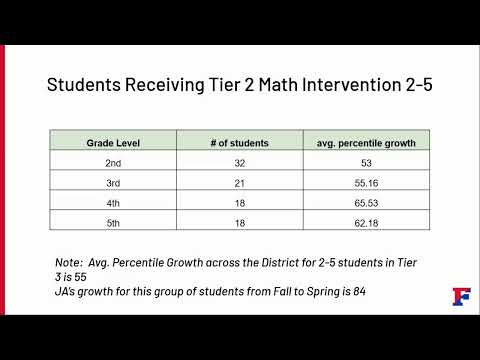
Staff highlighted a targeted use of IXL at Jefferson Avenue (JA) where a locally managed IXL intervention reportedly produced unusually high growth percentiles on the NWEA measure. Presentation slides and staff commentary said students using the IXL program in a monitored protocol averaged roughly an 84th percentile growth rate compared with roughly 55 percent elsewhere for students receiving tiered interventions. Lisa Benson and colleagues said the JA approach pairs short, daily IXL practice with teacher oversight and assignment alignment; the district plans to expand that model to additional buildings next year and to incorporate IXL into math tier‑3 plans.
Homework policy work included survey data from students, parents and teachers and the creation of three draft homework-policy models for further review. Mark Treywitz and the homework subcommittee reported that most student respondents called homework manageable and useful, while many parents reported their children felt stressed or overwhelmed; teachers strongly reported that homework reinforces learning goals. The subcommittee recommended further focus groups, differentiated guidelines by grade band and professional development for teachers on purposeful homework design.
Presenters asked the board to endorse continued cohorts for grading-for-learning, additional standards-unpacking work in PLCs and next steps for homework review. Staff also described summer programs targeted to students receiving both reading and math interventions. A board member commended the district for inviting students who qualify for both interventions to summer school.
Before adjourning the workshop portion of the meeting, the board voted to enter executive session on the listed agenda topics. The motion passed on a voice vote recorded as "aye, 7–0."