Get Full Government Meeting Transcripts, Videos, & Alerts Forever!
Get email alerts on the Building Energy Management topic
No spam. Unsubscribe anytime.
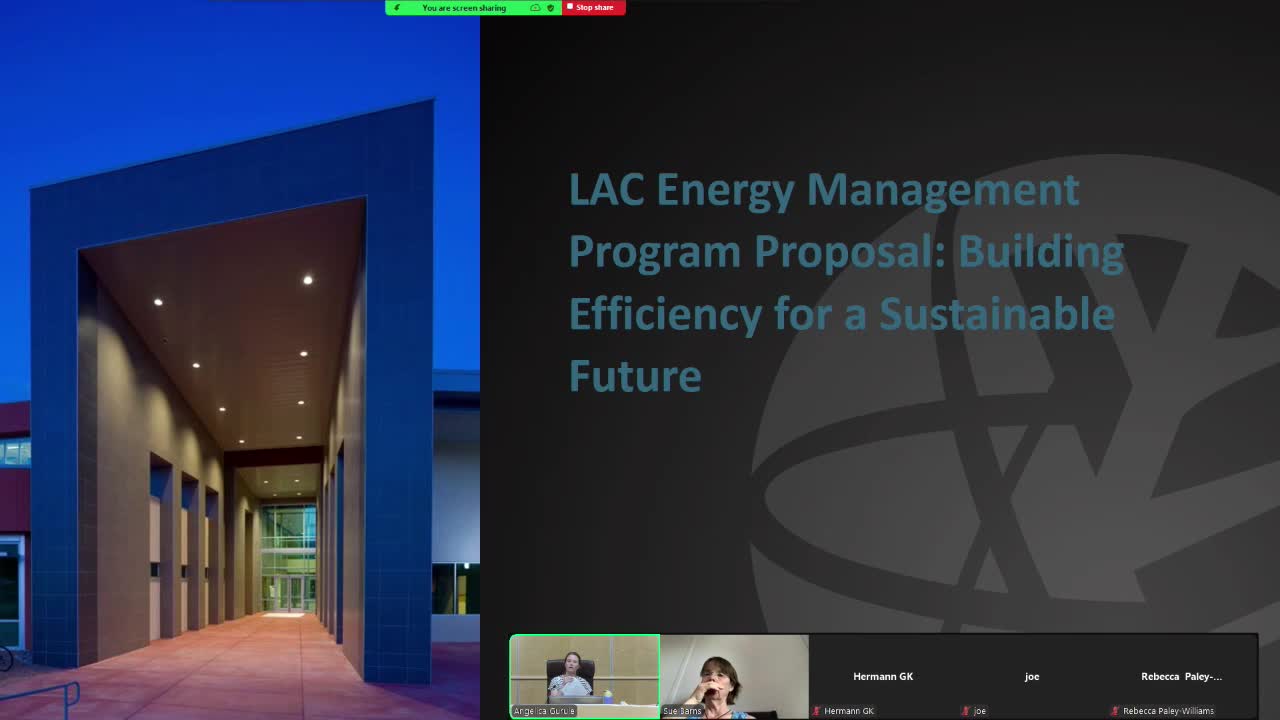
County audit finds building inefficiencies; airport manager pitches pilot program and 'BrainBox' AI to cut energy use
Summary
Los Alamos County airport manager Gary Goddard presented results of a targeted energy audit of the Municipal Building, proposing a pilot recommissioning program, deployment of BrainBox AI for continuous optimization, and a separate effort to explore solar and heat-pump conversions that could make the airport building net-zero.
Gary Goddard, airport manager for Los Alamos County, told the Environmental Sustainability Board on May 15 that a targeted energy audit of the Municipal Building found operational problems that have driven energy use well above expectations. "The building was using about 25% higher energy consumption than a building of its size," Goddard said, summarizing the audit his team performed with volunteer collaborator Joe Close.
Goddard said the audit found scheduling and control problems — weekend equipment running, disabled economizers, fixed supply temperatures, and a continuously running heating hot-water loop — and that many issues could be corrected at low or no cost through programming fixes and modest repairs. "A lot of this stuff was either low or no cost to fix," he said.
Why it matters: The board is charged with advising the county on climate and energy policy; reducing operational waste in county buildings would lower greenhouse-gas emissions and utility costs while prolonging equipment life. Goddard framed the work as a pilot that could produce repeatable templates and potentially fund a scaled energy-management program from realized savings.
Goddard described a three-part path forward: targeted energy audits and a pilot recommissioning on the Municipal Building; development of templates and intern-led audits to scale the work; and a trial of BrainBox, an AI-based optimization layer (recently acquired by Trane) that connects to building automation systems, makes small set-point changes, and learns whether the changes improve performance. "BrainBox... will keep an eye on the equipment and... look for anomalies," he said, explaining that the system can write modest set-point adjustments and revert them if performance worsens.
Board members pressed for details on measurement and scale. Chair Shannon Blair asked whether the presenters were "running math on all of this," and Goddard replied, "Yeah. I'm a trained engineer, and we did lots of math." Board member Sue Barnes and others discussed where to next: Goddard suggested prioritizing buildings where occupant comfort complaints indicate systems may be out of balance and proposed the PCS building as another likely candidate.
Goddard estimated conservative savings for HVAC-related measures at around 20% for the Municipal Building, saying the figure could be higher but that he preferred a cautious projection until the team demonstrates year-over-year results normalized for weather. "I will be able to tell you exactly normalized for weather, exactly how much energy the things that we just did saved," volunteer Joe Close added.
On the airport: Goddard also described ongoing audits of the county airport terminal, a 1947 cinder-block building with high ceilings and many windows that he called "terribly inefficient." He proposed repurposing existing solar panels from the landfill site, installing more panels on the airport's large flat roof, replacing gas furnaces with heat-pump equipment, and adding automated south-facing window shades tied to a small building-automation system. Those measures, together with possible rooftop solar and heat-pump conversions, could make the terminal a candidate for a net-zero demonstration project. "If it's possible to put enough solar panels up there and heat pumps and things, it might end up being the first net‑0 airport in the state," he said.
Goddard and board members discussed partnership opportunities. Members suggested outreach to New Mexico Tech, community colleges, and local pilot and tourism groups to use a net-zero airport as a training or demonstration site; Goddard said the Civil Air Patrol and Experimental Aircraft Association already use the space for weekend activities and that he has begun renting the space for small community events to increase public engagement.
Next steps and staff coordination: Angelica (county sustainability staff) said county staff will examine how to scale the pilot across additional county buildings and would provide follow-up on procurement and funding pathways. Goddard asked to return in roughly a year with normalized performance data and cost savings. The board signaled support for continued coordination and asked staff to report on pathways to scale audits and BrainBox-compatible upgrades.
Ending: Goddard said the Municipal Building recommissioning and a BrainBox pilot would provide the empirical data needed to determine whether a self-funded energy-management position and wider rollout would be viable. "The goal is not to just pay somebody but to also achieve the climate action goals at the same time," he said.