Get Full Government Meeting Transcripts, Videos, & Alerts Forever!
Get email alerts on the Infrastructure topic
No spam. Unsubscribe anytime.
Council hears long list of Kearney capital projects; Highway 30 reconstruction and Antelope/39th intersection cited as near-term costs
Summary
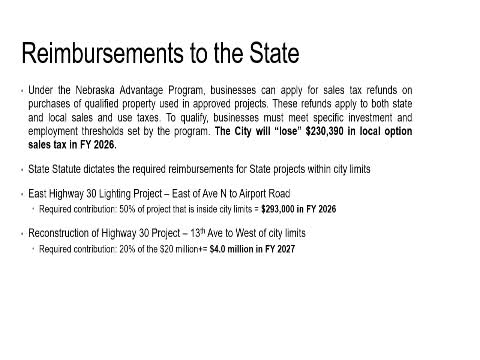
City staff presented a multi‑year capital project list that includes Highway 30 reconstruction (city share ~ $4M in FY27), an Antelope/39th corridor reconstruction (~$6.4M estimate for next‑year items) and major drainage projects estimated at several million dollars.
City Manager Brenda Jensen and public‑works staff presented a consolidated list of future capital projects and funding considerations, ranging from roadway and intersection upgrades to drainage, water and sanitary‑sewer expansions, a new vehicle maintenance facility and potential airport service subsidies.
Highway 30 and road projects
Jensen said the state will manage major work on West Highway 30 and that the city expects to pay a share. Staff projected the FY27 Highway 30 reconstruction as a roughly $20 million state project with an approximate city share near $4 million (about 20%). Jensen also described an East Highway 30 lighting replacement project that will cost the city about $293,000 next year.
Antelope/Thirty‑Ninth Street
Staff identified the Antelope/39th Street area as a priority because forthcoming annexation and nearby residential plats will increase traffic. Jensen outlined a proposed three‑lane section with a center turn lane and a roundabout; preliminary next‑year estimates for the city’s portion of work related to the Antelope/39th corridor were about $6.4 million (tapers to the roundabout included) but did not assume full Antelope improvements at this stage.
Drainage and bridges
Jensen described the downtown drainage vulnerability and a proposed project that would install twin 60‑inch pipes under the railroad to reduce downtown flooding; the city’s current estimate for that project is about $7 million and staff recommended a grant‑seeking strategy given the project’s historic‑flooding record and grant competitiveness.
Water, sewer and utilities
Staff flagged several utility projects intended to support growth and relieve existing constraints: an N‑Avenue water‑tower loop (~$1.1M), a Highway 30 water loop (~$410K), an M‑Avenue loop under the interstate (~$1.2M) and a Chase Avenue sanitary‑sewer trunk main tied to larger development needs (projects of several million dollars; portions eligible for EDA or similar grants were noted).
Other facilities and priorities
Vehicle maintenance: Staff said the current vehicle‑maintenance facility is undersized for modern fleet needs and recommended planning for a new maintenance building on city‑owned land; they said that the new building would likely require a new site rather than expansion of the existing facility.
West interchange and long‑range growth: Jensen outlined a possible west interchange scenario (Thirtieth Avenue) and itemized preliminary upstream costs — widening overpass lanes, paving Thirtieth Avenue and related connectors — that together could add many millions to a west‑interchange proposal. She noted federal participation or earmarked federal funds would federalize the project and add compliance costs.
Airport air service
Staff said the city has explored reestablishing a second scheduled route (for example, service to Chicago) and provided a placeholder annual cost of roughly $1.5–$1.8 million per year for market‑support costs; staff emphasized that number is a planning placeholder and that airline negotiations and federal EAS/MRG program relationships would determine any final subsidy requirement.
Why it matters: Jensen urged the council to prioritize projects to balance maintaining existing assets and investing to support growth; she said some $1M‑to‑$2M capital projects can be funded from the city’s special‑sales‑tax capital allocation while larger undertakings will require bonding, regional/federal grants or intergovernmental strategies.
Ending
Staff proposed turning the long list into a prioritized plan with funding strategies for council consideration; they said they will follow up with traffic studies, grant searches and financing scenarios for the projects that the council identifies as top priorities.