Get Full Government Meeting Transcripts, Videos, & Alerts Forever!
Get email alerts on the Consolidated Plan 2025 2029 topic
No spam. Unsubscribe anytime.
Erie holds second public hearing on draft 2025–2029 HUD consolidated plan; residents press for after‑school, homelessness and housing funds
Summary
City staff presented the draft 5‑year HUD consolidated plan and estimated 2025 allocations; residents and nonprofit leaders urged continued or increased Community Development Block Grant, HOME and ESG funding for after‑school programs, shelter capacity and affordable housing.
City of Erie staff and their consultant presented the draft 2025–2029 U.S. Department of Housing and Urban Development (HUD) consolidated plan and the proposed 2025 Annual Action Plan at a second public hearing, and nonprofit leaders and residents urged the city to prioritize after‑school programs, homeless services and affordable housing in the use of federal funds.
Bill Wasilewski, consultant with Mullen and Lonergan Associates, told the hearing the consolidated plan compiles a housing-market snapshot, a housing and homeless needs assessment and a strategic plan that sets priorities the city must use to program Community Development Block Grant (CDBG), HOME Investment Partnerships (HOME) and Emergency Solutions Grant (ESG) funds. Wasilewski said the planning process included five or six stakeholder sessions, targeted surveys of people with lived experience in shelters, and two public needs meetings. He said the plan incorporates those inputs when identifying “high priority needs” for the next five years.
The draft plan cites the 2024 point‑in‑time survey showing 378 people in emergency shelters and 76 unsheltered individuals; it reports roughly 30% of households in the area are cost‑burdened (paying more than 30% of income for housing) and describes an expanding gap in affordable, accessible units. Wasilewski said shelter capacity and longer wait times to enter shelter surfaced repeatedly in the persons‑with‑lived‑experience survey.
Deborah (Department of Economic and Community Development staff) and Dave Dieter (city staff) presented estimated fiscal‑year 2025 allocations, emphasizing they are estimates until HUD issues official numbers. Dieter said proposed category amounts for CDBG included $769,789.24 for public services, $221,000 for housing activities, $1,201,964 for public facilities and improvements, $114,918 for economic development, and $571,063 for general administration. He reported last year’s HOME allocation at $764,318 and ESG at $267,205 and noted HUD requires 15% of HOME be set aside for Community Housing Development Organization (CHDO) activities.
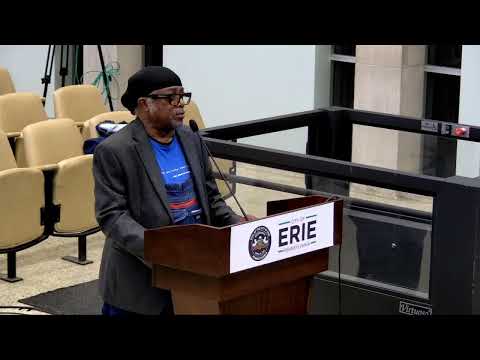
Speakers from a range of Erie nonprofits and community groups used the public‑comment period to describe services and to request support from CDBG, HOME or ESG funds. Karen Gretler of the John F. Kennedy Center urged continued support for after‑school programs, saying such programs “keep kids safe during out of school time.”
Jennifer Dunnehy, program director at Daftmark Dance Theater, described a free year‑round after‑school and summer arts program for youth living in public housing and said the program provides “47 weeks of programming. That’s 947 hours of programming annually,” and employs about 30 community teaching artists. Dunnehy asked CDBG support to sustain site‑level staff and improve pay to retain quality employees.
Chantelle Hilliard of the Booker T. Washington Center and other presenters made similar appeals to maintain summer and out‑of‑school programming with educational components, meals and transportation. Edison Nicholson of the Youth Leadership Institute of Erie asked that the city document how many young people are served in specific categories (leadership development, service learning, mentoring, post‑secondary assistance and workforce development) so outcomes can be tracked.
Jenny Haggerty of Mercy Center for Women said her organization houses people who are homeless and those fleeing domestic violence and reported a wait list: “We have 85 individuals trying to get into our program,” she said, and described a recent facility purchase to add space for 10–12 more residents. Mercy Center echoed other commentators in calling for greater coordination among city, county and nonprofit providers.
Bishop Frank Quinn of the Community Cornerstone Project, Gary Horton of Urban Erie Inc. Community Development Corporation and others described business incubator cohorts, services for new Americans, and efforts to leverage CDBG support for local entrepreneurs and housing improvements. Kathy Schoff, who identified herself as a council member, said she supports the nonprofit speakers and urged continued investment, saying “we’re better together.”
Wasilewski and city staff stressed the draft plans are on a 30‑day public display that began April 11 and runs through May 12, with a planned City Council adoption vote on May 21 and submission to HUD afterward. Wasilewski noted the city cannot finalize or submit final plans until HUD provides the official 2025 allocations and any submission timing guidance. He said the city expects HUD to release allocations in May and plans to submit the Annual Action Plan in early to mid‑June if HUD timing permits.
What happens next: the draft consolidated plan and the 2025 Annual Action Plan remain on public display through May 12; the city expects to present the plans to City Council for adoption on May 21 and then submit to HUD after the agency issues allocation and submission guidance. No formal votes or final funding decisions were recorded at the hearing; the figures presented were explicitly described as estimates pending HUD’s allocation.
Ending: City staff invited further written comments during the public‑display period and noted a second hearing scheduled later the same day. The hearing record will feed the final consolidated plan and Annual Action Plan that the City Council will consider for adoption.