Get Full Government Meeting Transcripts, Videos, & Alerts Forever!
Get email alerts on the Land Use Urban Growth topic
No spam. Unsubscribe anytime.
Lexington staff unveils framework for preservation and urban service area review
Summary
Planning staff outlined a proposed Preservation and Growth Management Program that would add an off‑cycle five‑year growth‑trends report and a formalized pathway for "special need" economic projects to request urban service area changes, with multiple public meetings and data tools planned.
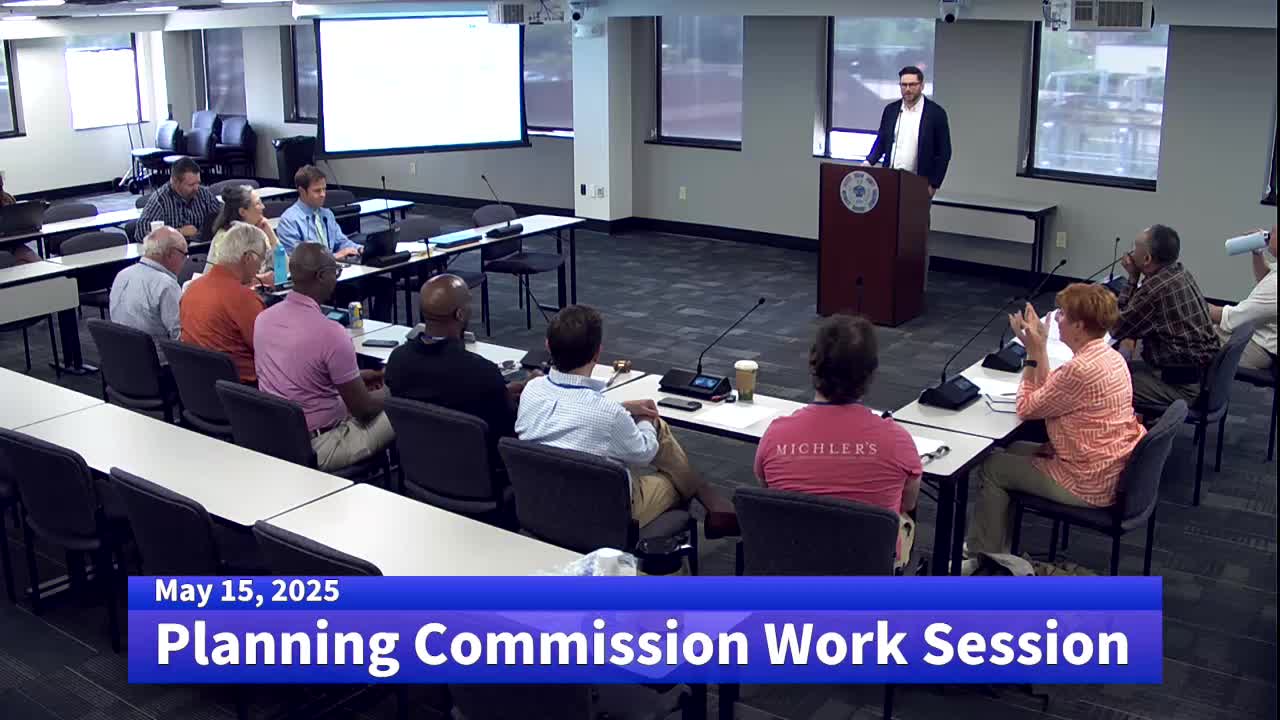
Planning staff presented an initial framework for a preservation and growth‑management program that would add an off‑cycle five‑year growth trends report and a defined process for considering changes to Lexington’s urban service area.
The presentation, given to the Planning Commission work session and described as a follow‑up to a May 6 briefing to the General Government and Planning Committee, lays out a process that begins with a five‑year trends report and projects land need over a 20‑year horizon. If the report shows adequate land supply, no further action would be taken. If it identifies a need, staff said the planning commission would recommend one or more responses — policy change, regulatory change, or an alteration of the urban service area — and forward those recommendations to the Urban County Council for decision.
Why it matters: supporters said the framework would create a transparent, data‑driven method to assess whether Lexington must expand its urban service area or instead meet demand through policy and zoning changes. Opponents and some commissioners pressed staff to ensure environmental protections, farmland preservation and transportation and equity goals are integrated into the metrics.
Planning staff described two pathways in the framework: a regular review tied to the comprehensive plan cycle and a separate “special need” route for transformative economic development projects that would require an Urban County Council supermajority to proceed. Hal Bailey, the staff presenter, told commissioners there will be public outreach: “There is a public outreach meeting next week, May 22. This is being held at the Senior Center.” Bailey said the plan also envisions publishing metrics on the city’s Imagine Lexington Data Research Center so residents can see the data informing decisions.
Under the proposed process, if a need for acreage is identified the planning commission would first review vacant land within the urban service area — including the option to remove underperforming parcels — then open a 60‑day window for proposals on sites that meet location/guardrail criteria. Selected parcels would be master planned, followed by zone‑change requests where required. Bailey estimated that a full alteration of the urban service area, from initial recommendation to adoption, would take roughly two years, with most time spent on master planning.
Commissioners and attendees asked multiple clarifying questions about definitions and tradeoffs. Commissioners pressed staff on how the program would treat privately held vacant land (staff said private property rights limit what local government can require), how commercial and industrial land needs would be weighed alongside housing needs, and how the process would protect natural and agricultural lands. Commissioner comments suggested several points of emphasis: integrate transportation and environmental data into the metrics, examine examples from states with similar programs (Oregon, South Carolina, Tennessee were cited), and codify the membership and duties of any planning‑commission subcommittee by ordinance rather than ad hoc process.
Staff also flagged existing inventories: Bailey said the Imagine Lexington data research center has been updated in the past month to include vacant‑land calculations by zone down to parcel level, and that the planning commission would use that information to evaluate underutilized parcels. He listed next steps and dates: additional outreach May 22 (Senior Center), updates to Urban County Council and GGP in July, a draft expected Sept. 9 and a public forum Sept. 16. The staff presenter said the work on metrics (which metrics to include and how to measure “need”) remains in progress.
The presentation emphasized that the framework is intended to codify existing practices and make the review more regular and transparent rather than to push expansion by default. Bailey said the process “is really just codifying the things that we have done in the past while also allowing our other elements of the comprehensive plan to breathe.”
Looking ahead: staff said a subsequent policy phase will define the exact metrics for the five‑year growth trends report, the composition of a planning commission subcommittee, and specific location criteria that would guide master planning. Commissioners asked staff to return with proposals that explicitly incorporate preservation goals, farmland and natural‑resource protections, and transportation and equity measures into the analytic framework.