Get Full Government Meeting Transcripts, Videos, & Alerts Forever!
Get email alerts on the Municipal Finance topic
No spam. Unsubscribe anytime.
Committee OKs first reading of $5.7M carryover appropriation for CIP projects ruled ineligible for tax-exempt bonds
Summary
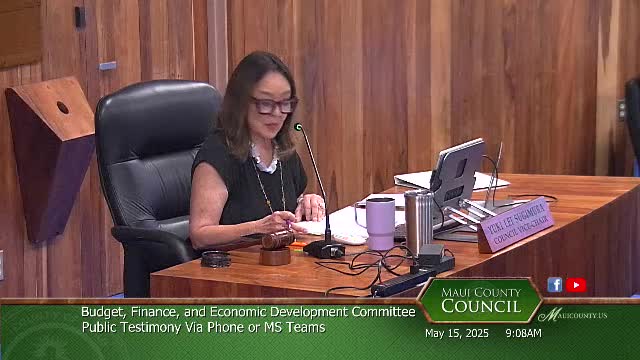
The Budget, Finance and Economic Development Committee recommended first reading approval of a bill to recognize roughly $5.7 million in carryover savings to reimburse the general fund for capital projects that no longer qualify for tax-exempt bond financing.
The Maui County Budget, Finance and Economic Development Committee voted to recommend first-reading passage of a bill that recognizes carryover savings to reimburse the general fund for capital improvement projects the county now says will not qualify for tax‑exempt bond financing.
The bill would appropriate roughly $5.79 million in carryover savings to a countywide line item titled “reimbursement to the general fund for projects disqualified from tax exempt bond issuance.” Budget and finance staff told the committee the projects had been paid with cash but will not meet federal timing requirements for tax‑exempt treatment when bonds are issued.
Why it matters: the county had previously planned to fund the projects with tax‑exempt bond proceeds but delayed issuance because of legal and settlement issues and the 2023 wildfires. That delay pushed several projects beyond the deadline that preserves tax‑exempt status; the administration says issuing taxable bonds or a separate bond series would be more expensive.
Deputy Finance Director Maria Zelinski told the committee, “We are seeking utilization of carryover savings of $5,000,007.94 76, to utilize for CIP that was initially earmarked for bond funding.” She and Budget Director Leslie Milner said staff had worked with bond counsel and the county’s municipal adviser to identify the projects that would become taxable and that the list is based on department reporting and counsel review.
Milner told members the appropriation will exhaust remaining carryover savings recognized in the fiscal year 2025 budget: “We will have no carryover savings left after this.” Committee members pressed staff on timing and scope. Dan Shupak (county CIP coordinator), appearing online, confirmed departments had been contacted to verify which projects could be completed within the timeframes required for tax‑exempt financing.
Staff described the technical reason as an arbitrage/timing issue under the Internal Revenue Code and the county’s general budget provisions: if projects are placed in service more than the allowed period before bonds are issued, bond counsel will deem them ineligible for tax‑exempt proceeds. The committee heard that one cutoff date referenced in testimony was July 16 and that staff are assuming a bond issuance in August or September.
Council members asked whether taxable issuance would be materially more expensive. The deputy finance director said the additional cost varies but estimated it could be on the order of a few dozen basis points and noted the administrative expense of a separate issuance could be substantial. Members also asked whether additional projects could become ineligible; staff said they had worked to identify all items that might become taxable by August.
The committee recorded a voice vote on first reading with seven members voting aye and two members excused. The transcript records the two excused members as Member Johnson and Member Kama. The committee did not adopt any other substantive changes at the meeting.
What’s next: the item moves to full council for second reading. Staff said they are coordinating with bond counsel before any final bond issuance.