Get Full Government Meeting Transcripts, Videos, & Alerts Forever!
Get email alerts on the Ignition Interlock topic
No spam. Unsubscribe anytime.
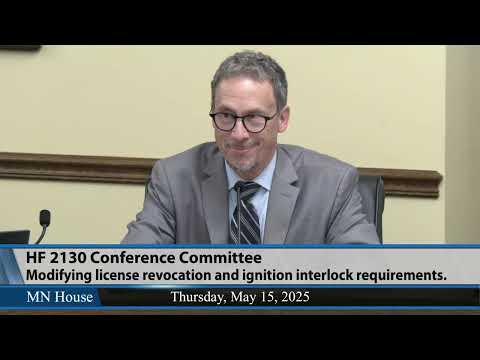
Conference committee approves changes to Minnesota ignition-interlock rules after St. Louis Park crash
Summary
A Minnesota legislative conference committee on May 15 approved amendments to House File 21 30 expanding ignition-interlock rules, increasing a penalty for driving without an interlock while on the program and adding a special-revenue appropriation of $382,000 per year beginning in FY2026.
A Minnesota conference committee on House File 21 30 on May 15 approved a package of changes to the state—s ignition-interlock program, including new rules for how time on the program is credited after interruptions, an increase in the penalty for driving without a required interlock while enrolled, and a $382,000-per-year appropriation from the Driver and Vehicle Services operating account beginning in fiscal year 2026.
The bill was brought after a September crash at the Park Tavern outdoor patio in St. Louis Park in which a driver with five prior DWI convictions killed two people and injured 12, a fact committee members cited repeatedly during debate. "This has been a journey ... born of a tragedy and hopefully will help prevent future similar tragedies," said Senator Latz, a sponsor of the bill.
Nonpartisan staff explained the key differences between the house and senate versions and summarized three scenarios the amendments address. First, if a participant temporarily cannot drive for non-alcohol reasons (for example, no longer owns an operating vehicle), they may voluntarily suspend participation and, if they later restart, receive credit for prior time on the program. Second, if a person has a non-driving alcohol-related conviction (a conviction involving alcohol but not driving), the participant may remain on the interlock while restarting the requirement and receives credit equal to half the time previously served. Staff gave the example that if a participant had a two-year requirement and completed one year, a later qualifying violation would require completion of an additional 18 months. Third, if a participant is removed from the program due to a new alcohol-related driving offense, they are terminated from the existing participation and must restart the interlock requirement; the applicable period will be the longer of the new revocation period or the original revocation period, preventing a shorter new sentence from shortening the total required time.
Committee members adopted three amendments by voice vote: the A7 amendment, which harmonizes the bill's new penalty for driving without an interlock with existing law (raising the existing misdemeanor to a gross misdemeanor and replacing the bill's separate penalty text with a cross-reference to that existing provision); the A8 amendment, which codifies the three restart/suspension scenarios described above; and the A10 amendment, which clarifies that a participant who voluntarily withdraws or is terminated and has the interlock device removed is not required to continue paying monthly device fees once the device is removed.
Staff also noted an appropriation on the house side: $382,000 in each fiscal year beginning in FY2026, paid from the Driver and Vehicle Services operating account (a special revenue fund), to cover costs related to expanding the interlock requirement. Senator Limmer confirmed the dollar amounts match the larger senate public-safety bill where similar funding was included.
The committee moved to adopt the house language (House File 21 30, fourth engrossment) as amended and to include the senate—s section 17 provision; both motions were approved by voice vote. Committee leadership directed nonpartisan staff to prepare the conference committee report and authorized staff to make technical and conforming edits to reflect the committee—s intent; members were asked to watch for the report by email for signature.
Members who spoke in support emphasized safety and the desire to increase participation in the interlock program by reducing financial barriers and clarifying restart rules. Several members also noted remaining work to address driving incidents tied to controlled substances versus alcohol, which they said is complicated to resolve within an alcohol-focused interlock regime.
The conference committee adjourned after adopting the amendments and instructing staff to complete the report for signature and transmittal to both houses.