Get Full Government Meeting Transcripts, Videos, & Alerts Forever!
Get email alerts on the Homelessness Funding topic
No spam. Unsubscribe anytime.
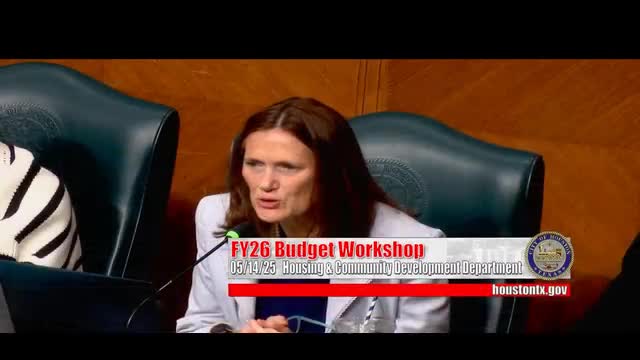
Houston housing department outlines FY26 budget, flags federal funding exposure and homelessness spending
Summary
At a Houston City Council housing budget workshop the department presented a reduced FY26 general fund allocation, detailed a new in‑street homelessness special revenue fund, and said a $314 million disaster‑recovery grant (DR24) is authorized but its grant agreement is pending. Officials emphasized the department
The Houston housing department presented its proposed fiscal 2026 budget at a council housing workshop, saying the department faces a smaller local allocation while remaining heavily dependent on federal grants and new special‑revenue money for street homelessness.
At the workshop the department said the FY26 general fund allocation it controls has been reduced by roughly 30 percent from FY25 (about $690,000) to a proposed $1,600,000, while a newly highlighted special revenue account for ‘‘in‑street homelessness’’ (Fund 2012) shows a balance presented in the slides as 31.485 (as presented). Department staff also said they expect all Fund 2012 dollars to be used for homelessness services and operations rather than personnel.
Why it matters: The department told council members it relies on federal programs for the overwhelming majority of its budget and staffing; the presentation slides listed 94.6 percent of the department of funding as federal, while presenters later said verbally that 98.7 percent of funding would come from federal sources. Staff warned that pauses or cuts in federal grants would have ‘‘drastic’’ effects on programs, residents and employees.
Key budget details and programs
- Federal grant exposure: The department identified HUD programs by name during the presentation (CDBG, HOME, ESG, HOPWA) and said HUD published FY26 allocations the morning of the workshop showing small increases in most programs (CDBG +3.5%, HOME +2.7%, HOPWA +2.8%) and a roughly $22,000 (~1%) lower ESG award than estimated. Staff said those FY26 changes affect the department beginning July 1, 2025, while larger federal‑budget proposals in the president budget would require congressional action in future years.
- Disaster recovery award (DR24): The presentation listed an authorized Disaster Recovery 2024 (DR24) award of roughly $314,000,000. Department staff said the DR24 grant is a new award for which a grant agreement is pending; the city has not yet closed the grant agreement and staff said they will return to the committee on June 3 to discuss DR24 planning and spending.
- In‑street homelessness special revenue fund (Fund 2012): The department described Fund 2012 as a special revenue account intended for homelessness services and operations. Staff said two major current contributors to Fund 2012 are a Metro grant (listed at $10,000,000) and a Houston First grant ($2,600,000). The Metro grant and Houston First funds have separate MOUs; staff said the Metro MOU is more prescriptive while the Houston First MOU is broader. Council members asked for written guidance showing what is allowable under Fund 2012 and staff agreed to provide MOU language and fund details.
- Navigation center: Staff said the city has a planned $3.5 million general‑fund request tied to a navigation center; some of that amount is anticipated to flow into Fund 2012. Staff said some of the city general‑fund request for the navigation center has already been allocated this year and the department will return annually to request additional funds as needed.
- County, philanthropic and private partners: Staff said Harris County negotiations could yield $8 million for homelessness work and another $8 million potentially for eviction protection or broader homelessness prevention, but those amounts remained under negotiation at the time of the workshop. Philanthropic partners described in the discussion expressed interest in providing recurring support; staff said philanthropies were ‘‘bullish’’ and suggested philanthropy could produce roughly $20 million a year if city and county commitments align, and that some philanthropic asks had been framed as a $70 million request.
Staffing, restructuring and one‑time costs
- Personnel totals and federal payroll coverage: The slides list 183 employees; staff explained a total of 208 positions when including employees funded in other city departments and said approximately 207.75 full‑time equivalents are covered by federal awards. That heavy federal reliance applies to program staff as well: staff said roughly one quarter of the department head's time comes from general funds and the rest is federally funded.
- Voluntary retirement payout and reorganization: The presentation said 29 employees were eligible for a voluntary municipal retirement payout option; 11 accepted at a 38 percent payout level, producing an estimated reduction of about $900,000. The department said it has reduced the share of managers with fewer than four direct reports from 52 percent to 36 percent and reduced management layers from eight to six as part of an ongoing restructure.
Metrics, program design and risk management
Council members pressed staff for outcome metrics. Staff described a two‑year homelessness plan goal of moving people off the street into housing or services rapidly (for example, targeting housing or program enrollment within 30 days of entry to the homeless response system) but said exact unit or placement counts would be provided after staff follow up. Council members also asked about eviction protection: staff said the hoped‑for county funding would be broader than the COVID‑era eviction programs and emphasized diversion and prevention (keeping people housed) rather than forced sheltering.
Public comment and community priorities
Two public speakers urged funding priorities and program design: Guadalupe Fernandez of Bayou City Waterkeeper urged the city to prioritize disaster‑recovery and CDBG funds for home‑repair programs (including private sewer lateral repairs) to prevent future housing deterioration, saying dedicated investment would help low‑income homeowners and prevent homelessness. "We strongly advocate for prioritizing programs that address the fundamental needs of homeowners impacted by disasters," Fernandez said.
Sarah Saeed, policy manager for Urijuntos, urged investment in disaster preparedness (not only recovery) and language access staff for multilingual communities, and asked whether the funding gap for the city's stated $70 million homelessness ask would be closed. Saeed said communities need staff who can coordinate with low‑income apartment and senior complexes during emergencies.
Department comment and next steps
The housing department warned council members it is monitoring federal actions closely: "We are monitoring everything that comes out of the federal government like a hawk," the department director said at the workshop. Staff said they will return to the committee on June 3 to present more details on the DR24 award and will provide MOUs and fund guidance for Fund 2012. Staff also said they will follow up with written metrics on unit production estimates and homelessness outcomes when that data is available.
What the workshop did not resolve
No formal votes were taken during the workshop. Several numeric items presented on slides differed from numbers cited verbally during discussion (for example, the slides and the oral remarks gave different percentages for federal funding), and staff committed to providing clarifying documents and written guidance for Fund 2012, DR24 planning, and unit/outcome metrics.
Ending note
Staff asked council members to consider the multi‑year nature of homelessness spending and the need to coordinate city, county and philanthropic resources. The committee scheduled a follow‑up presentation on the DR24 award and related planning for its June 3 meeting.