Pompano Beach leaders debate public financing, infrastructure bonds and community benefits for downtown project
Loading...
Summary
City staff, the CRA and developer RocaPoint outlined financing options and a master infrastructure plan for a proposed $2 billion downtown redevelopment; commissioners postponed final CRA bond votes and residents pressed for guarantees on jobs, a vocational center and preservation of the E. Pat Larkins community center.
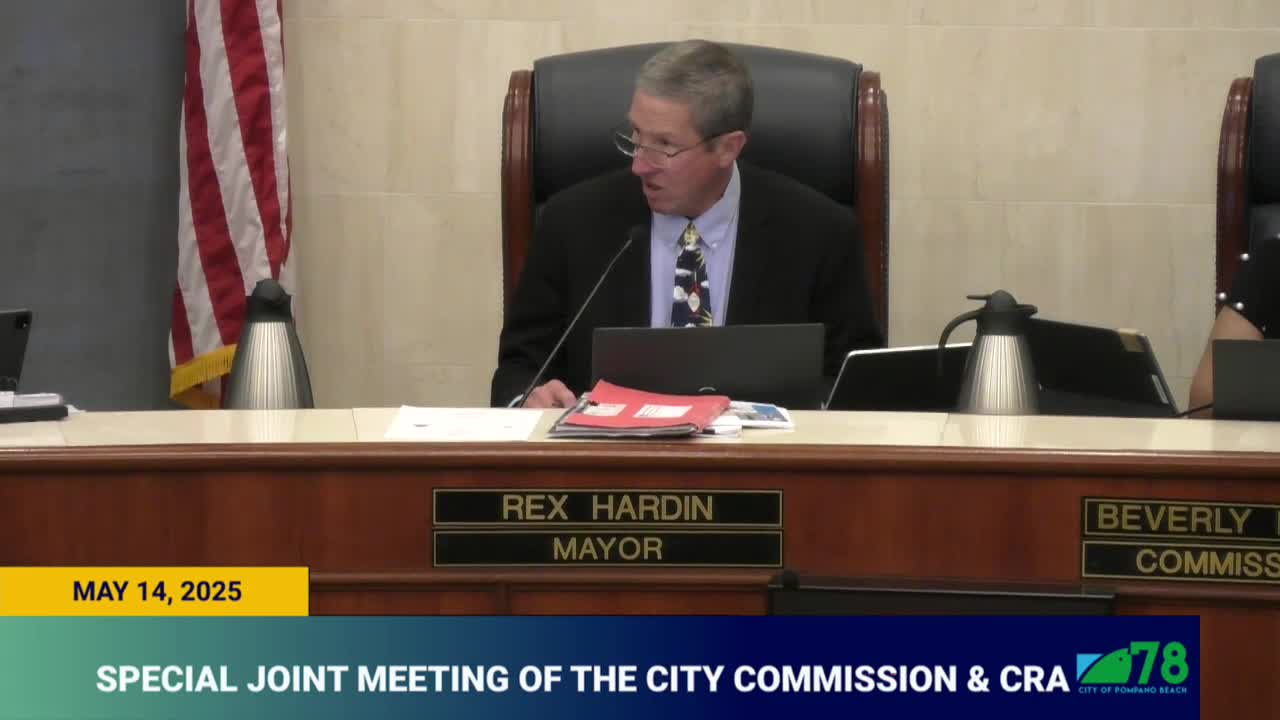
POMPANO BEACH, Fla. — City and Community Redevelopment Agency leaders on May 14 presented designs and financing options for a proposed downtown redevelopment that would include a new City Hall, a parking garage and substantial infrastructure, and heard hours of public comment pressing for local jobs, cultural preservation and protections against displacement.
The meeting focused on two financing choices spelled out in the city nd master development agreement with RocaPoint Partners approved in June 2024: private financing, under which the developer would borrow to construct the civic facilities and the city would make annual lease payments; and public financing, under which the city or CRA would issue debt directly. Assistant City Manager Suzette Sibyl framed the choice as one that could reduce long‑term costs and free money for community priorities. "By dropping that annual lease payment and reducing what we're gonna pay over the 30 year term, it frees up all of these resources to go towards supporting all of those elements," Sibyl said.
Why it matters: the commission and CRA are being asked to pay for both the civic buildings and a large "master infrastructure" package of utilities, stormwater and site preparation to make the CRA-owned pads developable and marketable. Staff and outside counsel said the infrastructure increases parcel values and will improve marketability, and that funding choices affect how much money the CRA has available for community elements such as job training, a vocational center and cultural/heritage programming.
Key facts and figures presented - The master development agreement approved June 20, 2024, obligates the city/CRA to construct civic facilities (City Hall, a parking garage and a community center) and to fund master infrastructure in the downtown area. - Staff presented two financing scenarios for the civic facilities: a private financing scenario with an annual lease payment capped at about $12.9 million and an assumed interest rate cited at about 8 percent, producing an estimated total payment of roughly $368 million over 30 years; and a public financing scenario with a projected annual payment near $9.1 million, a materially lower market interest rate (staff cited about 5.2 percent), and a total payment near $268 million over 30 years — a difference staff characterized as about $100 million in savings versus the private option. - The proposed ordinance language before the commission would authorize issuance of certificates of participation for the civic facilities (aggregate principal not to exceed $137 million was included in backup materials) and related trust/lease instruments; separately, the CRA considered a supplemental resolution to authorize up to $75 million of tax increment revenue bonds to fund the master infrastructure. - The CRA reported $3.6 million already budgeted toward initial infrastructure work; the proposed bond issuance would cover the remainder of the CRA's obligation for the master infrastructure.
Discussion and next steps CRA Director Nguyen Tran and RocaPoint partner Patrick Leonard described the scope of work needed to make the CRA pads developable: environmental remediation, raising grades to meet FEMA/floodplain requirements, replatting, burying and relocating utilities, stormwater work and a new road network. "This is probably another year's worth of work to get through all of these issues just to resolve it to make it sort of developable," Leonard said.
Longtime residents and community leaders used the public comment period to press elected officials for guaranteed local benefits. Ed Phillips, a northwest resident, summarized the message repeated throughout the meeting: "Find an African American who can do some of this stuff. It's nice to see all these folks up in here who are making money nd I think— of the commissioners mentioned a lot of money is being made here. Do not make us feel that we are asking to be at the table, and you're gonna put us at the table, but we want a knife and a fork to be able to carve some up too." Other speakers asked specifically for a new E. Pat Larkins community center (some asked for a new building rather than a renovation), a vocational/technical center, a college branch, minority business set‑asides and apprenticeship or local hire targets.
Legal and procedural points Outside counsel Eric Singer, who led the city's public‑private partnership practice, told the commission the development agreement gives the developer the default obligation to deliver and privately finance the civic buildings, and that the city has an option to exercise public financing. Singer also noted that the CRA's obligation to pay for the master infrastructure is independent of the particular bond issuance mechanics: "The obligation of the city to fund the infrastructure project isn't dependent on this particular bond issuance," he said.
Actions taken and scheduling - The commission approved the meeting agenda at the start of the session (voice vote recorded as unanimous). - The assistant city manager's presentation and demonstration slides were incorporated into the official meeting record at the request of staff. - After extended public comment and commissioner discussion about language in the draft resolutions and the need for more time to respond to community requests, CRA members moved to postpone further CRA votes on the bond and project resolution to allow additional review and outreach; the board scheduled a continuation for June 4, 2025, to re‑consider the CRA supplemental bond resolution and related actions.
What was not decided The commission did not adopt the certificates/lease ordinance or the CRA supplemental bond authorization during the session. Commissioners and several speakers said they wanted more time to resolve contract language, to firm up commitments on vocational training and community center design and to ensure the Northwest community's interests are better reflected in the project documents before final bond and lease approvals.
Where things stand The project remains under contract with RocaPoint Partners as master developer; staff and the CRA have signaled a staff preference for public financing to reduce interest costs and increase funds available for additional community elements, but the final financing path and the exact content of community commitments remained unresolved as the CRA postponed bond approval to June 4. The project team said the master infrastructure work is necessary to increase pad values and attract vertical developers once the CRA parcels are made developable.
What's next The CRA will reconvene on June 4, 2025, for continued consideration of the supplemental bond resolution and related financing items. Commissioners said they plan additional briefings and a possible public workshop to better document community benefits, local hire goals and physical design commitments before taking final votes.