Get Full Government Meeting Transcripts, Videos, & Alerts Forever!
Get email alerts on the Fuel Infrastructure Pipeline topic
No spam. Unsubscribe anytime.
Commission approves license and lease amendment to clear way for 20‑mile Flint Hills jet‑fuel pipeline
Summary
The Austin Airport Commission voted unanimously to authorize staff to negotiate and execute a license agreement with Flint Hills Resources for a proposed roughly 20‑mile jet‑fuel pipeline from Bastrop to Austin and to approve an amendment to the airline consortium's ground lease to accommodate the connection on airport property.
The Austin Airport Commission on May 14 authorized staff to negotiate and execute a license agreement with Flint Hills Resources for a proposed roughly 20‑mile jet‑fuel pipeline from Bastrop to Austin and approved an amendment to the airline fueling consortium’s ground lease to accommodate the pipeline connection on airport property. Both items passed unanimously at the commission meeting.
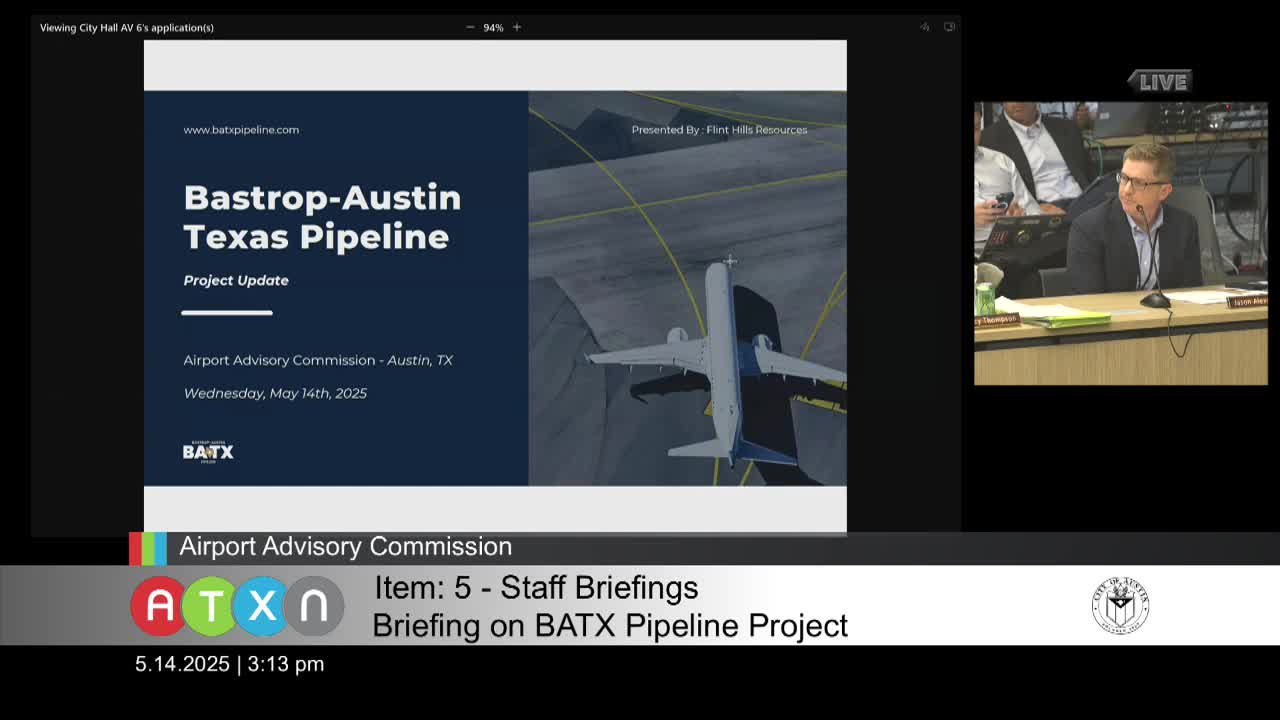
The project, presented by Flint Hills representatives Andy Saenz and Jake Rent, would replace daily truck deliveries to Austin–Bergstrom International Airport with a 10‑inch pipeline intended to improve reliability and reduce truck traffic. "My name is Andy Saenz. I'm the public affairs director for Flint Hills Resources," Saenz said during the presentation. Jake Rent described the proposal as a step to address supply reliability: "This project aims to improve the reliability of the transportation fuel delivery system to the Austin Airport," he said, noting Austin currently relies on more than 100 round‑trip truck deliveries a day from Bastrop.
Commissioners and staff received a technical briefing before voting. Jason Alexander, deputy chief of airport affairs, summarized the department’s role in coordinating with Flint Hills and TxDOT on route selection. Tracy Thompson, chief commercial officer, described the lease amendment as a narrow real‑estate change to move a small parcel of land from the fueling consortium’s lease into a license to be held by the pipeline company for the connection and long‑term maintenance.
Commissioners asked about schedule, permitting, land access and safety. Rent said the company expects to pursue permits and try to begin construction late this year if permits are secured, with about six months of construction once started and a target of being in service in early 2027, subject to permitting and schedule risks. He said the majority of the route follows TxDOT right‑of‑way, with "about 7%" on private easements and roughly 2.5 miles on airport property. On worker and construction safety, Saenz said Flint Hills would comply with the city's Build Better standards and vet contractors for safety records: "Safety is always first and foremost," he said.
Commissioner questions also probed capacity and redundancy. Rent said the 10‑inch pipeline design provides capacity to meet current demand—approximately 20 million gallons per month as cited during discussion—and can be uprated with additional pumping if demand rises. He said truck deliveries could still be used as a backup if required.
Before the vote, commissioners were told that approval at the commission would allow staff to present the agreements to city council for final action. Commissioners made and seconded motions to approve the two related items, paused for discussion as required by the commission's process, and then voted. The record shows both the license agreement authorization (agenda item 7) and the amendment to the amended and restated airline fueling lease (agenda item 8) passed unanimously with no recorded dissents.
The commission did not take further construction approvals; Flint Hills representatives said additional local permits, TxDOT coordination and other regulatory approvals remain to be completed before construction could begin. The company said it has pursued community engagement, public open houses and stakeholder meetings since the project's announcement and that the selected route attempts to minimize impacts by using existing TxDOT right‑of‑way where possible.
The commission's actions move the project to city council for consideration of the license and the lease amendment. Staff said updated RCA (request for council action) materials had been posted publicly prior to the meeting and would be part of the packet forwarded to council.