Get Full Government Meeting Transcripts, Videos, & Alerts Forever!
Get email alerts on the State Legislation topic
No spam. Unsubscribe anytime.
State lawmakers pass crime, behavioral-health and water bills; Sandoval delegation secures local capital outlay
Summary
New Mexico Representative Kathleen Cates and county lobbyist Lawrence Horan briefed the Sandoval County Commission on 2025 legislation that county officials say will affect public safety, behavioral-health funding, water regulation and capital projects in the county.
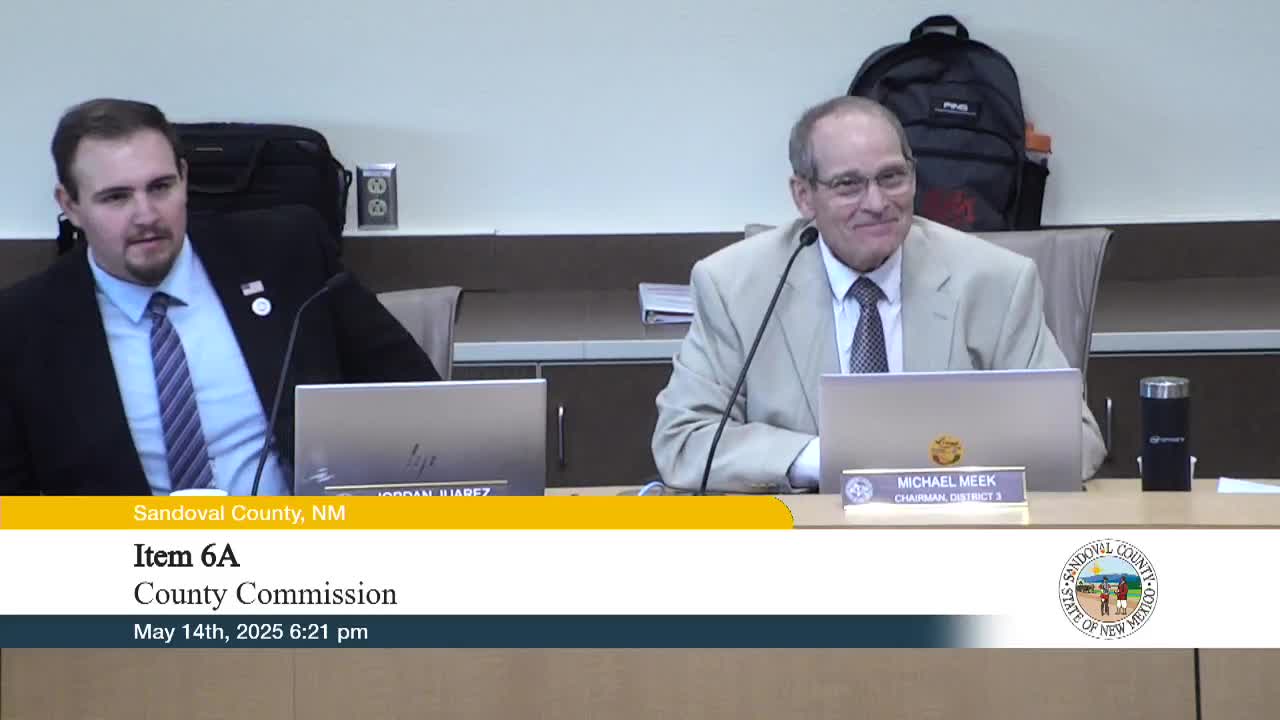
Representative Kathleen Cates, D-District 44, and lobbyist Lawrence Horan told the Sandoval County Board of County Commissioners on May 14 that the 2025 legislative session produced an omnibus crime package, major behavioral-health investments, changes to water regulation and a mix of capital outlay and program funding with direct relevance to the county.
Cates said an omnibus public-safety bill, described in the meeting as HB 8, rolled together six measures that increase criminal penalties in several areas and added state options for offenses that federal authorities do not pursue. "Our big lift for the first 30 days was HB 8 and also the Senate 3 bill behavioral health packages," Cates said, adding the package included changes such as defining competency and expanding restoration-to-competency mechanisms for people found unable to stand trial.
The congressionally recognized behavioral-health legislation was described by Cates as having "an unprecedented amount of funding" to implement programs requested by law enforcement and district attorneys. Horan said the legislature placed $200 million into a behavioral-health trust fund and created an advisory committee to plan statewide and regional behavioral-health services to be coordinated through the courts and administrative offices.
Cates and Horan also described other measures they said will affect Sandoval County: SB 16, which allows voters registered as "decline to state" (independent) to request a major-party primary ballot without changing registration; SB 21, intended to return certain surface-water regulatory authority to the state after a U.S. Supreme Court decision narrowed federal jurisdiction; and HB 192, a study and funding mechanism for the state's digital trunked radio system used by first responders.
"This bill allows us to study and provide information back to the legislature on the financial burden to our smaller communities," Cates said of HB 192, noting the state previously charged emergency-response areas subscriber fees that were burdensome for small towns.
Horan summarized the fiscal context: the legislature approved roughly a $10.8 billion budget with about $3.5 billion in new revenue and maintained reserves above 30 percent. He said lawmakers also established a Medicaid trust fund to hold excess reversions above a threshold for use on Medicaid, citing the program's large fiscal footprint.
The delegation reported several capital-outlay wins targeted to county priorities: $1.25 million for animal shelter construction, $1,005,000 toward courthouse work, $525,000 for an emergency dispatch center, $900,000 for sheriff's vehicles, $150,000 for broadband and $75,000 for a fire-suppression water-storage tank. Cates highlighted a Rio Rancho Career and Technical Education (CTE) ribbon-cutting and a statewide initiative to expand adult changing tables in public, gender-neutral restrooms; the tourism bureau will provide grants ranging from $5,000 to $50,000 to qualifying sites.
Horan and Cates also identified measures that did not pass. Horan said a paid family and medical leave bill stalled in the Senate Finance Committee after being pared back in the House. He also described contested tax-equalization proposals that lost funding support in the Senate. Several public-records (IPRA) reform proposals had hearings but did not advance; Horan said county and municipal stakeholders intend to continue conversations.
Commissioners asked follow-up questions about bills likely to return in future sessions and about how the state will fund ongoing radio-subscriber fees and other continuing costs. Cates said she anticipates returning to work on several public-safety, disability and water-conservation bills in the 2026 session.
Ending: The presentation closed with offers to continue intergovernmental coordination on capital projects and program implementation during the interim. Commissioners thanked Cates and Horan for the overview and said county staff will continue tracking statute language and appropriation details as programs move from policy to implementation.