Get Full Government Meeting Transcripts, Videos, & Alerts Forever!
Get email alerts on the Antisemitism In Schools topic
No spam. Unsubscribe anytime.
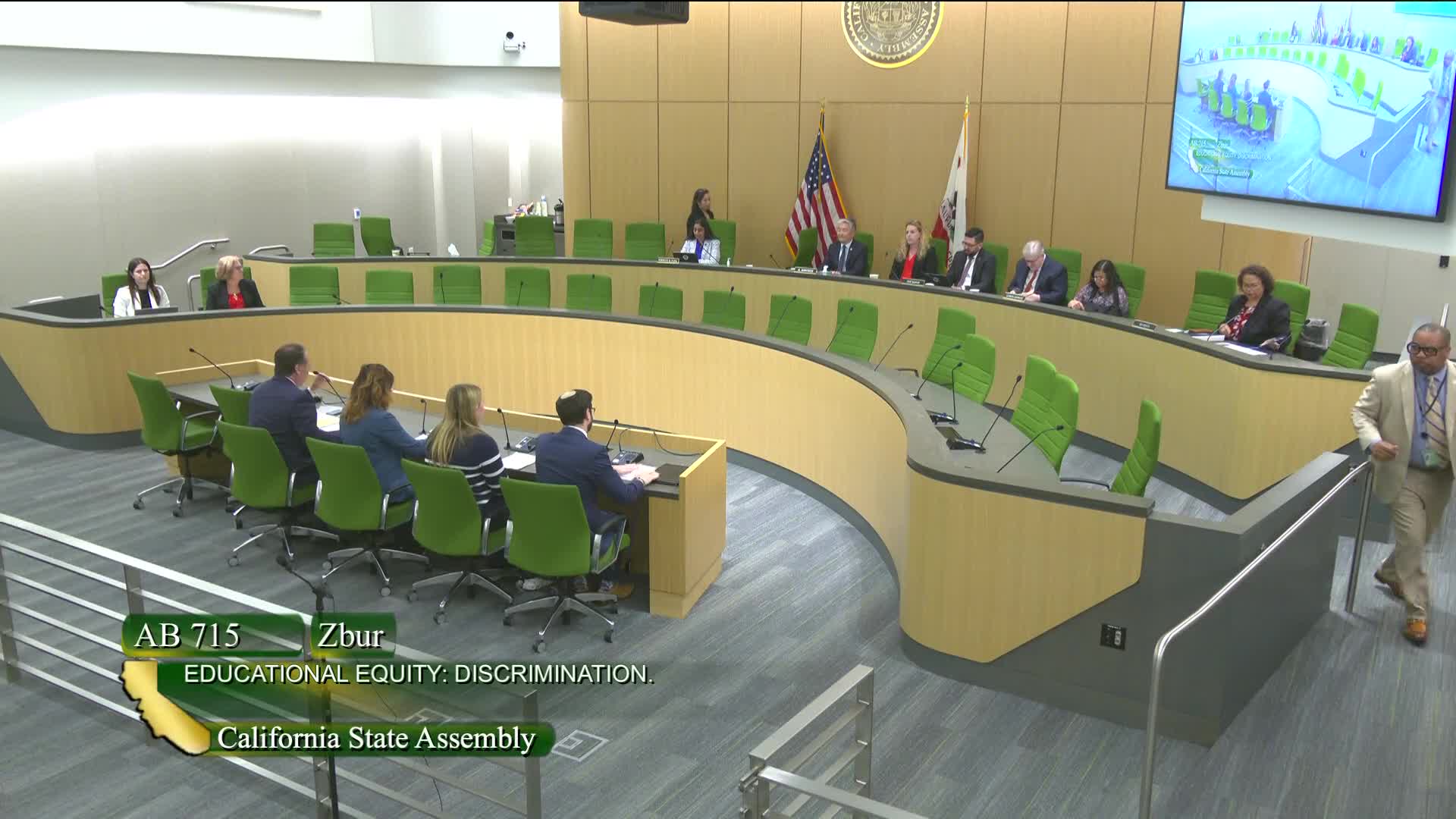
Assembly education committee advances bill to address antisemitism in K–12 schools amid debate over academic freedom
Summary
The Assembly Education Committee voted 9-0 to send AB 715 to the Appropriations Committee after a multi-hour hearing in which supporters described rising antisemitic incidents in California schools and opponents warned the bill could chill classroom discussion about Israel and Palestine and expand the uniform complaint process.
Assemblymember Zibur and Assemblymember Don Addis introduced AB 715 to the California State Assembly Education Committee and the panel voted to pass the bill to the Appropriations Committee by a 9-0 roll call. Proponents said the bill would strengthen protections and accountability for Jewish students facing harassment in K–12 schools; opponents said the bill’s language is vague and could be used to censor classroom instruction and to expand the Uniform Complaint Procedure (UCP) in unintended ways.
The authors framed AB 715 as a civil-rights response to a sharp rise in antisemitic incidents. "This new bill is the product of deep discussions and partnership among the Jewish, AAPI, Black, and Latino legislative caucuses and represents a new approach to addressing growing and unacceptable antisemitism in K through 12 schools," said Assemblymember Zibur. Assemblymember Addis said the measure aims to prevent and respond to antisemitism by clarifying protections for religion and nationality, tightening district accountability for complaints and by establishing a state-level coordinator to address antisemitism.
Supporters gave specific examples of harms they said the bill would address. Ella, a middle-school student from San Jose who testified, said she was harassed and ostracized by peers after October 7 and that a UCP her family filed took four months to get a response. "At first, I hoped that the school staff would help and protect me," Ella said. "We submitted a UCP about the harassment I encountered. It took 4 months to get a response... As the weeks went by, the situation only got worse. Finally, at the end of the semester, my parents withdrew me from the public school and enrolled me in a private Jewish school." David Bacarsley, executive director of JPAC (Jewish Public Affairs Committee of California), said schools often lack training and tools to respond and cited ADL and DOJ data showing large increases in anti-Jewish incidents.
Witnesses representing school boards, teachers and civil‑liberties groups voiced concerns. Carlos Machado of the California School Boards Association said the bill’s change to Education Code language could place boards in the position of having to "allow or disallow" specific classroom materials and thus invite new categories of complaints. "This opens districts up to a whole new category of complaints and puts boards in a position to micromanage what's happening in the classroom," Machado said. David Goldberg, president of the California Teachers Association, said educators support work to address hate but warned the bill "could actually have unintended consequences, including giving more power to extremists on school boards to threaten, intimidate, and control teachers."
Many public commenters spoke; hundreds of individuals and dozens of organizations submitted testimony both supporting and opposing the bill. Supporters included Jewish community groups and parents who said students have been called names, physically harassed, and pushed out of public schools. Opposition came from ethnic-studies faculty, civil‑liberties groups, Jewish Voice for Peace and other organizations that argued the bill could chill teaching about Palestine and Israel, expand the UCP to target teachers, and be used to censor critical perspectives.
Committee members asked authors to clarify intent and implementation. Several members, including Assemblymember Patel and Assemblymember Alvarez, pressed for concrete details on remedies, how the Department of Education would respond to expanded complaints, and whether local control could be weakened. The authors said the current hearing presented intent language and that they planned extensive stakeholder negotiations to define operative terms (including a narrower operational definition of antisemitism) and to work through implementation details.
Votes at a glance: The committee voted to pass AB 715 to the Appropriations Committee by roll call, 9 ayes, 0 noes. Recorded ayes: Marasucci; Hoover; Addis; Alvarez; Bonta; Castillo; Garcia; Lowenthal; Patel.
Next steps: Committee members and authors said they will continue stakeholder conversations as the bill moves to Appropriations. The bill’s text presented at the hearing was intent language; supporters and opponents alike asked for more precise operative language before floor consideration.
","sections":{"lede":"Assemblymember Zibur and Assemblymember Don Addis introduced AB 715 to the Assembly Education Committee and the panel voted 9-0 to send the bill to the Appropriations Committee after a hearing in which supporters described rising antisemitic incidents in K–12 schools and opponents warned the measure could chill classroom discussion and expand the uniform complaint process.","nut_graf":"Supporters, including a student who testified about harassment and a coalition of Jewish organizations, urged immediate action to protect Jewish students. Opponents — including teachers, ethnic-studies faculty, civil‑liberties groups and some Jewish organizations — said the bill’s current language is vague and risks censorship or misuse of the Uniform Complaint Procedure. Authors said the bill is intent language and pledged continued stakeholder negotiations to define operative terms and remedies.","ending":"Committee members said they expect to see revised operative language as AB 715 moves to Appropriations and emphasized they will watch for changes intended to protect classroom academic freedom while providing clearer, faster recourse for students who report discrimination."},