Get Full Government Meeting Transcripts, Videos, & Alerts Forever!
Get email alerts on the Bond Budget Legislative topic
No spam. Unsubscribe anytime.
MEDINA VALLEY ISD hears updated bond and budget scenarios as preliminary values rise; board warned of legislative timing risks
Summary
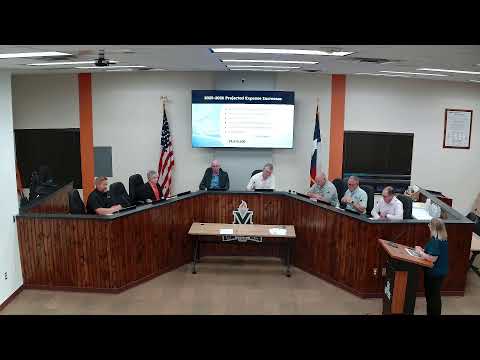
District staff and the district’s financial adviser told the MEDINA VALLEY ISD Board of Trustees on May 14 that preliminary property values are higher than budget assumptions and that the district can likely proceed with previously outlined bond sales — but that choices about timing and size will affect the pledge of operating funds and carry legislative timing risk.
District staff and the district’s financial adviser told the MEDINA VALLEY ISD Board of Trustees on May 14 that preliminary property values are higher than budget assumptions and that the district can likely proceed with previously outlined bond sales — with choices to accelerate funding if the board favors that path. Board members pressed staff on the timing, pledge levels and legislative risks that could change how much the district can issue or when.
Miss Hermit (district finance staff) and Victor Quiroga, the district’s financial adviser from Specialized Public Finance, presented updated models using preliminary valuations from Bexar and Medina counties. The district’s preliminary growth figures were reported in the range of about 11.26% to 11.68% on combined preliminary values; staff and advisers said a $50 million additional value from Medina County could push modeled growth toward 12%.
That growth matters because it affects the district’s I&S (interest and sinking) and M&O (maintenance and operations) capacity and therefore how much bond principal the district can safely sell without increasing its long-term reliance on “tier 1” funds (district M&O funds pledged to support debt service). The board discussed three core elements: the defeasance strategy already in motion, a planned $70 million bond sale this summer, and an accelerated option (labeled scenario 1b) that would raise roughly $132 million this summer but require a substantially larger tier 1 pledge.
Key figures presented on the record - Defeasance strategy: staff said the district planned a two-part defeasance using interest earnings from prior bond proceeds and targeted $15 million in defeasance overall to reduce early-year debt-service pressure. The first part released roughly $8 million in cash and produced about $1.42 million in interest savings; the next step would release about $7 million more. - Bond program: the district’s original scenario planned to fund a $290 million bond program over multiple sales. The board has already sold about $11.2 million (athletic projects) and the plan calls for a $70 million sale this summer tied to the middle-school project and initial design work for other projects. - Accelerated option: scenario 1b would bring forward a roughly $132 million sale this summer. Staff said the tax-rate model could support the sale, but it would require an estimated tier 1 pledge of about $7 million versus about $3 million estimated under the $70 million sale scenario. - Timing and certification: presenters said they would wait for certified values from both appraisal districts (statutory certification date July 25) and could enter the market as soon as the following week. Closing before Sept. 1, 2025, was emphasized to avoid new legislation that could take effect for transactions closing after that date.
Legislative risks and funding changes Staff reviewed several bills that could alter bonding capacity or school funding, and they emphasized uncertainty while the Legislature is in session. Bills referenced on the record included House Bill 9 (business personal property exemption changes), Senate Bill 4 (homestead exemption adjustments and related hold-harmless provisions), House Bill 2 and other school-finance measures, and earlier proposals such as House Bill 19 (which aimed to limit use of operating tax revenue for debt) that had drawn concern earlier in the session. The board was warned that elements from failed or altered bills could reappear in other legislation.
Staff and advisers also reviewed likely finance changes from pending legislation that could affect the district’s 2025–26 operating budget. The senate substitute under consideration would shift some funding approaches away from a single large basic-allotment increase toward targeted allotments: a teacher-retention allotment, expansions to teacher-incentive funding and other targeted proposals. On amounts on the record: - Teacher-retention allotment: presenters said the package under discussion would bring roughly $2.7 million to the district earmarked for staff who meet the years-of-service thresholds; the board was told those funds would pass through to eligible teachers if the bill holds. - Basic allotment: a smaller increase of $55 per pupil in the senate substitute was estimated to yield about $800,000 in district revenue, while trading off future components of the formula’s “golden penny” yield. - School safety allotment: an increase from $10 per student and $15,000 per campus to $28 per student and $30,000 per campus was estimated to add roughly $250,000 to the district.
Budget planning implications District staff said preliminary budget assumptions put roughly $9.5 million in additional revenue on the table for next year based on continued enrollment growth (about 1,000 additional students modeled) and property-value growth assumptions. Staff flagged competing costs: hiring for growth (staffing for new campuses), deferred maintenance (HVAC and bus replacements), capital projects (playgrounds, auditorium lighting and the Panther Dome), and one-time costs tied to opening new campuses (Creekview/portables). Staff said they currently plan for about 50 new teachers (less than an earlier estimate of 60), and that a 1% across-the-board pay increase would cost about $720,000.
Board questions and clarifications Board members asked for clarifications on how tier 1 pledges are applied. Presenters said, based on communication with bond counsel, the tier 1 pledge calculation is not cumulative across years; rather, the calculation reflects the district’s last pledge for a particular bond sale and the resulting annual debt-service structure. The board asked for follow-up materials on historical tier 1 usage and prior pledge levels; staff agreed to provide those details.
Timing next steps Presenters recommended finalizing defeasance steps in June, waiting for certified property values on July 25, and preparing to enter the bond market in late July or early August so the district could close before Sept. 1 if it chooses to proceed. The board did not take a bonding vote at the workshop; the discussion framed options the board may act on after the July certification and as legislative uncertainty clarifies.
Speakers and roles referenced in this article appear in the meeting record and include district staff, the superintendent and the district’s retained financial adviser.