Get Full Government Meeting Transcripts, Videos, & Alerts Forever!
Get email alerts on the Health And Human Services Omnibus topic
No spam. Unsubscribe anytime.
Senate passes 2025 Health and Human Services omnibus after hours of debate and close votes
Summary
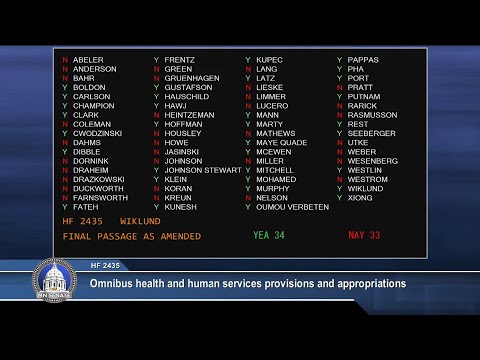
The Minnesota Senate passed House File 2435, the 2025 Health and Human Services omnibus bill, 34–33 on May 14 after extended floor debate and votes on more than a dozen amendments covering hospital payments, pharmacy rules, ambulance funding and eligibility for MinnesotaCare.
The Minnesota Senate passed the 2025 Health and Human Services omnibus, House File 2435, on May 14 by a 34–33 vote after hours of floor debate and a string of roll-call votes on amendments.
The bill, presented by Senator Wicklund, lays out a broad package of health and human services policy and spending that sponsors said is intended to stabilize hospitals, increase rates for some providers and expand program integrity work. Key provisions include directed payment programs intended to boost hospital and provider reimbursements; changes to pharmacy benefit management for public plans; funding for ambulance operating deficit grants and higher ambulance reimbursement rates; restoration of a 2% provider tax; and several maternal and reproductive health provisions including rates for birth centers and licensure for certified midwives.
Senator Wicklund, the floor sponsor, described the bill as “the product of months of thoughtful collaboration,” and said it “establish[es] a directed payment program to stabilize hospital finance systems” and includes measures to “raise medical assistance reimbursement rates to match Medicare levels.” She also told senators the omnibus is more than a budget exercise: “This bill is about preserving health care access, supporting our most vulnerable families, and investing in a sustainable, healthy future for all Minnesotans.”
Why it mattered
Supporters said the measure is aimed at strengthening access to care amid provider shortages and reinsurance funding changes at the federal level. The bill includes a 20% premium subsidy intended to reduce individual-market premiums, funded by an assessment on health plans, and directed payments that lawmakers said would maximize federal matching dollars. The bill also restores a provider tax to 2% to avoid cuts to public programs, according to sponsors.
Opponents criticized the bill’s revenue mechanisms and some policy choices. Several senators said fees and assessments in the bill would raise costs for patients and employers, and that some provisions should have received more committee vetting. Debate on MinnesotaCare eligibility for people not lawfully present in the U.S. drew sustained, heated floor discussion and multiple failed amendments to change that policy.
Major floor actions and outcomes
- A31 (technical/substantive corrections) — adopted on voice vote. - A18 (Senator Mann) — amended protections against midyear formulary changes to include biosimilars; adopted by roll call, 67–0. Senator Mann said the amendment would prevent patients from being “kicked off their medications midyear” and would add biosimilars to exceptions allowing switches. - A26 (ridering/accountability for agency appropriations, offered by Senator Aki) — defeated, 33–34. - A28 (Senator Rasmussen) — would have repealed MinnesotaCare eligibility for undocumented people and redirected savings; defeated, 33–34. - A12 (Senator Gruenhagen) — similar repeal amendment; not adopted after a 33–33 tie. - A50 (Senator Klein, facility fees) — modified an original prohibition on facility fees to disallow facility fees for telemedicine and certain preventive services; adopted, 59–8. - A57 (Senator Rasmussen) — redirected $18 million in ambulance operating deficit funding to the EMS distribution formula used in last year’s bipartisan EMS package; adopted. - A8 (Senator Dames) — would have repealed the proposed premium subsidy program; not adopted, 33–34. - A11 (Senator Abler) — granted local ambulance providers additional ways to raise or receive revenue; adopted, 66–0. - A1 (Senator Abler) — changes on Social Security survivor/benefit handling for children in foster care (narrow carve-out); adopted by voice vote after floor discussion. - A22 (Senator Drazkowski) — “I’m not a robot” provision requiring managed-care organizations to re-verify enrollees to reduce improper payments; not adopted, 33–34.
Final passage and next steps
After the amendment process, the Senate passed HF2435 on a 34–33 roll-call vote. The measure will go to conference with the House. Senate floor debate repeatedly flagged implementation issues that sponsors said will require work in conference, including computer systems and coordination with MNsure and state agencies if the premium subsidy model is implemented.
Selected quotes
- “This large bill is the product of months of thoughtful collaboration,” Senator Wicklund said when she introduced the omnibus. “It represents the work of the committee to address needs, and it cuts across three different agencies.” - On the A18 formulary protection, Senator Mann said the amendment would ensure that when a formulary changes a patient would not be told at the pharmacy counter “you can no longer have your medications.” - On Medicaid coverage for non-lawfully present people, Senator Rasmussen said his repeal amendment would “redirect those savings to priorities I hear about from Minnesotans,” while Senator Wicklund replied the program is fee-for-service and “the total cost of the paid claims was $3,900,000 as of April 24” with 20,187 people enrolled as of that date.
Key clarifications from the floor
- Sponsor note: Senate sponsors said the HHS omnibus exceeds 600 pages and that the bill text and amendments are available online to members. - Enrollment and early claims for the January-started MinnesotaCare expansion: Senator Wicklund said in floor debate that, as of April 24, MinnesotaCare enrollment for the newly eligible included 20,187 people and the paid claims total at that date was approximately $3.9 million; sponsors emphasized the program is fee-for-service and utilization will determine costs as the year progresses. - Ambulance funding: Sponsors said the bill contains an $18 million program to support ambulance operating deficits and that a later amendment aligned distribution to the formula used in last year’s EMS package.
What the bill does not do on the floor record
Senators on both sides warned that aspects of the premium-subsidy plan and other assessment-funded approaches depend on administrative systems and third-party timelines (MNsure, insurers, Department of Commerce) and that delays or changes could affect implementation. Floor discussion also flagged potential federal funding risks tied to MinnesotaCare eligibility changes and to how the Health Care Access Fund is used.
Next steps
HF2435 moves to conference committee. Sponsors and critics both said they expect additional negotiation over the revenue package, the premium subsidy mechanics, and program implementation details. Conference appointments were announced before adjournment.
Ending
Senators closed a full day of debate after taking a series of close roll-call votes on amendments touching immigration eligibility, pharmacy rules, ambulance funding, hospital financing and program integrity. The bill’s authors said the measure is intended to shore up access to care for Minnesotans; opponents said the tax and assessment structure will raise costs and that other reforms are needed for affordability.