Get Full Government Meeting Transcripts, Videos, & Alerts Forever!
Get email alerts on the City Budget Goals topic
No spam. Unsubscribe anytime.
Agoura Hills narrows goal funding as staff warns only $150,000 available for general fund projects
Summary
City staff told the City Council the municipal sales- and property-tax forecasts are modest while councilmembers must prioritize roughly $150,000 in general-fund discretionary dollars amid roughly $570,000 of project requests.
Agoura Hills — City staff told the City Council at a goal‑setting workshop on Monday that tight revenue forecasts leave about $150,000 in discretionary general‑fund dollars available for new priorities, and asked councilmembers to rank projects across subcommittee recommendations.
City Manager Nathan Hamburger framed the discussion, saying staff has “thrown everything out” for review and is now asking the council to select priorities so those items can be reflected in the draft budget for the June budget meeting. He warned that “we may not be able to fund all of those at that price,” and urged the council to prioritize projects that can be accomplished within the projected revenue picture.
The finance presentation outlined the revenue assumptions behind that constraint. Finance staff Diego said the city’s combined sales tax rate inside Agoura Hills is 9.75 percent. Of that total, 3.93755 percent is allocated to the state general fund and 1 percent flows to the city’s general fund; the remaining roughly 4.81 percent is distributed across county transportation and other regional measures. Staff also noted that Measure A, effective April 1, 2025, replaced Measure H and will route the city’s share for homeless services ($71,046) to the regional Local Solutions Fund through the Las Virgenes–Malibu COG, not to the city’s general fund.
Brenda Cho, finance manager, said the city’s contracted property‑tax forecaster (HDL) projects next year’s property‑tax receipts for the city at about $3,650,000, an increase of roughly 3.5 percent from the current fiscal year. Cho summarized the modeling assumptions, noting that California’s 1 percent ad valorem property‑tax rate and the typical 2 percent annual assessed‑value inflation factor drove the estimate.
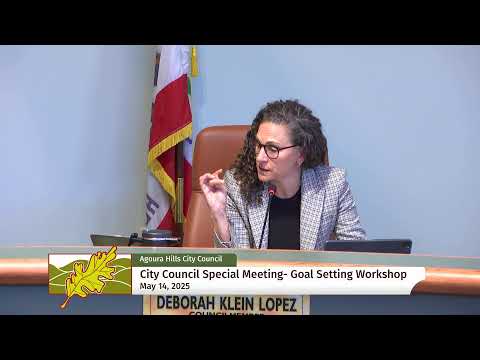
Council members said the staff presentation helped explain why priorities must be pared back. Council member Manns said he tallied “about $570,000 in requests total” against the $150,000 that staff recommends setting aside from the general fund. Mayor Pro Tem Wolf and Council member Deborah Klein Lopez both urged targeting near‑term public safety and infrastructure priorities—particularly trails and road repairs in Old Agoura—over multi‑year planning studies that can be deferred.
Staff described options to rebalance costs by using special funds where possible. Manager Hamburger noted some items recommended by subcommittees already draw on special funds or grants (for example, several public‑works projects and Measure W allocations), which would not count against the $150,000 general‑fund target.
The council did not adopt final budget numbers at the workshop; staff said the finance subcommittee and a future budget workshop will refine recommendations and prepare the formal budget for the June hearing.
Votes at a glance: The workshop agenda was approved by roll call 5‑0. Mayor Pro Tem Wolf made the motion and Council member Deborah Klein Lopez seconded; the city clerk recorded Aye votes from Council members Anderson, Anstead, Klein Lopez, Mayor Pro Tem Wolf and Mayor Sylvester.
What’s next: Staff will return with refined cost estimates, a prioritized list of goals for the two upcoming fiscal years, and options that shift work into special funds or future years. The council signaled support for preserving flexibility while prioritizing emergency‑resilience and near‑term public‑safety projects.