Get Full Government Meeting Transcripts, Videos, & Alerts Forever!
Get email alerts on the International Day Of Vesak topic
No spam. Unsubscribe anytime.
United Nations marks Vesak with calls to apply Buddhist teachings to SDGs and pleas for Myanmar
Summary
At a United Nations commemoration of the International Day of Vesak, diplomats and religious leaders urged compassion and mindfulness as practical guides for international cooperation, highlighted national policies linking Buddhist values to sustainable development, and appealed for prayers and assistance for people in Myanmar.
At a United Nations commemoration of the International Day of Vesak, diplomats, religious leaders and U.N. officials said the Buddha’s teachings offer practical guidance for addressing global challenges and urged renewed attention to people affected by conflict and disaster.
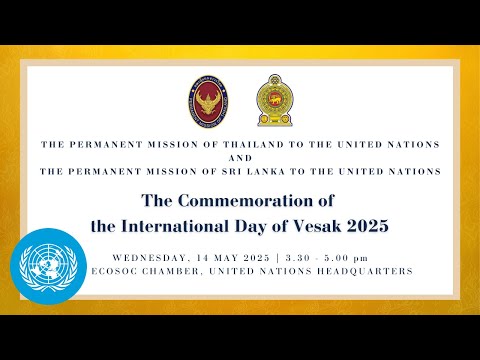
Speakers at the event — co-hosted by the Permanent Missions of Thailand and Sri Lanka — framed Vesak as a moment to apply values of compassion, moderation and interdependence to the U.N. sustainable development agenda and to current crises. The gathering included video messages from national ministers and a sermon by a senior Buddhist cleric.
The event opened with a reading of remarks for the President of the U.N. General Assembly, Philemon Yang, who said, “Peace begins within,” and urged diplomats and citizens to draw on the Buddha’s teachings of awareness, ethical living and compassion. U.N. Secretary-General Antonio Guterres in a video message wrote that “the Buddha’s teachings of compassion, tolerance and selfless service resonate deeply with the values of the United Nations.”
Several delegations linked Buddhist precepts directly to policy. The minister of foreign affairs of Thailand described the country’s sufficiency economy philosophy as aligned with the Buddha’s Middle Path and said it offers a framework to pursue the 2030 Agenda for Sustainable Development. The minister of foreign affairs of Sri Lanka described a national “Clean Sri Lanka” policy, saying the government is “aligning the pursuit of economic development with environmental stewardship” and presenting the policy as a way to advance the three pillars of sustainability — economic, social and governance.
Religious leaders and member states urged that spiritual teachings be translated into concrete action. Venerable Aludgama Damajyoti Thero, chief incumbent of the New York Buddhist Vihara, called for ongoing engagement beyond the ceremony: “Let this conference not be the end of our gathering, but the beginning of a global commitment.” He urged that Buddhist practice reach beyond monasteries “into communities, into policies and into action.”
Several delegations used the occasion to highlight national heritage and legal recognition of Vesak. The permanent representative of Mongolia said Mongolia amended its law on public holidays in 2019 to include Vesak and that the first official public-holiday celebration took place on June 5, 2020. The deputy permanent representative of Nepal noted Lumbini — the Buddha’s birthplace — and recalled the U.N. secretary-general’s 2023 visit and remarks calling for peace; Nepal’s representative said the government remains committed to preserving and promoting Lumbini as “the fountain of Buddhism and world peace.”
Speakers also drew lines from Vesak values to U.N. priorities. Delegations including Singapore, Vietnam, Japan, Bhutan, India, Cambodia, Russia, Pakistan, Indonesia, Morocco, the Republic of Korea, Ukraine, Malaysia and Lao PDR spoke about compassion, tolerance and the need for interfaith dialogue as complements to multilateral efforts on peace, human rights and sustainable development. Pakistan’s representative reiterated that Pakistan and the Philippines co-sponsor a biennial General Assembly resolution promoting interreligious and intercultural dialogue; the statement said that resolution seeks to combat racism, xenophobia, hate speech, violence and discrimination.
Several delegations used their remarks to draw attention to specific humanitarian crises. Myanmar’s permanent representative said the aftermath of the February 2021 coup has left civilians in a “dire” situation and described aerial attacks and other atrocities; the representative asked attendees to pray for people affected by conflict and by a recent 7.7 magnitude earthquake. The permanent representative of Ukraine tied Buddhist teachings on dignity and nonviolence to the need for a rules-based international order and accountability.
The closing remarks, delivered by the meeting chair on behalf of the co-hosts, reiterated an appeal to apply the Buddha’s “middle way” to achieve social and economic justice, sustainable use of resources and peaceful interdependence among nations. The chair concluded with a traditional blessing and a restatement of the event’s central themes: compassion, mindfulness, and translating religious reflection into public action.
The session consisted of religious blessings and a sermon followed by statements from a long list of member-state delegations. No formal U.N. votes or resolutions were taken at the commemoration itself.