Get Full Government Meeting Transcripts, Videos, & Alerts Forever!
Get email alerts on the Committee Report Votes topic
No spam. Unsubscribe anytime.
Revenue and Taxation committee advances disaster, housing and energy tax measures; several proposals fail or are left on call
Summary
The California Senate Committee on Revenue and Taxation met May 20 and advanced a slate of bills addressing disaster tax relief, 529-account rollovers, housing tax exemptions and public-safety exemptions while rejecting or holding others pending fiscal review.
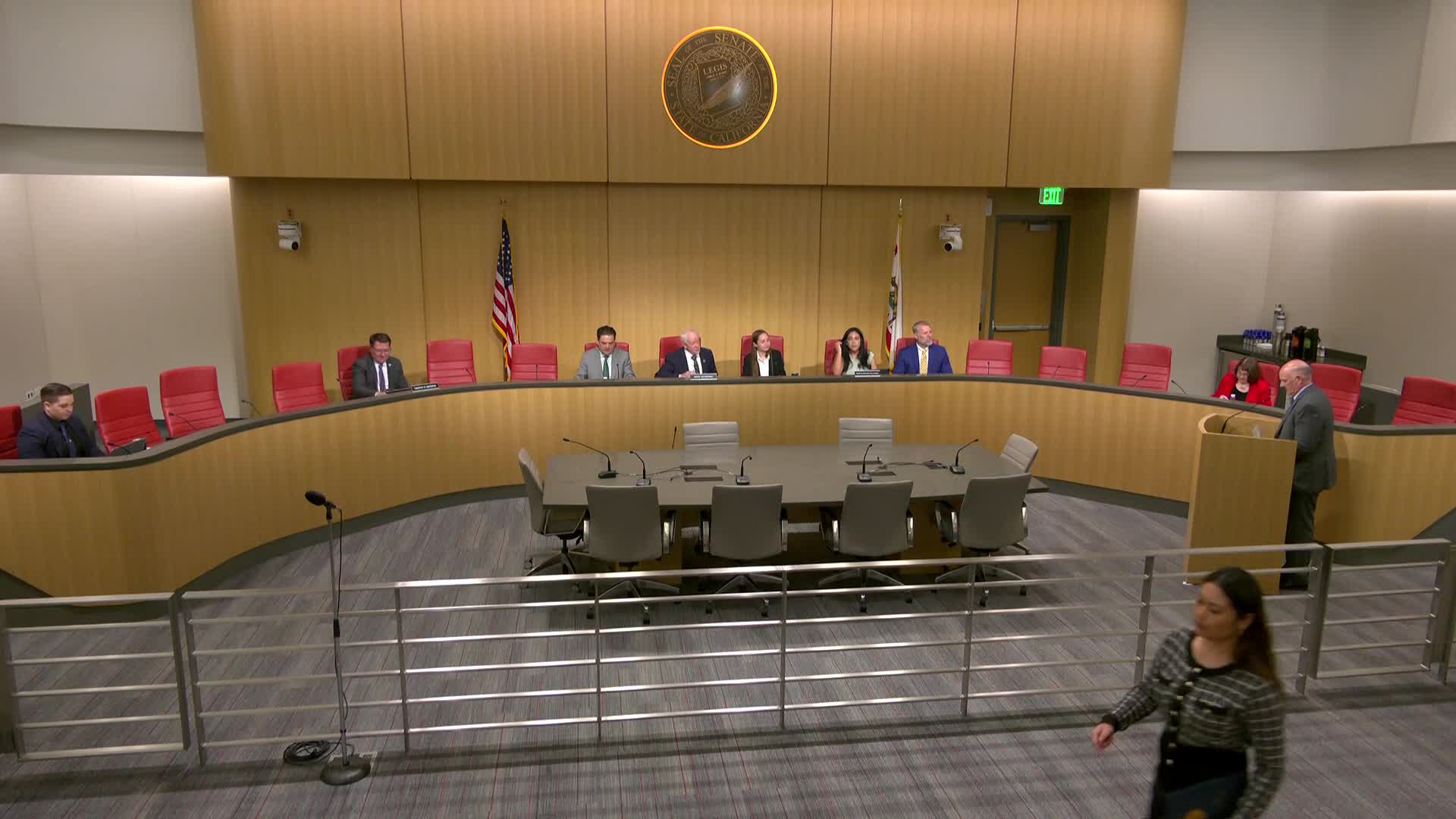
The California Senate Committee on Revenue and Taxation met in Sacramento on May 20 and considered 21 bills covering property-tax rules after disasters, conformity with federal retirement-savings rules, tax incentives for teachers and home hardening against wildfires, exemptions for firefighting equipment, and other revenue measures.
The committee approved or put on call multiple bills for referral to the Senate Appropriations Committee, left several on hold for later budget work, and rejected or tabled measures it deemed costly or insufficiently targeted. Major actions included votes to advance bills to appropriations on disaster-related property-tax relief, a conformity change to allow rollovers from 529 accounts to Roth IRAs, and a package of housing and manufacturing proposals. Other items — notably proposals to create tax credits for home and retail security and a broad increase to the homeowner’s exemption for people 62 and older — failed or were sent back for reconsideration.
Why it matters: The committee’s decisions affect how California will tax property and untaxed settlements after disasters, how families may use unused college-savings for retirement, and whether the state will subsidize home hardening, solar adoption, or industry investment. Several measures carried potential near-term budget impacts that senators flagged during debate.
Key outcomes and highlights
- Disaster property-tax base transfers: The committee advanced a bill to allow counties to extend the five-year Prop 50 transfer window for properties damaged by a governor-declared disaster by up to three additional years for affected properties. Proponents said the measure responds to prolonged rebuilding timelines caused by large wildfires and post‑disaster permitting and insurance delays. Vote recorded at committee: passed to appropriations (3–0, on call).
- Conforming state law to Secure Act (529-to-Roth): SB 657 would align California law with the federal Secure Act provision allowing rollovers from 529 qualified tuition plans into Roth IRAs. Supporters, including the ScholarShare Investment Board and financial-planning groups, argued the change would reduce a barrier to opening 529 accounts and help lower- and moderate-income families. The committee moved the bill to appropriations (vote recorded: on call; tally reported during the hearing sequence).
- Teacher classroom-supply tax credit: SB 267 would create a personal income tax credit of up to $250 for qualified teachers who spend their own money on classroom supplies; it would be temporary (proposed effective Jan. 1, 2026, through Dec. 1, 2031). Supporters framed the credit as modest relief; opponents warned of implementation and budget questions. The committee passed the measure to appropriations (vote recorded 4–0).
- Disaster settlement exemption from state income tax: SB 268 would exclude settlement payments received because of a governor-declared state of emergency from state taxable income. Witnesses said the change would spare disaster victims unexpected tax bills after settlements. The bill was moved forward and placed on hold for appropriations (vote recorded 4–0).
- Fire Safe for Home tax credit: SB 269 proposes refundable personal income tax credits for homeowners who undertake home-hardening measures and vegetation management, limited by income and by fire-hazard zone and with an annual cap and reservation system. The committee advanced the bill to appropriations (vote recorded 4–0, bill on hold).
- Tax treatment of unused 529 funds (deduction) and other 529-related proposals: Two measures addressing 529 savings were debated. SB 529 (a proposal to allow a state tax deduction for contributions to qualified tuition programs) failed in committee during the session (reported vote 2–0; reconsideration granted). SB 657 (conformity to the Secure Act allowing rollovers to Roth IRAs) was moved to appropriations (on call). Witnesses debated whether changes disproportionately benefit higher-income families and whether the state should adopt them in a larger conformity package.
- Firefighting equipment sales/use tax exemption: SB 696 would exempt purchases of firefighting apparatus and equipment by local fire departments and fire protection districts from state sales and use tax. Supporters — including county and district fire leaders and the California Fire Chiefs Association — said the move would let local agencies keep more funds for readiness and training; one witness cited an estimated $21 million in sales-and-use tax that would remain in the service the next fiscal year. The committee passed the measure to appropriations (vote recorded 5–0).
- Manufacturing investment tax credit: SB 587, a tax credit tied to sales tax on qualified manufacturing equipment intended to encourage investment and job creation, was advanced to appropriations (vote recorded 3–0 at the hearing; later listed 3–0 on the roll call).
- Housing and the welfare-property-tax exemption: SB 336 would expand an existing welfare property-tax exemption (used to support affordable housing) to include a portion of moderate-income rental housing (targeting 80–120% AMI) with the same deed-restriction and enforcement terms as low-income projects. Supporters said the change addresses the “missing middle” in housing production; the committee voted to advance the bill to appropriations (vote recorded 4–0).
- Farm-to-food-bank tax credit permanence: SB 353 would remove the sunset and make permanent a 15% state tax credit for farmers who donate food to food banks. Supporters said the credit reduces food waste and improves access to fresh produce; the committee moved the bill to appropriations (vote recorded 4–0).
- Solar/storage property tax exclusion extension: SB 710 would extend the exclusion that prevents residential and small-business solar and storage installations from being added to property tax assessments. Sponsors said the exclusion supports solar adoption and grid resilience. The committee approved the measure for appropriations (vote recorded 3–0; later 3–0 on roll call).
- Zero-emission bus exemption extension: SB 752 would extend an existing partial sales-and-use tax exemption for zero-emission buses purchased by transit agencies to support the transition called for in California’s clean transit regulation. The committee passed the measure (roll-call vote recorded 5–0).
Bills that failed or were left on call
- Home and retail security credits: Two related bills proposing tax credits for home security systems and for qualified retail establishments to offset anti-theft investments drew partisan and policy disputes over whether such subsidies belong in the general fund. Both measures failed in committee (votes recorded 1–4 and 1–4 at roll call) and were held for reconsideration.
- Broader homeowner exemption increase for seniors: A proposal to raise the homeowners’ exemption and the renter’s credit for taxpayers age 62+ drew questions about fiscal cost and targeting. The initial committee vote was split and the measure was left on call for reconsideration.
What senators and witnesses emphasized
Committee members repeatedly framed decisions around the state’s budget constraints and trade-offs between targeted relief and broad tax expenditures. Supporters of disaster and wildfire-related measures stressed the mismatch between statutory timelines and the realities of rebuilding after major fires, while proponents of 529 conformity urged the committee to eliminate a deterrent to opening college-savings accounts. Witnesses from local government, industry groups, and nonprofit sponsors described operational details and local consequences if measures were not enacted.
Next steps
Most measures approved by the Revenue and Taxation Committee were referred to the Senate Appropriations Committee for further fiscal review. A number of bills were left “on call” or placed on hold pending budget negotiations or technical amendments.
Ending note
Committee members and the bill authors signaled willingness to continue negotiations on amendments for budget specificity and targeting, and several bills were advanced so the Appropriations Committee can evaluate their cost and fiscal offsets.