
Coconino County IT outlines Windows 11 migration, cyber protections and broadband plans funded partly by stimulus grants
Get AI-powered insights, summaries, and transcripts
Sign Up Free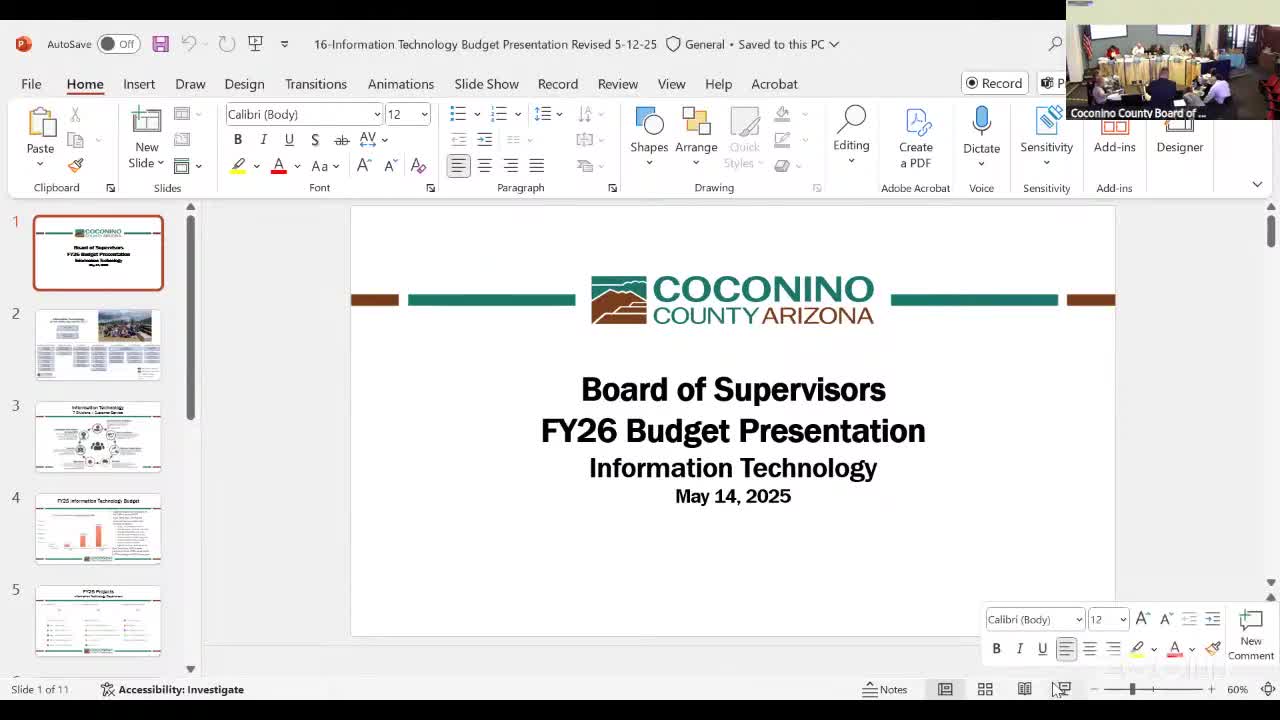
Summary
IT presented FY26 planning including migration to Windows 11, zero cyber incidents record, rural broadband work and use of stimulus (non‑ARPA) funds for digital transformation. Department warned of a spending cliff when grant reserves end in FY28 and reiterated ongoing need for lifecycle funding.
Coconino County’s Information Technology staff briefed supervisors on May 14 about ongoing security work, a planned migration to Windows 11, broadband projects and the use of non‑general‑fund stimulus dollars to accelerate digital transformation.
Matt Fowler (presenter) outlined seven IT divisions and said the department had administered roughly 5,500 help tickets in the year and supports about 250 enterprise applications. He said IT benefited from non‑ARPA “non‑revenue loss” funds that have funded infrastructure upgrades and one‑time investments and that those reserves are scheduled to decline by FY28. “The money’s also allowed us to invest in what’s called a storage array … and network micro‑segmentation,” Fowler said.
IT emphasized cybersecurity and continuity of operations. The department reported no cybersecurity incidents during the fiscal year and said it has patched tens of thousands of vulnerabilities across systems. Billy Holloway (information security staff) said the county has prioritized identity, multi‑factor authentication and governance, risk and compliance work. Fowler said a new disaster‑recovery appliance and micro‑segmentation are among investments that harden systems and support elections and other critical services.
On migration, Fowler said the county will complete the upgrade from Windows 10 to Windows 11 and be fully compliant in FY25–FY26: “Our goal is to be 100% compliant ahead of schedule.” He described plans to explore a 10‑gigabit Internet circuit and possible hybrid or cloud data center approaches to reduce long‑term capital costs for data center power and HVAC.
Fowler also reviewed rural broadband activities. The county has an RFI/RFP and has earmarked $1 million toward a local fiber contribution that would secure strands for county use when larger carriers build regional networks. He asked supervisors to consider lifecycle funding for network refreshes: historically IT has requested a $300,000 annual lifecycle tranche (roughly 20% of a $1.5 million network life‑cycle estimate) to avoid large backlogs.
Board members asked about broadband timelines, the status of state allocations for broadband, and potential impacts of federal policy moves on broadband and digital equity funding. Fowler said the state’s allocation process for the nearly $1 billion statewide program was still being finalized; awards to carriers were expected later in the year, and county staff are coordinating with the Arizona Commerce Authority and regional partners.
Ending: IT said stimulus dollars have enabled timely upgrades but warned of a “cliff” when those one‑time funds run out; it recommended continued planning for recurring lifecycle funding and said staff will return with a five‑year strategic plan and further updates on broadband and Windows 11 migration.