Get Full Government Meeting Transcripts, Videos, & Alerts Forever!
Get email alerts on the Environmental Permits Sewage topic
No spam. Unsubscribe anytime.
Miami-Dade committee approves ordinance to allow limited administrative approvals for on-site sewage and certain slips
Summary
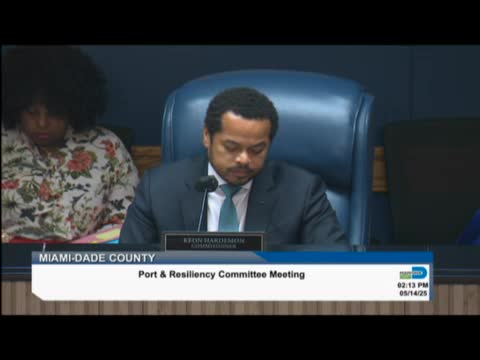
The Miami-Dade County Portland Resiliency Committee on May 14, 2025, unanimously approved an ordinance amending county code to permit administrative approval in some cases for on-site sewage treatment and for certain slips in NOAA-defined areas via class 1 permits; no members of the public spoke at the hearing.
Miami-Dade County Portland Resiliency Committee approved an ordinance May 14, 2025, that amends portions of the Miami‑Dade County Code to allow limited administrative approvals for some on-site sewage treatment and disposal systems and for certain slips in areas defined by National Oceanic and Atmospheric Administration (NOAA) mean low water datum. The committee voted unanimously to adopt the ordinance during a short meeting that included no public speakers.
The ordinance, listed on the agenda as Item 1 g 1, amends section 24-42.7 to authorize administrative approval of on-site sewage systems that do not meet specified minimum setback distances “under certain circumstances,” and amends section 24-48.3 to permit administrative approval of certain slips in areas with specified NOAA mean low water datum through issuance of class 1 permits. The public hearing on the item drew no commenters; the committee closed the hearing before voting.
Committee members said the change is intended to streamline administrative processing while retaining environmental safeguards. A commissioner noted the county worked with outside parties referred to in the record as “Durham” to shorten processing time for systems that can be handled administratively, and said the change would not reduce environmental protections. The record also references the Environmental Quality Control Board (EQCB) as an existing forum for review in more complex cases.
The motion to approve the ordinance was placed on the floor, seconded by the chair, and passed unanimously in a recall vote. A roll-call question was asked to Commissioner Bermudez (recorded as “yes”); the meeting record states the motion “passes unanimously.” The ordinance text and effective date were read into the record at the meeting but an explicit effective date is not specified in the transcript excerpts.
The committee meeting was brief: the chair opened the reasonable opportunity for the public to be heard, no members of the public spoke, and the ordinance proceeded to a vote. The agenda also included references to a separate committee amendment to item 2a (adopted earlier by the Parks and Recreation Committee on behalf of Commissioner Steinberg and sponsored by Senator Rene Garcia), but that amendment concerns a different item and was handled separately.
What the ordinance changes and what it does not: according to the language read into the record, the ordinance permits administrative approvals in limited circumstances where systems or slips meet criteria set out in the code; it also includes standard severability and inclusion-in-code language. The transcript indicates that sites already operating or already in planning and ADA-compliant would be excluded from certain adaptations discussed elsewhere on the agenda. The ordinance does not, in the record provided, remove existing environmental review forums (for example, EQCB) where those are required.
No implementation timeline, budgetary impacts, or additional departmental rules were specified in the transcript. The meeting concluded immediately after the vote and the chair adjourned the committee.