Get Full Government Meeting Transcripts, Videos, & Alerts Forever!
Get email alerts on the Workforce Development topic
No spam. Unsubscribe anytime.
Committee hears proposal to credit Marion S. Barry SYEP time toward D.C. retirement; agency flags data, administrative hurdles
Summary
Councilmembers and government staff discussed Bill 206-43, which would allow prior Marion S. Barry Summer Youth Employment Program participation to count as creditable service toward District retirement. Witnesses praised the intent; the Department of Employment Services said records and IT limits could complicate implementation.
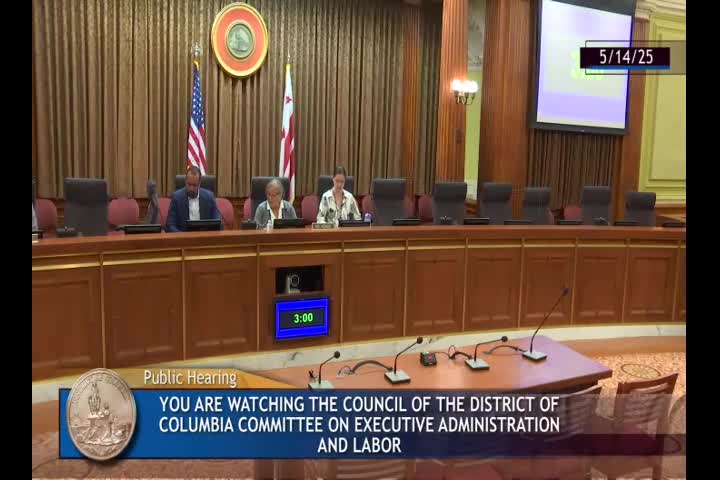
The Committee on Executive Administration and Labor heard testimony May 14 on Bill 206-43, the Marion S. Barry Summer Youth Employment Program Creditable Service Benefit Amendment Act of 2025. The measure would count past participation in the Marion S. Barry Summer Youth Employment Program (SYEP) as creditable service for District retirement calculations.
Councilmember Kenyon McDuffie, who introduced the bill's SYEP provision, framed the change as recognition of SYEP participants' work as public service. "This time in the program is service to the district and its citizens, and it should be treated as such," McDuffie said, describing his own experience as an alumnus and arguing the change could encourage youth to view D.C. government as a career path.
Witnesses and agency testimony: Dr. Eunique Morris Hughes, Director of the D.C. Department of Employment Services (DOES), described the program as a long-standing workforce pipeline and provided operational context: SYEP will run in 2025 from June 23 to Aug. 1 and DOES expects to serve roughly 12,000 youth this summer. However, Hughes said DOES's current records and IT systems only reliably retain participant enrollment and completion data dating back to about 2012. "In compliance with the district's record retention policies, DOES no longer has access to participant enrollment or completion dating as far back as 1980," Hughes told the committee, adding that implementing retroactive credit for service would create significant administrative challenges.
Why it matters: The bill would recognize SYEP participation as time toward vesting and retirement eligibility for employees who later join D.C. government. Proponents said the step both corrects a long-standing omission and could incentivize youth employment and public-sector career paths.
Outstanding questions: Committee members and the agency discussed how to verify decades-old participation, the potential administrative costs of retroactive crediting, and whether to limit credit to participants for whom reliable records exist. Dr. Hughes said DOES is willing to work with the bill's sponsor and the committee to refine the proposal to preserve its intent while addressing operational hurdles.
Next steps: The committee left the record open for additional written testimony through May 28 and indicated staff will coordinate with DOES and the bill sponsor to explore technical fixes, including limiting the effective date to years with verifiable records or creating an applicant-driven verification process.