Get Full Government Meeting Transcripts, Videos, & Alerts Forever!
Get email alerts on the County Budget topic
No spam. Unsubscribe anytime.
Miami-Dade officials warn of roughly $387 million FY26 shortfall; constitutional offices increase pressure on budget
Summary
Carla Denise Edwards, Miami‑Dade County chief administrative officer, told the county’s Appropriations Committee on May 6 that the county faces a projected $387 million deficit for fiscal year 2026, driven by rising costs tied to new constitutional offices, anticipated revenue declines and market volatility.
Carla Denise Edwards, Miami-Dade County chief administrative officer, told the Appropriations Committee on May 6 that the county is facing a projected $387 million deficit for fiscal year 2026. Edwards said the shortfall stems from three primary “headwinds”: increased costs tied to newly implemented constitutional offices, anticipated downward pressure on revenues and market volatility that raises operating costs.
Edwards, who oversees the Office of Management and Budget, strategic procurement and internal operations, said Miami‑Dade’s $12.7 billion enterprise includes roughly $8 billion in operating expenses and $4.1 billion in capital spending. For the general operating budget, Edwards said projected revenues and carryover for FY26 total about $3.2 billion, roughly $6 million less than the prior year, while projected operating expenses total about $3.6 billion, leaving what she described as a $387 million gap.
“Expenses have gone up, and our projections of revenue have gone down,” Edwards said, adding that assumptions underlying the forecast included a 6–7% growth rate in property tax rolls. She listed five expense drivers, including transit operational shortfalls, recurring grant obligations, the tax collector’s commission and negotiated labor increases that add both base costs and contractual growth.
David Clodfelter of the Office of Management and Budget said last year’s five‑year forecast projected a countywide shortfall of approximately $53 million; that figure has grown as constitutional offices’ implementation details became clearer. Clodfelter said the tax collector’s election to operate as a fee officer altered revenue expectations: the fee officer structure will require charging statutory fees that shift roughly $107 million countywide in revenue treatment, a change the office could not fully anticipate last year.
Constitutional officers presented their tentative FY26 requests during the meeting. Elena Garcia, supervisor of elections, said the office’s tentative operating budget is $52 million, including a $47.5 million request from the general fund; she also requested $4.1 million for capital purchases such as voting equipment and $1.7 million for voter check‑in stations and facility upgrades. Garcia said equipment is over 18 years old and noted risks from unscheduled special elections and the fiscal impacts of state and federal legislation.
Barbara Galvez, chief administrative officer for the Clerk of the Court and Comptroller, said the clerk’s office is requesting a general‑fund increase that equates to roughly 4.5% growth (about $1.53 million) after an internal revenue swap and other adjustments. Galvez said many functions previously funded through an IT model were moved to the general fund as a neutral change and that banking fees are expected to rise when the county’s banking contract expires in September 2025.
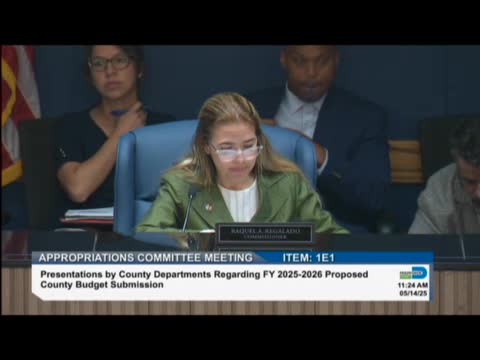
Committee members pressed for more detail on the assumptions and timing behind the forecast. Vice Chair Cohen Higgins and Chairwoman Regalado both asked for clearer breakdowns of which line items drive the deficit and urged collaboration to identify cuts that preserve core services. Edwards and Clodfelter said the administration is pausing non‑essential hiring, travel and promotions, investing in automation and consolidating functions to reduce costs without proposing a millage increase.
Why it matters: Committee members stressed the shortfall’s scale — Edwards and Clodfelter compared it to past fiscal stress — and said the board must decide how to reconcile growth requests from constitutional offices with a shrinking revenue base. Commissioners also asked the administration to provide a clearer exhibit listing which boards and entities already have audit requirements and how constitutional‑office transitions were funded in prior years.
Next steps: Edwards and OMB staff said they will continue updating the forecast and present more detailed budget proposals and options to close the gap ahead of the June 1 deadline for tentative millage rates and the formal FY26 budget process. Committee members asked for later briefings tying procurement and capital requests back to budget line items, and for a breakdown of impacts by district/zip code for programs such as Housing Choice Vouchers.