Get Full Government Meeting Transcripts, Videos, & Alerts Forever!
Get email alerts on the Folly Road Safety topic
No spam. Unsubscribe anytime.
SCDOT outlines scaled-back Folly Road safety plan amid resident concerns over medians and emergency access
Summary
South Carolina Department of Transportation representatives presented a revised Folly Road safety proposal that reduces raised medians to three locations and keeps several sidewalk and pedestrian features under study after public feedback; residents raised safety and emergency-access questions during the steering committee meeting.
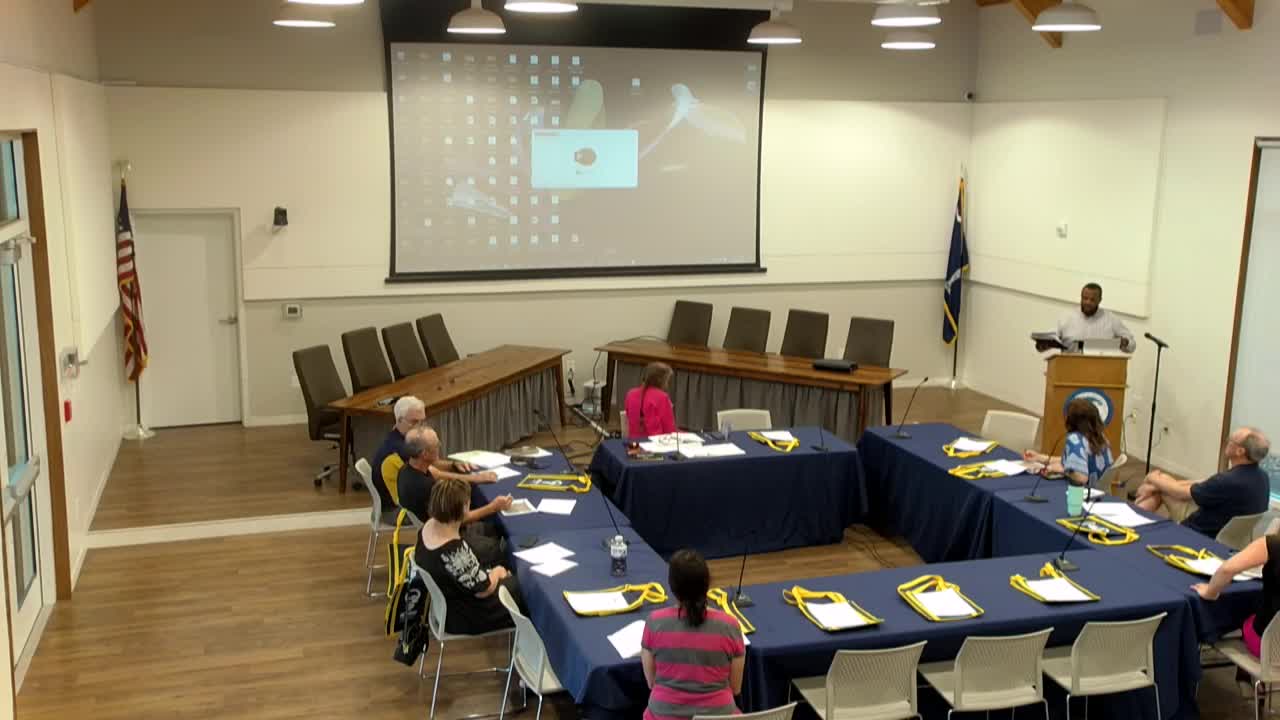
South Carolina Department of Transportation representatives on May 22 told the Rethink Folly Road steering committee they had revised an earlier, more aggressive concept to show three raised medians at Avenue A, Truist (Truist Bank area) and Camp, while removing other medians originally proposed through the Walmart frontage.
The change follows public comments and a DOT re-evaluation of crash data, DOT presenter Sean Sally said. “When we initially do these projects … we kind of throw everything out there that’s going to optimize safety. We do a lot of systemic things,” Sally said. He added staff then “go back and look at the crash data” and remove elements that do not clearly improve safety or that could create other hazards.
The revised plan retains pedestrian improvements including crosswalks and signal upgrades at several locations and proposes a HAWK (high-intensity activated crosswalk) beacon at the Truist crossing, Sally said. The plan will include refuge islands at selected crossings and “push-button” pedestrian signals tied into nearby traffic signals.
Why it matters: Folly Road is a primary artery to Folly Beach and carries heavy summer traffic. Residents and business owners raised concerns that new medians could block left turns and push traffic onto neighborhood streets, create access problems for deliveries and emergency vehicles, or turn nearby side streets such as Bradford Avenue into faster alternate routes.
Residents and business owners asked for crash data and for DOT to show how the design would accommodate deliveries and emergency access. Rebecca Lourdes, a resident of Riverland, asked whether concrete medians would prevent emergency vehicles from reaching Folly Beach during peak summer congestion. Sally said DOT will address emergency access and acknowledged the concern, noting the project will include targeted signal and crosswalk improvements and that some medians were removed after the crash review.
Spencer Wetmore, a committee member, emphasized for the public that the set of plans in the meeting packet was the older design and the version released for public comment reduced the number of raised medians to three. “What he’s going to present is not this,” Wetmore said, urging the public to refer to the updated materials.
DOT staff said they will test the project using traffic counts and before/after crash studies (three years pre- and post-project) as part of federally required benefit-cost justifications for FHWA (Federal Highway Administration) funding. Sally repeated that if traffic studies show a median is shifting trips into residential neighborhoods in a way that harms those neighborhoods, DOT will re-evaluate the design.
Several property- and business-owners pressed specific operational questions: how semitrailer and delivery access would work at Casa Fiesta and other restaurants; whether right-turn-only restrictions might be sufficient instead of physical medians; and whether any medians would be left in front of Fort Johnson and the James Island Emergency Room. DOT replied that some medians remain where crash patterns and signalized intersections show a safety benefit and that delivery and access patterns are considered during the detailed design and traffic-count phase.
DOT staff reiterated an upcoming public open-house format meeting May 22 at Camp Road Middle School (two-hour drop-in window) where attendees could review boards and speak one-on-one with design staff. “If you can’t make it to the meeting next Thursday, go to the website. Put those comments on the website where we can address,” Sally said.
Votes at a glance: The steering committee approved routine minutes at the meeting by voice vote; no roll-call tally was recorded.
The committee encouraged DOT to bring crash data to public sessions and to post clear diagrams of proposed crosswalks and signal types. DOT said the current materials on the project website reflect the revised design and that they will include clarifying graphics and the crash analyses at upcoming public events.