Get Full Government Meeting Transcripts, Videos, & Alerts Forever!
Get email alerts on the Public Safety Drones topic
No spam. Unsubscribe anytime.
Michigan lawmakers hear public‑safety case for drones as lawmakers flag counter‑UAS and cybersecurity gaps
Summary
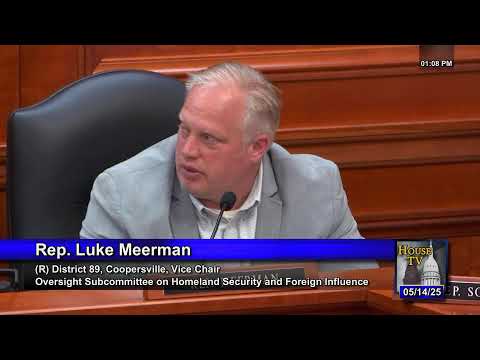
At a meeting of the Michigan House Oversight Subcommittee on Homeland Security and Foreign Influence in Lansing, Matt Rybar, president of the Michigan Public Safety Drone Association, told lawmakers that public‑safety agencies across the state are using drones for search and rescue, tactical operations, scene assessment and disaster response but that Michigan lacks robust detection and mitigation capabilities for nefarious drone use.
At a meeting of the Michigan House Oversight Subcommittee on Homeland Security and Foreign Influence in Lansing, Matt Rybar, president of the Michigan Public Safety Drone Association, told lawmakers that public‑safety agencies across the state are using drones for search and rescue, tactical operations, scene assessment and disaster response but that Michigan lacks robust detection and mitigation capabilities for nefarious drone use.
Rybar, who also works in remote operations for Unmanned Vehicle Technologies and serves locally as an emergency manager and patrol officer, said the association represents roughly 500 members and about 20 organizations and that roughly 200 agencies in Michigan now operate drones. He said the association has organized training and regional events to raise operational standards and will soon roll out a flight proficiency accreditation intended to document hands‑on capability.
"This drone should be looked at as just the next tool in that toolkit," Rybar said, arguing that drone data should be treated like other law‑enforcement digital evidence and handled under established cybersecurity standards.
Why it matters: Rybar told the committee that agencies rely on foreign‑manufactured airframes for capability and cost reasons, while U.S. manufacturers lag three to five years behind in features and remain substantially more expensive. That gap, he said, complicates any effort to ban certain manufacturers without leaving responders without effective tools.
Key points from the presentation - Uses now: Rybar described recent, specific uses including a Mason County search that recovered a 73‑year‑old missing woman within hours; tactical deployments in which a drone helped prompt a suspect to surrender; inspection flights after ice storms that helped locate and repair damaged public safety radio towers; and aerial support at large events and VIP visits. - Training and standards: The Michigan Public Safety Drone Association has organized regional training in eight regions aligned to the state homeland security regions, hosted a statewide conference that drew about 75 public‑safety attendees from 55 organizations, and is launching a flight proficiency accreditation next month to provide a hands‑on standard agencies can cite for liability reduction. - Drones as first responder (DFR): Rybar demonstrated a docked drone concept, where drones are launched remotely from rooftops or platforms tied to a real‑time crime center to get eyes on scene in roughly 20 seconds before units arrive. He said DFR is a potential force multiplier in urban areas but is not suitable for every jurisdiction. - Cybersecurity: Rybar recommended using U.S.‑based software and secure cloud infrastructure (for example, AWS or Microsoft Azure) and putting foreign‑manufactured drones into local data mode to reduce outside communications. He said agencies should expect drone data to be handled to CJIS and NIST‑level standards like other law‑enforcement systems. - Detection and mitigation gaps: Rybar said Michigan has limited drone detection capability and no local legal authority to mitigate or take down an unlawful drone; mitigation today requires federal involvement from agencies such as the Department of Justice, Department of Homeland Security and, in some events, Customs and Border Protection. He noted that federal agencies previously mitigated several drones during the 2024 NFL draft.
Questions from lawmakers Lawmakers pressed Rybar on cyber risk, procurement and whether his employer engages in lobbying. Rybar said Unmanned Vehicle Technologies represents more than 50 manufacturers, including U.S. and foreign products, and that the company does not employ lobbyists. Lawmakers asked whether the association or industry recommends U.S.‑made products; Rybar said vendors recommend products that match an agency's operational and cybersecurity needs and that the association supports policies that would grow U.S. manufacturing capacity.
On the question of whether foreign‑made drones can be shut down in a conflict, Rybar cited third‑party audits by firms such as FTI Consulting and Booz Allen Hamilton and said those audits have not shown a backdoor when drones are flown in local data mode and with U.S.‑based software, though he acknowledged he is not an IT auditor. He reiterated that U.S. manufacturers currently lag in capability and price, and that abruptly banning widely used systems could leave fire and police units without functional alternatives.
Requests and next steps Rybar asked state leaders to consider (1) adopting cybersecurity standards for drone software, (2) supporting development of a domestic manufacturing ecosystem for unmanned aircraft systems, and (3) helping strengthen counter‑UAS capabilities by funding shared detection assets or distribution of grant‑funded equipment across regions.
Committee context Members described the topic as high priority for homeland security. Lawmakers raised practical questions about jurisdictional coordination on lakes and at large events, whether retailers or manufacturers can be required to provide buyer education, and how federal audits required under recent national directives might change the state's approach if they identify specific risks. Rybar and committee members repeatedly noted that mitigation authority and many advanced counter‑UAS tools remain under federal control.
Rybar closed his remarks by urging lawmakers to pursue a layered approach that balances operational needs with cybersecurity protections. "Until our U.S. manufacturers and our friendly countries bring that equipment up to a level playing field, we'll be doing a disservice to public safety by regulating out the use of some of this equipment today," he said.
No committee votes or formal policy actions were taken during the meeting; the session moved to member questions after the presentation and then adjourned.