Get Full Government Meeting Transcripts, Videos, & Alerts Forever!
Get email alerts on the Mdard Budget Legislative Priorities topic
No spam. Unsubscribe anytime.
Michigan agriculture director outlines budget priorities to bolster biosecurity, soil testing and rural development
Summary
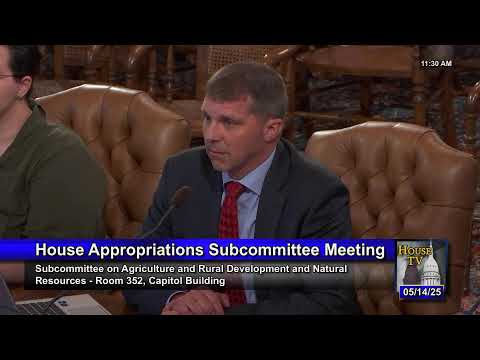
Tim Boring, director of the Michigan Department of Agriculture and Rural Development (MDARD), told the Michigan House Appropriation Subcommittee on Agriculture and Rural Development and Natural Resources on Oct. 26, 2025, that the department’s governor-recommended budget focuses on strengthening biosecurity, expanding plant and soil pest diagnostics, and reauthorizing the Freshwater Protection Fund.
Tim Boring, director of the Michigan Department of Agriculture and Rural Development (MDARD), told the Michigan House Appropriation Subcommittee on Agriculture and Rural Development and Natural Resources on Oct. 26, 2025, that the department’s governor-recommended budget focuses on strengthening biosecurity, expanding plant and soil pest diagnostics, and reauthorizing the Freshwater Protection Fund.
Boring said the department is proposing a mix of one-time and ongoing funding to increase testing capacity for plant disease, soil-health services and invasive-species detection, and to raise the administrative cap on the department’s rural development fund to use existing balances from mining severance revenues. "We continue to lose the number of farms we have here in Michigan," Boring said, and noted that National Agricultural Statistics Service counts now list about "200 commodities produced here in Michigan" versus roughly 300 in previous years.
Why it matters: Boring presented the requests as measures to protect Michigan’s food supply and support farm economic opportunities after recent animal-disease responses. He framed the investments as small in budget share but high in community effect: "Our budget comprises 0.18% of the state budget," he said, while noting MDARD’s work touches food safety, consumer protection, laboratory testing, county fair support and environmental programs.
Major proposals and discussion - Biosecurity and animal disease response: Boring said lessons from recent responses to outbreaks affecting poultry and dairy have driven an emphasis on biosecurity across species and on developing a proposal for USDA grant opportunities to strengthen state capacity. He described continued risks from animal diseases and said MDARD seeks to bolster rapid detection and response capabilities.
- Plant, soil and pest diagnostics: The department proposed funding, split between one-time and ongoing dollars, to increase in-state testing capacity so Michigan growers do not need to ship samples out of state. Boring said the goal is to provide soil-health testing and Michigan-specific interpretation for crops such as dry beans, potatoes and wheat.
- Freshwater Protection Fund reauthorization: Boring reminded the committee that assessments on fertilizer and pesticide sales that feed the Freshwater Protection Fund are subject to periodic reauthorization and said MDARD has been engaging farm groups, industry and conservation organizations about the fund’s future. He said the fund supports conservation districts, technical assistance and pesticide recycling programs.
- Rural development fund cap: MDARD proposed raising the administrative cap for grants from the rural development fund (supported by mining severance receipts in the Upper Peninsula) to better deploy fund balances for infrastructure and business development in rural communities.
- Soil health and regenerative agriculture: Boring described plans to expand soil-health testing capacity so fertilizer recommendations reflect biological soil measures and can lower input costs for farmers who adopt regenerative practices. He said MDARD is coordinating with Michigan State University’s Center for Regenerative Agriculture and with demonstration projects, including a 600-acre operation at the VFW facility in Eaton Rapids that has been used for workforce and veterans’ programming.
- Farm-to-family and distribution bottlenecks: Committee members and Boring discussed barriers that limit smaller and midsize farms’ access to institutional buyers (schools, restaurants) and retail channels. Boring described the farm-to-family pilot and planned grants to food hubs and farm‑stop concepts intended to aggregate, transport and market local product.
Questions from lawmakers - Representative Green asked whether fee increases in some programs would raise producer costs; Boring described past changes to pesticide assessment structures and said some costs have been shifted toward industry rather than directly onto farms. He said current fertilizer assessments are about "$1 per ton" and emphasized stakeholder conversations around cost allocation.
- Representative McKinney raised federal cuts to food-access programs and said "I think it's around $4,300,000 in cuts, which equates to around 2,000,000 meals." Boring noted many federal nutrition programs are administered outside MDARD and cautioned that reduced federal demand for Michigan-grown fruits and vegetables can affect smaller producers who rely on those markets.
- Representative Desena and others asked how Michigan could increase beef production and processing capacity. Boring said expanding livestock value on existing acreage, mitigating bovine TB risks in parts of the state and increasing local processing and retail options are priorities; he recommended technical assistance, targeted infrastructure investment and distribution innovations (for example, community retail consignment models and freezer-beef sales) rather than only expanding acreage.
- Representatives asked about tracking of prime farmland loss and the department’s outreach practices. Boring said MDARD does not itself track annual farmland conversion (that role has historically been within USDA’s National Agricultural Statistics Service) but described new MDARD emphasis on community engagement, round-table meetings and a community engagement position to hear producer concerns directly.
Formal action The committee approved the minutes from May 7 on a motion by Representative DeSena. There were no objections and the clerk recorded the minutes as approved.
Ending Boring closed by urging continued engagement with local producers and stakeholder groups and by encouraging lawmakers to use MDARD as a resource: the department’s legislative liaison, Mikaela Heffernan, was offered as the subcommittee contact for district visits and small round‑table meetings.
(Reporting based on MDARD presentation and members’ questions during the House Appropriation Subcommittee on Agriculture and Rural Development and Natural Resources.)