Get Full Government Meeting Transcripts, Videos, & Alerts Forever!
Get email alerts on the Workers Compensation topic
No spam. Unsubscribe anytime.
Senate Finance panel backs workers' compensation advisory council recommendations; $2,500 filing fee estimated to raise $50,000 biennially
Summary
The Minnesota Senate Finance Committee recommended passage May 14 of legislation that adopts unanimous recommendations from the Workers' Compensation Advisory Council, including a $2,500 filing fee for certain controlled-insurance programs that fiscal staff estimate will generate about $50,000 in new general fund revenue per biennium.
The Minnesota Senate Finance Committee on May 14 recommended passage of legislation adopting recommendations from the Workers' Compensation Advisory Council, including a $2,500 filing fee for owner-controlled and contractor-controlled insurance programs that fiscal staff estimate will generate about $50,000 in new general fund revenue per biennium.
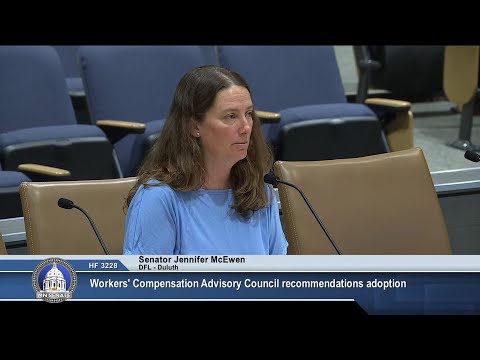
Senator McEwen told the committee the council — a 12-member body evenly split between labor and business representatives — unanimously approved the package of recommendations before the Legislature considered them. "The language, in that has just been amended into the bill today was passed unanimously by the council," Senator McEwen said.
Megan Bursch, a fiscal analyst supporting the Labor Committee, told senators the fiscal note completed by the departments of Labor and Industry (DLI), Commerce and Human Services (DHS) estimates a net fiscal impact of $50,000 in new general fund revenue per biennium. "The fiscal note for Senate File 3407 was completed by the departments of labor and industry, commerce, and human services, and estimates a net fiscal impact of $50,000 in new general fund revenue per biennium," Bursch said. Bursch said the revenue stems from a required $2,500 filing fee per application and that Commerce assumes about 10 such applications annually, producing roughly $25,000 per year or $50,000 per biennium. She added DLI expects to update its workers' compensation insurance verification website and may see a small increase in calls, but those costs can be absorbed within existing staffing.
Commerce senior associate counsel Gillespie explained procedural timing in the bill for application review. "The 60 days doesn't start running until the department has received a completed application," Gillespie said. Committee members pressed on what would occur if the department missed that 60-day window; Gillespie said the bill as written imposes a 60-day review timeline but contains no penalty for exceeding it. "Currently, in the language, there is no penalty," Gillespie said.
Several senators asked for clearer accountability language before the measure reaches the floor. Senator Pratt asked whether an application would be "automatically approved" if the department allowed the clock to run, and Senator Brett said she wanted the department held to the same accountability standards applied to applicants; both urged staff to seek clarity. Miss Glasby was asked to follow up with Senator McEwen before the bill reaches the floor.
Procedural motions: early in the hearing Senator Friends moved to strike the title and contents of House File 3228 and replace them with the title and contents of Senate File 3407; the committee approved that motion by voice vote. Later, Senator Friends moved that House File 3228, as amended, be recommended to pass. The committee approved that recommendation by voice vote; no roll-call tally was recorded in the hearing transcript.
Votes at a glance
- House File 3228 (substituted with Senate File 3407): Motion to recommend passage moved by Senator Friends; approved by voice vote. No roll-call vote recorded.
The committee adjourned after that action; staff said they anticipate scheduling hearings on capital investment and pension bills in the near term.