Get Full Government Meeting Transcripts, Videos, & Alerts Forever!
Get email alerts on the Grants Management topic
No spam. Unsubscribe anytime.
NC PRO training outlines pass-through entity duties, risk-based monitoring for State Fiscal Recovery Fund
Summary
A Deloitte-led NC PRO webinar reviewed written-agreement requirements, risk assessment, monitoring practices, audit obligations and record-retention rules for pass-through entities administering State Fiscal Recovery Fund awards in North Carolina.
NC PRO hosted a technical-assistance webinar reviewing pass-through entity responsibilities under federal and state rules for the State Fiscal Recovery Fund, with Deloitte consultants outlining written-agreement requirements, risk assessment methods, monitoring activities and record-retention obligations.
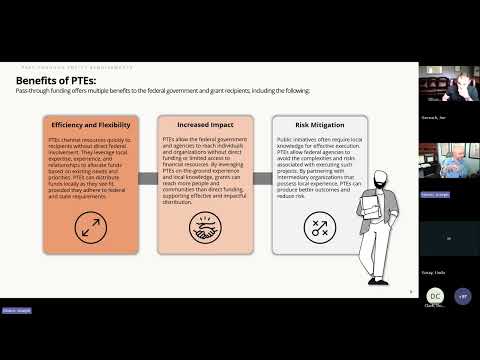
The session, delivered by Deloitte consultants and NC PRO staff, focused on practical steps pass-through entities must take to identify awards, evaluate subrecipient risk of noncompliance, monitor performance and financial reporting, and follow up on audit findings. Joe Gorsuch, a Deloitte consultant working with NC PRO, summarized the role: "Pass-through entities are responsible for identifying your awards, evaluating risk of subrecipient noncompliance, monitoring subrecipients to facilitate closeout, and meeting federal and state audit requirements."
Why this matters: pass-through entities sit between federal awarding agencies and subrecipients and are required by federal uniform guidance (2 CFR 200) and the North Carolina Administrative Code to document subawards, assess risk, monitor subrecipient performance and financials, provide technical assistance, and maintain records that support audits and program oversight.
Presenters emphasized three foundational pass-through duties: (1) written subaward agreements that incorporate required federal terms and the assistance listing; (2) a documented risk assessment used to stratify subrecipients for monitoring; and (3) an implemented monitoring plan that includes financial and performance review and follow-up on audit findings. The presenters recommended preparing subaward agreements early in the award cycle and using documented monitoring plans auditors can review.
On risk assessment, Deloitte staff recommended dividing indicators into programmatic, compliance and fiscal categories. Examples covered in the webinar included: capital projects that may face supply‑chain delays (programmatic risk), prior federal audit findings (compliance risk), and materiality or the dollar value of the award (fiscal risk). Presenters said risk assessments can be simple surveys scored with rubrics that produce high/moderate/low buckets and drive the monitoring treatment.
Monitoring activities described included desk reviews, in‑person site visits for high‑risk subrecipients, verification of procurement processes, sampling of expenditures (invoices, purchase orders, proof of payment), debarment/suspension checks, issuance of written observations, and documented remediation plans that include technical assistance. The consultants noted monitoring plans should be revisited periodically and retained as evidence of the pass-through entity's compliance efforts.
On audits and record retention, presenters said entities must ensure subrecipients complete any required single-audit or program-specific audit and must follow up on corrective actions for audit findings. Webinar materials and presenters repeatedly stated that records related to the State Fiscal Recovery Fund should be retained through December 31, 2032, or until all audit findings are resolved, whichever is later. (The presenters referenced a change to the single-audit threshold; the Uniform Guidance currently requires a single audit or program‑specific audit for non‑federal entities expending $750,000 or more in federal awards during a fiscal year.)
Presenters also reviewed relevant authorities and resources: the federal uniform guidance (2 CFR 200 and related sections, including Appendix II to Part 200), the North Carolina Administrative Code sections cited in the webinar (agency responsibilities and monitoring requirements), the State Fiscal Recovery Fund terms, and related state procurement and reporting policies. Deloitte staff encouraged pass-through entities to consult the .gov sources for the most current regulatory text and to document any state-specific flow-down terms in subaward agreements.
The webinar closed with a Q&A about whether cabinet agencies and universities require different treatment. Presenters said the applicable documents—the federal award terms, state statutes and the North Carolina Administrative Code—determine responsibilities; for SFRF the state as the recipient has delegated responsibilities to agencies, and the most stringent applicable requirement should be applied. Joy (NC PRO) noted that NC PRO expects monitoring of state agencies and that Deloitte is assisting NC PRO with that monitoring.
The presenters provided webinar slides and indicated the Q&A and slides will be posted on the NC PRO website for reference. The session host said roughly 200 participants attended the webinar.