Get Full Government Meeting Transcripts, Videos, & Alerts Forever!
Get email alerts on the Labor Wage Theft topic
No spam. Unsubscribe anytime.
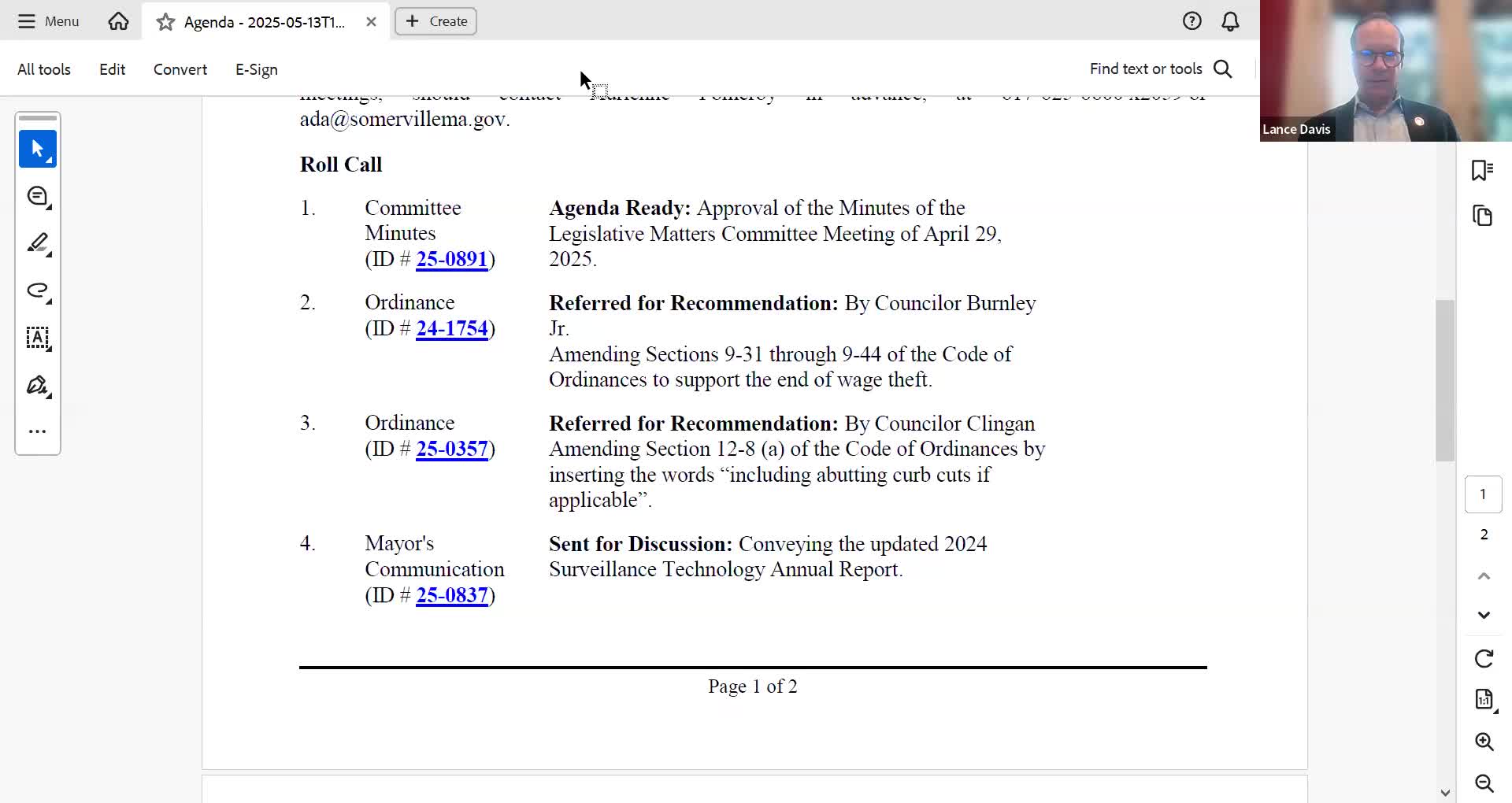
Somerville committee advances amended wage-theft ordinance, sends measure to council
Summary
The Somerville Legislative Matters Committee voted to recommend approval of an amended ordinance to strengthen the city's wage-theft framework, making several drafting and procedural changes and clarifying enforcement and committee roles.
At a remote meeting of the Somerville Legislative Matters Committee (date not specified), members voted to recommend approval of an amended ordinance aimed at bolstering the city's approach to wage theft and restoring an advisory committee to study and respond to complaints.
The committee's vote clears a version of the ordinance that incorporates multiple drafting changes and procedural clarifications. Committee chair Lance Davis said the item had been "the end of a long process" and that members were working from a redline version of the ordinance attached to the meeting agenda. The committee voted to recommend approval of the proposed amendment as amended; the clerk reported five councilors voting in favor.
Why it matters: The ordinance retools language around the city's Wage Theft Advisory Committee and clarifies what constitutes wage theft, how timely payment is defined, the committee's role in receiving information, and the referral pathway for allegations. Supporters said the changes will help the city stand up a functioning advisory body and focus its role on education and system-level prevention while preserving referral of complaints to state enforcement agencies.
What the committee changed and why - Time limits: The committee amended references in sections 9-31(a) and 9-31(b) to extend certain lookback periods from three years to five years after a review by staff and the law department, which noted other time references in the draft used five years. - Business certificate: Section 9-34(e) will no longer reference a "business certificate" (a DBA). Legislative staff explained a DBA does not confer a license to operate and removing the reference avoids implying the city could revoke a DBA as a penalty. - Definitions: The draft removes two definitions that were judged unnecessary or legally imprecise: the definition of "TIF plan" (unused elsewhere in the ordinance) and an internally drafted definition of "wage." Deputy City Solicitor David Shapiro told the committee that Massachusetts case law and legal dictionaries provide the governing meaning of wage and that no statutory definition exists that the city should replace. - TIF agreement: The committee replaced the definition of "TIF agreement" with a text referencing the statutory sources (M.G.L. ch. 23A 3A; ch. 40 59; and 760 CMR 22) to clarify the term for readers. - Timely payment of wages: The ordinance will define "timely payment of wages" by reference to M.G.L. ch. 149, 148 (payment of wages at regular intervals as established by statute). - Complaint handling and committee role: Language in section 9-36(a) and (b) was changed to require that what the committee receives and forwards is "information regarding an allegation of" a violation rather than a formal "complaint alleging" a violation. Staff also replaced language that said the committee would "assist the complainant" with "provide information to the complainant regarding submitting," to make the committee's role educational and informational rather than appearing to provide representation or maintain a caseload.
Officials and staff who spoke - Lance Davis, committee chair; led the meeting and framed the item as closing a multiyear effort. - Brandon Salisbury, legislative and policy analyst; walked the committee through the proposed drafting changes and recommended specific edits (three-year to five-year changes, striking the business certificate, definition edits, TIF language, definitions of timely payment and wage theft, and complaint-process wording). - David Shapiro, deputy city solicitor; advised the committee that the struck building-code-related provision was preempted and that Massachusetts case law does not supply a statutory definition of "wage," so the city should avoid attempting to create one that could unintentionally narrow protections. - Rachel Latt Carney, director of economic development; said the department will assist with recruitment for the advisory committee once the ordinance aligns with the city's boards-and-commissions processes.
Clarifying details captured during the meeting - The redline version attached to the agenda (15 pages) was the working document for the session and included prior changes from earlier meetings. - Staff recommended changing two references from three years to five years to match the rest of the draft. - The city clerk and economic development staff clarified that a business certificate (DBA) does not grant a business license and many home-based businesses file DBAs but do not hold a separate city license. - Deputy City Solicitor Shapiro said the building-permit-based enforcement language struck from the draft raised a building-code preemption concern. - The city expects the Wage Theft Advisory Committee to collect and publish a report on local wage-theft status; staff did not provide a count of complaints referred in prior years and said the procurement department or other offices might track related numbers but that data were "not specified" during the meeting. - Job posting: Administration staff said they were preparing a city staff position to support the committee and provide outreach/education; the exact job title and timeline were under discussion and the administration expected to post the vacancy "in the coming weeks."
Discussion vs. formal action - Discussion: Committee members pressed staff and the solicitor's office for legal and operational clarifications (DBA impacts, enforcement pathways, scope of definitions). Multiple councilors urged prompt posting of the staff position that will support the committee. - Direction/assignment: Staff (Economic Development) agreed to help recruit advisory-committee members under the city's usual appointments process; staff also will follow up with the clerk and the law department on the final appointment mechanism. - Formal action: The committee voted to recommend approval of the proposed amendment as amended (final vote reported as five in favor). The formal motions to amend were moved on the record and the clerk read the consolidated amended language before the final roll call.
Ending The committee recommended the amended wage-theft ordinance for approval by the City Council and instructed staff to follow up on recruitment and procedural items needed to operationalize the Wage Theft Advisory Committee. Several councilors urged rapid posting of the staff position to support committee work and education/outreach to employers and workers.