Lifetime Citizen Portal Access — AI Briefings, Alerts & Unlimited Follows
Public witnesses allege petition fraud and whiteout on Initiative 83; Board of Elections says enforcement and challenges are public processes
Loading...
Summary
Witnesses at a May 13 roundtable alleged forged signatures, removed challenge pages, and widespread use of whiteout on Initiative 83 petitions. BOE said it has assessed fines against circulators linked to whiteout use, described its challenge review process and said criminal referrals and civil penalties are possible under existing law.
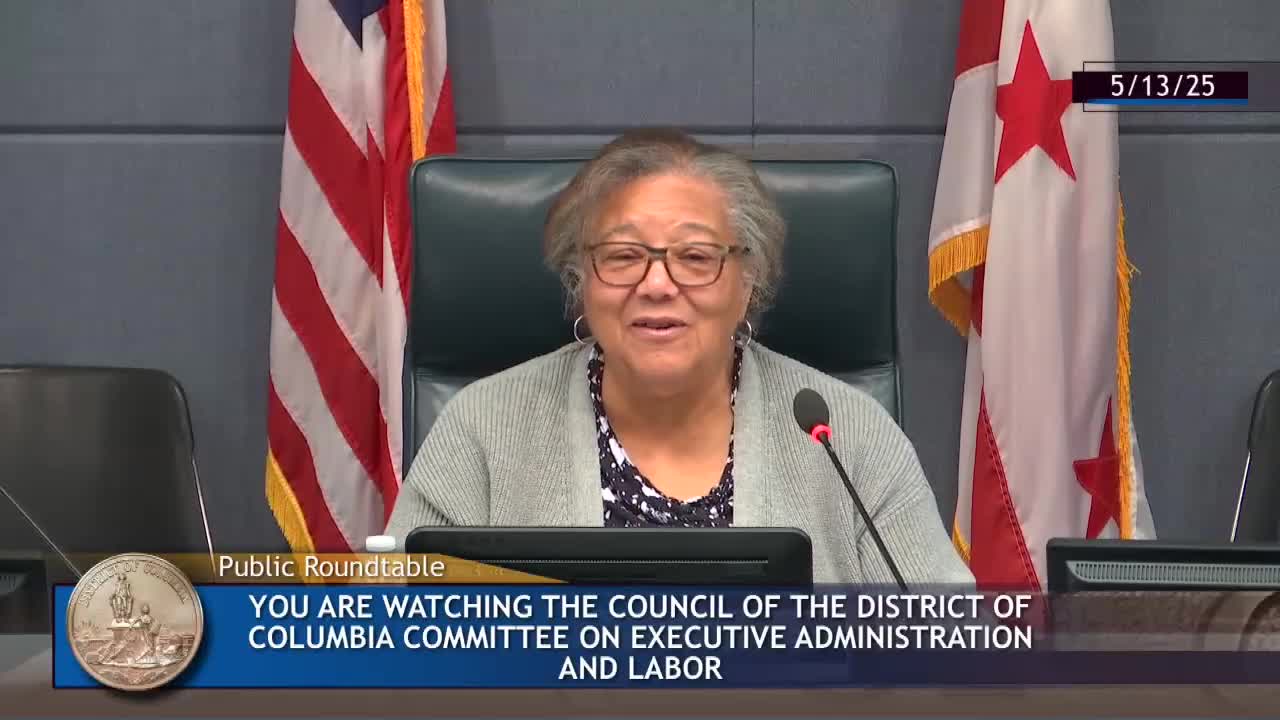
Multiple community witnesses told the Committee on Executive Administration and Labor on May 13 they had evidence of petition tampering and process failures during nominating and initiative petition activity in 2024 and 2025.
Commissioner Robbie Woodland testified she submitted four stacks of challenge paperwork on April 29, 2025, alleging dozens of forged signatures on a candidate’s nominating petitions for the Ward 8 special election. Woodland said a Board of Elections staffer, identified in her testimony as Maisha (or Myesha) Thompson, took the documents into a back office rather than completing the usual front‑desk receipt and count. "This breach of protocol broke the secure chain of custody designed to protect the integrity of election challenges," Woodland said. She added: "Miss Maisha Thompson removed 24 pages from our filing. This action effectively crippled our challenge and denied the people of Ward 8 a fair electoral process. This election interference—this is election interference."
The Board of Elections said it is investigating the specific allegations but told the committee it had not yet received all evidence referenced by Woodland; the board said staff accepted four challenge packets that day but later determined some pages were missing from those packets and requested copies. Marissa Curente, the registrar, described BOE’s challenge workflow and said staff aim to notify challengers within about 24 hours whether an initial filing is sufficient to proceed to a line‑by‑line review.
Separately, witnesses and advocacy groups pressed the committee on Initiative 83, the 2024 ballot measure that became subject to litigation and public scrutiny after BOE staff observed use of whiteout to alter petition sheets. Attorney Deirdre Brown, chair of the Vote No on Initiative 83 coalition, told the council the board’s April 9 order confirmed a fraudulent use of whiteout and said "this new evidence underscores the urgent need for reform." Witnesses said some out‑of‑state, well‑funded operatives had used whiteout and other alterations while collecting signatures in DC neighborhoods.
BOE provided the committee with its verification summary for Initiative 83: the agency reported it received roughly 42,640 petition pages, rejected 14,867 signature lines and verified 27,773 valid signatures — a total that exceeded the charter threshold and ward requirements. BOE also said it issued enforcement fines to four circulators associated with altered pages; the board described civil penalties as possible and noted it can refer matters for criminal prosecution. The board’s legal counsel said the agency can assess fines and that the statutory cap for a civil penalty is up to $2,000 per violation.
Why it matters: petition circulation and challenge procedures determine who appears on ballots. Witnesses called for clearer written policies, uniform verification standards, stronger enforcement and a pause on certification while legal challenges are pending. BOE said it would not decline to follow the law but acknowledged it must refine procedures, increase transparency about standards and complete its internal investigations.
Committee follow‑up: the council requested copies of documentary evidence referenced by public witnesses and asked BOE to provide its internal findings and written procedures for petition verification and challenge handling. Several witnesses also asked the council to consider criminal referrals to the Attorney General or Inspector General and to consider statutory changes to petition handling.