Get Full Government Meeting Transcripts, Videos, & Alerts Forever!
Get email alerts on the Social Media Policy topic
No spam. Unsubscribe anytime.
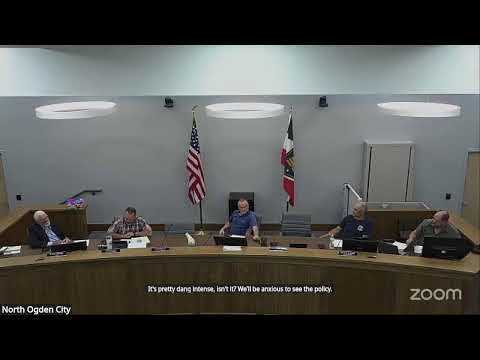
North Ogden council debates Facebook comments, votes to draft social-media policy
Summary
After months of staff restrictions on the city’s official Facebook page, the City Council voted to direct staff to draft a formal social‑media policy but rejected an immediate move to restore public comments on the official page.
Council Member Dalpez led a heated discussion on whether the city should restore public comments on the official "1 North Ogden" Facebook page, saying, "I'm firmly against disallowing comments on the 1 North Ogden Facebook page." The council voted down an immediate restoration of comments and then approved a separate motion directing staff to draft a social‑media policy for the council to consider.
The debate followed public comments from residents who urged the council to keep comments enabled. Resident Sandy Cochran told the council, "Stopping commenting on your Facebook page will leave you with statements and directives, and that's not communication." Philip Swanson, another resident, asked the council to find a way to preserve citizen voice while protecting city employees from online abuse.
Council members split on immediate action. A motion to immediately turn comments back on (mover: Council Member Dalpez; seconder: Council Member Watson) failed on a recorded roll call (tally recorded in the meeting as 2 yes, 3 no). After that failed motion, the council approved a separate motion directing staff to develop a social‑media policy within one month, with the understanding that policy language could later be used to decide whether comments should be re‑enabled. Staff confirmed there is no expectation that the council or staff must respond to every comment if comments are restored.
City staff cautioned that legal and administrative limits apply to moderating a municipally controlled social account. Staff member John Call noted that "the no comments policy is easier to manage," and explained some content (threats, incitement, promotion of illegal activity, explicit threats) may be removable under existing legal standards while other comments (including some profanity or harsh criticism) cannot always be deleted without raising First Amendment issues. Council members also discussed the practical burden of monitoring, suggested options such as a published comment policy, selective disabling of comments on some posts, volunteer flaggers to notify staff of problematic content, and appointing a single staff or council designee to approve posts.
The council asked staff to draft a policy referencing sample language from other Utah cities (Kaysville, Sandy and others) and to return with recommended procedures and enforcement language. Council members and residents suggested the draft should address: criteria for immediately removing material (threats, incitement, personal data), expectations about whether the city will respond to comments, whether some posts should have comments disabled, and a process for an independent volunteer or a staff point‑person to flag content for review.
The council did not adopt a final policy at the meeting. Staff was tasked to return with a draft policy in roughly one month for council review and to include procedures for a volunteer flagging mechanism and a recommended moderation workflow.