Get Full Government Meeting Transcripts, Videos, & Alerts Forever!
Get email alerts on the Land Use Creek Corridor Amendment topic
No spam. Unsubscribe anytime.
Planning commission recommends amendment to creek‑corridor rules for single small subdivision along Hobble Creek
Summary
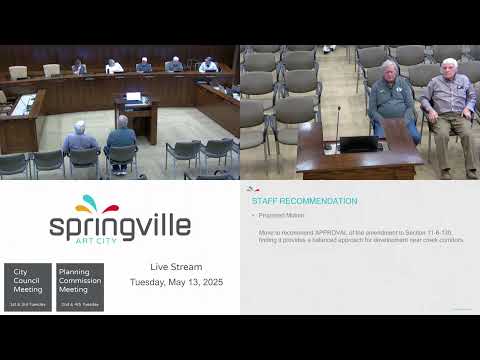
Springville Planning Commission voted to recommend approval of a staff-drafted amendment to Springville City Code section 11-6-130 that would allow a reduced park strip and other special streetscape standards for small subdivisions on one property along Hobble Creek; the recommendation will go to the City Council.
The Springville Planning Commission voted to recommend approval of a staff-drafted amendment to Springville City Code section 11-6-130, the city’s protection of creek corridors rule, to allow a narrower park strip and related standards for a small subdivision on a specific property along Hobble Creek.
The recommendation, moved and seconded at the planning commission meeting, applies only to the Clyde property between 1200 East and 1700 East and only to subdivisions of fewer than eight lots. The proposal keeps the existing 50-foot setback measured from the top edge of the creek bank (which includes a 20-foot recreation and maintenance easement) while allowing the park strip adjacent to some street frontages to be reduced to a minimum of 3 feet with compensating landscaping and tree requirements.
City staff member Josh, who presented the item, said the staff proposal "essentially reduces park strip width to a minimum of 3 feet" for streets that abut Hobble Creek lots within the defined area. Under the draft amendment, the typical street cross-section would include a 29-foot half pavement width, a 2-foot curb and gutter, a 3-foot park strip, and a 5-foot sidewalk; trees would be planted on private property 5 feet behind the sidewalk at about 30 feet on center. The park strip itself would not be permitted to be paved and would be landscaped with shrubs, ground cover or sod; landscaping must reach roughly 50 percent coverage within three years, the staff presentation said.
Applicant Paul Washburn, who spoke for the petitioner, said the property is an "infill" parcel with topography and creeks that make development difficult and that the proposal is intended to preserve existing trees and the stream while allowing appropriate residential development. "This property is a very unique piece of property," Washburn said, and he told commissioners he met with staff and a geotechnical consultant to identify constraints and protections for the creek and trees.
Commissioners asked technical questions about curb, gutter and asphalt cross-sections and whether trees would be provided by the city. Josh said developers would pay a street-tree fee and the city typically handles installation, and clarified that the trees required under the amendment would not be paid for directly by the city. The presentation noted a Development Review Committee (DRC) review concluded that code‑compliant development could be possible without the amendment, a point several commissioners raised when discussing precedent concerns.
Commissioners voiced support for using the narrowly tailored amendment as a "stopgap" for this specific property while noting the city’s broader general plan and active transportation plan standards remain unchanged. Several commissioners suggested the city should consider a more general infill or flexible‑development provision in the forthcoming general plan update so similar proposals have clear, citywide rules rather than ad hoc amendments.
A motion to recommend approval of the revised staff proposal carried; the commission recorded the motion as passing and directed that the item move forward to the City Council for its consideration.
The planning commission’s recommendation does not itself change the code; any change would require final action by the Springville City Council. The amendment, as presented, is limited in geography (1200 East to 1700 East), in scale (subdivisions fewer than eight lots) and in content (retains the 50-foot creek setback and 20-foot easement while allowing the narrower park strip if landscaping and tree placement requirements are met).