Get Full Government Meeting Transcripts, Videos, & Alerts Forever!
Get email alerts on the County Finance Budget topic
No spam. Unsubscribe anytime.
Kern County officials warn of major state, federal funding risks as 2025–26 budget forms
Summary
County administrative staff and department heads told the Board of Supervisors that a mix of state mandates, potential federal Medicaid and SNAP cuts, and shrinking discretionary grants could force service reductions or one-time fixes in the fiscal year 2025–26 budget.
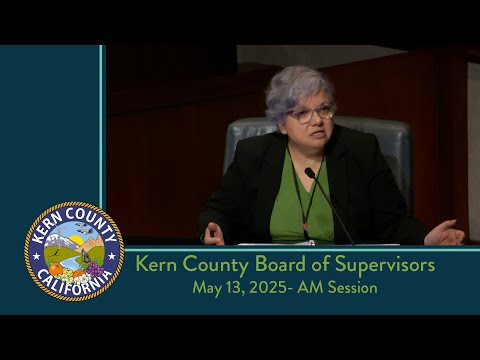
Kern County administrators and department directors told the Board of Supervisors on May 13 that a mix of state mandates and possible federal funding cuts present substantial risks to the county's 2025'026 budget and could force service reductions or one-time responses.
The presentation from the County Administrative Office and budget staff centered on volatility in property and sales tax receipts, a $46.5 million slate of supplemental departmental requests, and a range of anticipated state and federal changes. Assistant CEO Elsa Martinez told the board, "This is not something we discovered yesterday. We don't come out with 18,000,000. This is something that we monitor on a biweekly basis." That $18 million figure referred to emergency overtime reimbursements the county expects to receive for firefighting and mutual-aid deployments.
Why it matters: kernels of the county's discretionary spending'property and sales tax'are subject to market shifts and policy-driven realignment formulas. Department leaders warned that new state laws and proposed federal budget changes could cut resources used to run public health, behavioral health, social services and other safety-net programs.
County staff outlined key budget lines and pressures. Alex Alvar, the county's budget and finance director, summarized that property assessed valuation (AV) growth has historically funded cost-of-living and equity pay adjustments and capital projects, but sales-tax-driven realignment revenue is more volatile and now comprises a large share of program funding. Departments submitted supplemental requests totaling about $46.5 million: roughly $20.6 million in ongoing needs and $19.9 million in one-time requests, the CAO's office said.
Public health director Brynn Kerrigan described immediate program-level impacts. She said the department has seen a $12.5 million reduction in discretionary revenue over the last two years and that, effective Jan. 1, 2025, SB 525'the state's health care worker minimum wage'has increased baseline salary costs. Kerrigan added that the department received an unexpected CDC stop-work order affecting roughly $10.5 million in anticipated revenues and that, as a result, "we issued an immediate internal hiring freeze and overtime freeze as well as a spending and travel restriction" and that the department is "no longer able to sustain status quo operations in our existing workforce without additional support." The department rescinded offers and terminated some contracts in response.
Department heads outlined further risks. Lito Murillo, director of the Department of Human Services, warned that federal proposals under consideration could reduce Medicaid (Medi-Cal) funding and change eligibility and renewal rules; he described potential cuts, work requirements and shorter retroactivity periods as proposals that would increase county workload and reduce coverage. Behavioral health director Allison Burrows said a collection of new or expanded mandates'including Proposition 36, care-court requirements and changes to the Mental Health Services Act'are largely unfunded or underfunded and that county reimbursement rates are among the lowest in the state. Jeremy Oliver, director of Aging and Adult Services, flagged possible changes to In-Home Supportive Services and to the federal structure for Older Americans Act programs.
Board discussion and short-term actions: supervisors asked questions about reserves, one-time versus ongoing uses of revenue, and workforce protections. The CAO's office said it will prioritize mission-critical services and seek to limit workforce impacts "to the greatest extent possible," but cautioned that it cannot backfill all state or federal reductions indefinitely. Staff said realignment reserves and one-time resources could buy time, but are not sustainable long term.
The board received the financial update and related materials and voted to "receive and file" the CAO report. Supervisors also referred a separate request to the finance committee to explore budget efficiencies and to consider hiring a third party to evaluate potential operational improvements; the board approved that referral unanimously.
What's next: the county will publish a recommended preliminary budget on June 24, to be updated in July after the assessor finalizes assessed values and after the state's May revise becomes official. County staff said they will return with more precise fiscal impacts as additional state and federal details become available.
Ending note: supervisors and department heads stressed the need for additional information from Sacramento and Washington and said the county will continue to weigh one-time measures against structural changes if outside funding is reduced.